
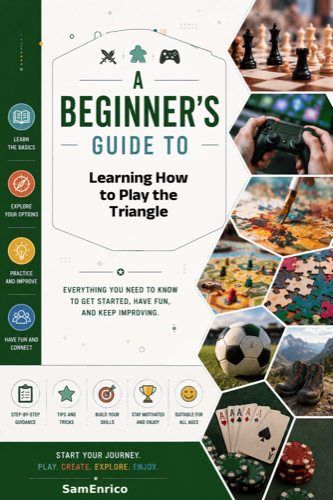
Learn to Play the Triangle
This publication, published by SamEnrico, covers L
This publication, published by SamEnrico, covers Learn to Play the Triangle
Formats
About this book
Free sample
Chapter 1: The Exotic Ancestor...--–- Before the triangle became an orchestral punchline, it was a symbol of terror, power, and the mysterious East. Most beginners pick up a triangle believing they are playing a simple, almost childish instrument—a metal rod bent into a shape that any child could draw. They are wrong. The triangle’s history is a story of conquest, cultural appropriation, and a radical transformation from military terror to Romantic sublime. Understanding this journey is not merely academic trivia; it is the first step toward mastering the instrument.
Because the moment you realize that the triangle was once perceived as dangerous, exotic, and thrillingly loud, you stop treating it like a timid “ding” and start playing it like the powerful coloristic voice it was always meant to be.This chapter traces the triangle from its obscure origins in medieval European churches to its current place in the modern orchestra, with a crucial detour through the battlefields of the Ottoman Empire. Along the way, we will correct common myths, introduce key repertoire that you will encounter in later chapters (particularly Chapter 7’s orchestral excerpts), and establish the historical foundation for the “color vs. soloist” framework that appears in Chapter 11. By the end of this chapter, you will never hear a triangle the same way again. You will hear ghosts of Janissary bands, echoes of Liszt’s audacity, and the shimmer of Wagner’s magic fire.
You will hear, in short, the exotic ancestor.The Straight Bar: Before the Bend Before the triangle had its distinctive shape, it had no shape at all—or rather, it was straight. The earliest surviving iconographic evidence suggests that what we might call “proto-triangles” appeared in medieval European church manuscripts and carvings as simple straight bars, often struck with a key or a small hammer. These instruments were not called triangles; they did not have a standardized name. They were simply “struck bars,” used primarily in monastic settings to call monks to prayer or to mark specific moments in the liturgy. Unlike the resonant, shimmering triangle of today, these straight bars produced a dry…
This is the end of the free sample. Get the eBook to keep going. Buy now
Contents
- Chapter 1
- Chapter 2
- Chapter 3
- Chapter 4
- Chapter 5
- Chapter 6
- Chapter 7
- Chapter 8
- Chapter 9
- Chapter 10
- Chapter 11
- Chapter 12
Details
- Author
- Whelan German
- Publisher
- SamEnrico
- Language
- English
- Genre
- music, Informative, Educational
- Released
- 2026-06-03
- Pages (approx.)
- 148
- Available as
- eBook, Audiobook

Read better in the ZLOADR app
Your eBooks on your phone or tablet. Sign in with your SamEnrico account and start reading.
More by Whelan German
 Behavioral Economics DemandWhelan German$11.99
 HIIT Postnatal RecoveryWhelan German$11.99
 Instagram Story Viewer StatusWhelan German$11.99
 Food Addiction and ADHDWhelan German$11.99
 Anansi's Golden Web: The Spider Who Stole the MoonWhelan German$11.99
 Police WorkWhelan German$11.99
 How to Start a Billiard Ball Business (Beginners Guide)Whelan German$11.99
 Executive Time Blocking ToolsWhelan German$12.99