
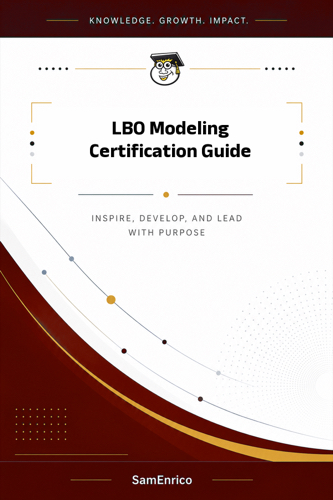
Non-FictionCapital & Valuation RegisterCertification
LBO Modeling Certification Guide eBook
Prepare for Wall Street Prep, BIWS, and other LMO
Prepare for Wall Street Prep, BIWS, and other LMO modeling exams.
Formats
Free sample
Chapter 1: The Invisible Engine--–- In a windowless conference room on the forty-second floor of a midtown Manhattan skyscraper, a thirty-two-year-old private equity principal named David drew two rectangles on a whiteboard. One was labeled “Asset Value.” The other was labeled “Equity Value.” Between them, he drew a series of arrows representing debt, fees, amortization, and cash sweeps. He turned to the nervous investment banking analyst sitting across the table and said, “Forget the model for a minute. Just tell me: why does this whole machine work?”The analyst froze. He had spent seventy hours that week building a three-statement LBO model.
He had mastered INDEX-MATCH, data tables, and circular references. He could recite the keyboard shortcut for tracing precedents. But he could not answer the principal’s question. He did not understand the invisible engine that makes every leveraged buyout go.That engine is not leverage itself, despite what most candidates think. Leverage is the fuel.
The engine is something more fundamental: the separation between the cash flows a business generates and the claims on those cash flows held by debt holders versus equity holders. When you understand this separation—really understand it, not just memorize it—the entire LBO model becomes obvious. Every formula, every schedule, every sensitivity analysis is simply a way of tracking how value flows from the business to the people who own its debt and equity.This chapter strips away the complexity of Excel models and certification exams to reveal the invisible engine that drives every LBO. By the time you finish reading, you will never look at an LBO the same way again. You will see through the mechanical details to the economic logic underneath.
And you will be prepared to answer the question that stumped that analyst—the question that appears in every private equity interview and every advanced certification exam: “Why does this whole machine work?”The Two Worlds of Enterprise Value and Equity Value Every LBO model rests on a distinction that seems simple but confounds many candidates: the difference between enterprise value and equity value. Enterprise value is the total value of the business—its operations, its assets, its future cash flows. Equity value is what remains for shareholders after paying off debt. In an LBO, the private equity sponsor buys the enterprise value but finances the purchase with a mix of debt and equity. The debt holders get repaid before the equity holders.
That priority is the invisible engine.Consider a concrete example. A company has an enterprise value of $1,000. It has $600 of debt and $400 of equity value. A private equity sponsor agrees to buy the entire company for $1,000. The sponsor puts up $300 of its own equity and borrows $700 from banks and bondholders.
Wait—that does not match the existing capital structure. The existing debt of $600 must be refinanced or repaid. The new debt of $700 replaces the old debt and adds an extra $100 of leverage. The existing equity of $400 is bought out, with the sponsor’s $300 and the new debt covering the purchase.This is the standard LBO transaction. But here is what most candidates miss: after the transaction closes, the company has $700 of new debt and $300 of sponsor equity.
The enterprise value is still $1,000 (ignoring fees). But the equity value is now $300, not $400. The sponsor has paid $1,000 for an asset worth $1,000, but has put in only $300 of its own money. The remaining $700 came from debt holders.Why would debt holders lend $700 against a $1,000 asset? Because they have first claim on the company’s cash flows.
Before any dollar goes to the sponsor’s equity, the debt holders must be paid their interest and principal. This priority is the invisible engine. It allows the sponsor to control a $1,000 asset with only $300 of its own capital because the debt holders are willing to accept a lower return in exchange for seniority.The certification exams test this distinction relentlessly. A typical Wall Street Prep question might ask: “A company has an enterprise value of $500 million and net debt of $200 million. What is the equity value?” The answer is $300 million.
That is simple. The harder questions ask: “If a sponsor acquires the company with a 40% equity cushion, how much new debt is raised?” The answer is 60% of $500 million, or $300 million. But the existing debt of $200 million must be refinanced, so the new debt is $300 million, not $300 million minus $200 million. The distinction between refinancing and incremental leverage is a common trap.The Cash Flow Waterfall: Who Gets Paid First The invisible engine becomes visible when you trace the flow of cash through a leveraged company. Every dollar of operating cash flow must be allocated according to a strict pecking order.
That pecking order is called the cash flow waterfall, and understanding it is the single most important skill for passing LBO certification exams.The waterfall, from first to last, is as follows:Mandatory debt amortization (scheduled principal payments)Mandatory interest payments (calculated on outstanding debt)Cash sweep (optional prepayments of debt, typically Term Loan B)Revolver paydown (if the revolver was drawn for liquidity)Distributions to equity (dividends or share buybacks)Notice where equity sits: last. The sponsor’s equity is the residual claimant. It gets whatever is left after every other claim has been satisfied. This residual nature is why equity returns are volatile. In a good year, when cash flows are strong and debt is paid down quickly, the residual grows rapidly.
In a bad year, when cash flows are weak, the residual may shrink or disappear entirely.The certification exams test the waterfall through questions about CFADS (Cash Flow Available for Debt Service), which we will explore in depth in Chapter 5. For now, understand that CFADS is the cash available after operating expenses, capital expenditures, and taxes, but before any debt service. It is the numerator in every debt covenant calculation. A typical exam question might provide a company’s EBITDA, Cap Ex, tax rate, and working capital changes, then ask: “What is CFADS?” The correct answer is EBITDA minus Cap Ex minus cash taxes minus changes in net working capital. Many candidates mistakenly include interest or principal payments in CFADS.
They do not. CFADS is before debt service. That is the whole point.The Interest Tax Shield: Why Debt Is Subsidized The invisible engine has a hidden component that many candidates overlook: the interest tax shield. Because interest payments are tax-deductible, every dollar of interest reduces the company’s taxable income by one dollar, saving the company cash equal to the interest multiplied by the tax rate. This tax saving is a real cash benefit that accrues to the company—and ultimately to the equity holders, because they are the residual claimants.Consider a company with $100 of EBIT (earnings before interest and taxes), a 25% tax rate, and no debt.
The company pays $25 in taxes and has $75 of net income. Now consider the same company with $40 of interest expense. EBIT is still $100, but interest reduces taxable income to $60. Taxes are $15 (25% of $60). Net income is $45.
The company paid $40 of interest but saved $10 in taxes ($25 without debt minus $15 with debt). The effective after-tax cost of the interest is only $30. The $10 tax saving is the interest…
This is the end of the free sample. Get the eBook to keep going. Buy now
About this book
Details
- Author
- Donovan Velda
- Publisher
- SamEnrico
- Language
- English
- Genre
- Non-Fiction, Capital & Valuation Register, Certification
- Released
- 2026-06-07
- Pages (approx.)
- 142
- Available as
- eBook, Audiobook

Read better in the ZLOADR app
Your eBooks on your phone or tablet. Sign in with your SamEnrico account and start reading.
More by Donovan Velda
 New Parent Social IsolationDonovan Velda$11.99
 Free Creator Research Stack GuideDonovan Velda$11.99
 Order Solar Temple Rosicrucian Roots CourseDonovan Velda$11.99
 Mindfulness for Parenting StressDonovan Velda$11.99
 The Unseen Brushstrokes: How Frida Kahlo’s Pain Became Her MasterpieceDonovan Velda$11.99
 Echoes of the Underground: The Secret Railroad That Saved a GenerationDonovan Velda$11.99
 Understanding Cerebellar Hypoplasia Tapetoretinal DegenerationDonovan Velda$17.99
 How to Start a Poster Publishing Business (Beginners Guide)Donovan Velda$11.99
 Ramadan And Cultural GuideDonovan Velda$12.99
 ESG Small Cap vs Large Cap GuideDonovan Velda$12.99
 Associate Trial AttorneyDonovan Velda$11.99
You may also like
 Hong Kong Handover 1997Dunn Johnnie$11.99
 Zumba For Postnatal Recovery CourseNeal Christian$11.99
 Zumba for BeginnersLadner Nikia$11.99
 YouTube Comment Mining GuideHumes Pandora$12.99
 Worry Box MeditationCarlin Rudy$11.99
 Workplace Stress MeditationNguyen Lynn$11.99
 Workplace Stress and Sleep RepairHawley Ivory$11.99
 Workplace Perfectionism CureDelaney Jeffry$11.99
 Workplace Injustice Anger GuideWallen Isabelle$11.99
 Work Addiction and Burnout LinkGreenwood Ester$11.99
 Women in Yoga and WellnessBeattie Galina$11.99
 Women in Stand Up ComedyChun Evangeline$11.99