
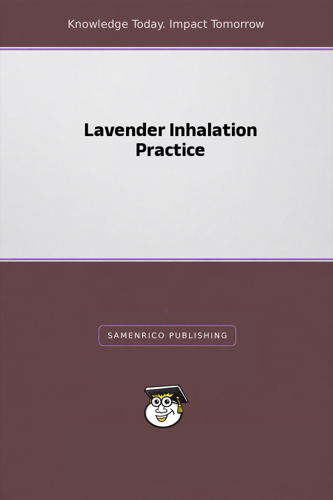
Non-FictionSelf-HelpAromatherapyLavender
Lavender Inhalation Practice eBook
Use calming lavender scent as an anchor during anx
by Sisson Aimee
Use calming lavender scent as an anchor during anxious moments.
Formats
Free sample
Chapter 1: The Shortest Path--–- The first time Sarah smelled lavender and felt nothing at all, she assumed the practice was useless. She had bought a small glass bottle of essential oil from a popular online retailer, dabbed some on a tissue, and inhaled deeply while sitting in her parked car before a difficult meeting. Nothing happened. No wave of calm. No sudden clarity.
No reduction in the tightness spreading across her chest. She tried again the next day, holding the tissue closer, breathing slower. Still nothing. “Another wellness scam,” she muttered, and tossed the bottle into her glove compartment.What Sarah did not know—and what this chapter will reveal—is that her failure had nothing to do with lavender and everything to do with timing, neurobiology, and a fundamental misunderstanding of how scent actually communicates with the brain. She expected an instantaneous drug-like effect.
She wanted lavender to do something to her. But lavender is not a tranquilizer. It is a signal. And a signal, no matter how well-designed, only works when the receiver is tuned to the right frequency.This chapter establishes the scientific foundation for everything that follows. You will learn why the olfactory system is uniquely suited to interrupt anxiety before your conscious mind even registers a threat.
You will discover how lavender’s active compounds interact with your brain’s built-in calming machinery. And most importantly, you will understand why most people fail when they first try to use scent for anxiety relief—not because the method is flawed, but because they are fighting against the very biology that could save them.By the end of this chapter, you will never think about smell the same way again.The Architecture of Panic: Why Your Brain Fears First and Asks Questions Later Before we can understand how lavender works, we must understand what it is interrupting. Anxiety is not a character flaw. It is not a sign of weakness or a failure of willpower. Anxiety is a survival circuit—an ancient, exquisitely efficient neural pathway that evolved to keep your ancestors alive in a world full of predators, rival tribes, and environmental hazards.Deep within your brain, tucked beneath the cerebral cortex like a frightened animal beneath a porch, lies the limbic system.
This collection of structures—the amygdala, hippocampus, hypothalamus, and thalamus—operates on timescales measured in milliseconds, not seconds or minutes. By the time you consciously think, “I feel anxious,” your limbic system has already been firing for several hundred milliseconds. It has already released stress hormones. It has already redirected blood flow away from your digestive system and toward your large muscle groups. It has already made you faster, stronger, and, paradoxically, dumber—because rational thought is a luxury when you are being chased by a saber-toothed tiger.The problem, of course, is that modern anxiety is rarely triggered by actual saber-toothed tigers.
It is triggered by email notifications, performance reviews, crowded subways, social media comparisons, unpaid bills, and the vague sense that something terrible is about to happen even when everything is objectively fine. Your amygdala cannot tell the difference between a predator and a passive-aggressive text message. It responds to perceived threat with the same full-body alarm regardless of the source.The amygdala’s response time is approximately 50 to 100 milliseconds. That is faster than a hummingbird’s wingbeat. Faster than you can blink.
By the time you consciously notice that your heart is racing, the amygdala has already done its damage.This speed presents an enormous challenge for traditional anxiety management techniques. Cognitive reframing, positive affirmations, and rational analysis all require the prefrontal cortex—the “thinking brain”—to engage. But the prefrontal cortex is slow. It operates on timescales of 300 to 500 milliseconds, and that is only after you have already noticed the anxiety and deliberately chosen to intervene. By then, the physiological cascade is already underway.
You are not preventing anxiety; you are mopping up after a flood.What you need is an intervention that matches the speed of the limbic system. An intervention that does not require conscious deliberation. An intervention that can bypass the slow, rational brain and speak directly to the ancient survival circuits. That intervention, as you may have guessed, is scent.The Bypass: How Smell Hacks Your Brain’s Security System Every other sense—sight, hearing, touch, taste—relays information through a central switching station called the thalamus before reaching the higher brain regions. The thalamus acts like a gatekeeper, filtering and prioritizing sensory data before passing it along.
This filtering takes time. It introduces a delay of tens of milliseconds. That delay does not matter much when you are looking at a sunset, but it matters enormously when a predator is lunging at you.Smell does not use the thalamus.The olfactory system is the only sensory system with direct, unmediated access to the limbic system. Odor molecules enter your nasal passages and bind to receptor cells in the olfactory epithelium. Those cells send signals via the olfactory nerve directly to the olfactory bulb, which then projects straight to the amygdala and hippocampus.
No detours. No gatekeepers. No delay.The direct olfactory-amygdala pathway is one of the fastest neural routes in the human body. Studies using electroencephalography (EEG) have detected olfactory-evoked potentials as early as 150 to 200 milliseconds after sniff onset—comparable to the amygdala’s own threat-detection speed.This means that by the time you consciously register an odor, your limbic system has already responded to it. The emotion comes first.
The identification comes second. You feel calm (or disgusted, or nostalgic, or alert) before you can even name what you are smelling.This is why a particular perfume can trigger a vivid memory of your grandmother before you consciously think, “That smells like her garden.” This is why the scent of a hospital can make your stomach clench even if you have no conscious recollection of a traumatic medical event. The limbic system remembers what the thinking brain forgets.For anxiety management, this direct pathway is revolutionary. It means you can deliver a calming signal to the amygdala before the amygdala finishes sounding the alarm. You are not fighting against your biology; you are working within its existing architecture.
You are using the same high-speed channel that anxiety uses, but sending a different message.The Chemistry of Calm: Linalool and Linalyl Acetate Lavender essential oil is not a single compound. It is a complex mixture of over 100 different molecules, but two of them—linalool and linalyl acetate—account for the majority of its calming effects. These are not magical substances. They are well-studied, chemically understood molecules that interact with specific receptors in your brain and body.Linalool is a terpene alcohol found in many plants, including lavender, coriander, basil, and mint. It has been shown in multiple peer-reviewed studies to reduce anxiety-like behaviors in animal models, and human trials have confirmed its anxiolytic (anti-anxiety) properties.
Linalool’s primary mechanism involves modulation of the GABAergic system—the same neurotransmitter system targeted by benzodiazepine medications like Valium and Xanax.Linalyl acetate is an ester that converts partially to linalool after absorption. It has its own distinct calming properties and contributes to lavender’s characteristic floral scent profile. Together, these…
This is the end of the free sample. Get the eBook to keep going. Buy now
About this book
Details
- Author
- Sisson Aimee
- Publisher
- SamEnrico
- Language
- English
- Genre
- Non-Fiction, Self-Help, Aromatherapy, Lavender
- Released
- 2026-06-11
- Pages (approx.)
- 154
- Available as
- eBook, Audiobook

Read better in the ZLOADR app
Your eBooks on your phone or tablet. Sign in with your SamEnrico account and start reading.
More by Sisson Aimee
 College Application Essay GuideSisson Aimee$11.99College Application Essay GuideSisson Aimee$11.99
 Road Rage And Low Blood SugarSisson Aimee$11.99
 The Lucid Dreaming Memory TechniqueSisson Aimee$11.99
 Divorce and PregnancySisson Aimee$11.99
 The Gold Smugglers of Buenos Aires: A Syndicate's Shadow EmpireSisson Aimee$11.99
 Understanding Pitt–Rogers–danks SyndromeSisson Aimee$17.99
 1099 Contractor Setup GuideSisson Aimee$12.99
 Tech Giant Acquisition Targets GuideSisson Aimee$12.99
 Associate Marketing ManagerSisson Aimee$11.99
 How to Start a Butterscotch Business (Beginners Guide)Sisson Aimee$11.99
You may also like
 Hong Kong Handover 1997Dunn Johnnie$11.99
 Zumba For Postnatal Recovery CourseNeal Christian$11.99
 Zumba for BeginnersLadner Nikia$11.99
 YouTube Comment Mining GuideHumes Pandora$12.99
 Worry Box MeditationCarlin Rudy$11.99
 Workplace Stress MeditationNguyen Lynn$11.99
 Workplace Stress and Sleep RepairHawley Ivory$11.99
 Workplace Perfectionism CureDelaney Jeffry$11.99
 Workplace Injustice Anger GuideWallen Isabelle$11.99
 Work Addiction and Burnout LinkGreenwood Ester$11.99
 Women in Yoga and WellnessBeattie Galina$11.99
 Women in Stand Up ComedyChun Evangeline$11.99