
Non-FictionSelf-HelpLavenderScent
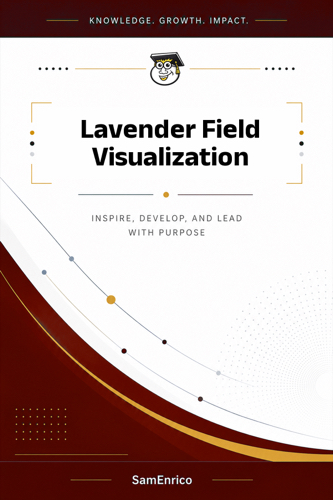
Lavender Field Visualization eBook
Walk through imagined purple lavender rows breathi
Walk through imagined purple lavender rows breathing in calming scent.
Formats
Free sample
Chapter 1: The Gate Before Lavender--The first mistake almost everyone makes is trying to see the lavender before they have even found the gate.You have probably done this yourself. You close your eyes, and immediately you reach for the purple rows, the flowering spikes, the soft scent. You want the reward before the preparation. And when the image comes up blurry, or not at all, you conclude that visualization does not work for you. But the problem is not your ability to visualize.
The problem is that you are trying to run a marathon while your brain is still firing at the speed of a panic attack.This chapter is not about lavender. Not yet. This chapter is about the doorway you must walk through before any lavender can appear. Without this doorway, every visualization you attempt will feel like trying to pour water into a cup that is already full—full of stress, full of racing thoughts, full of the Beta brainwave state that dominates modern life. With this doorway, the lavender field will open to you like a place you have always known.Let me show you what is happening inside your skull right now.The High-Alert Trap Your brain produces electrical patterns called brainwaves, measured in cycles per second, or hertz.
When you are awake and actively engaged in problem-solving, work, traffic, social media, or anxious rumination, your brain is operating primarily in Beta frequency, which ranges from approximately 13 to 30 cycles per second. The higher end of Beta—above 21 hertz—is associated with stress, hypervigilance, and the feeling of being "wired but tired."Here is the problem that no one tells you about visualization: Beta is the worst possible brain state for generating mental imagery.Think of Beta as a crowded room where ten people are shouting at once. In that room, you cannot hear a whisper. Visualization requires a whisper. It requires the brain to shift into Alpha frequency, which ranges from 8 to 13 cycles per second.
Alpha is the state of relaxed alertness—the moment just after you close your eyes but before you fall asleep, the feeling of a long exhale after a hard day, the creative flow state where ideas arrive without effort.In Alpha, the room quiets. The shouting stops. You can hear the whisper.Most people try to visualize by simply closing their eyes and hoping for the best. But closing your eyes does not automatically shift your brainwave state. You can close your eyes while your mind is still screaming through a to-do list, still replaying an argument, still worrying about tomorrow.
That is Beta with your eyes shut. And visualization cannot take root there.You need a bridge. You need a deliberate, repeatable method to step out of Beta and into Alpha. You need a gate.The Three-Two-One Countdown The gate you will learn in this chapter is called the 3-2-1 Breathing Countdown. It is deceptively simple, and because it is simple, many people will be tempted to skip it.
Do not skip it. Simplicity is not weakness. The most powerful tools in any discipline are often the ones that reduce complexity to a single, repeatable action.Here is how it works.Find a comfortable position. Sitting upright in a chair with your feet flat on the floor is better than lying down for this practice, because lying down may trigger sleep onset before you have completed the exercise. If you are already in bed and intending to sleep, you may adapt this later, but for learning the skill, sit.Close your eyes.Take a deep breath in through your nose, filling your lungs completely.
Do not force it. Let the inhale be full but effortless.Now exhale slowly through your mouth. As you exhale, mentally say the word "Three" three times. Not out loud. Inside your mind.
Like this: Three. Three. Three. Stretch the word across the exhale. Do not rush it.Take another deep breath in.Exhale.
This time, mentally say "Two. Two. Two."Another breath in.Exhale. Mentally say "One. One.
One."That is one complete round of the 3-2-1 Countdown. It takes approximately thirty to forty-five seconds.Now do it again. Three rounds total is sufficient for entry. Some people need five rounds. You will learn your own number with practice.Why does this work?
Because mental counting occupies the brain's language centers, specifically the left inferior frontal gyrus and the supplementary motor area. When these regions are engaged in a repetitive, rhythmic task, they have less bandwidth available for anxious rumination. You cannot mentally count "Three, Three, Three" while simultaneously replaying an argument from three hours ago. The counting crowds out the noise.Additionally, the slow, rhythmic exhale stimulates the vagus nerve, which we will explore in depth in Chapter 5. For now, understand only this: the 3-2-1 Countdown is not a relaxation technique that happens to also shift your brainwaves.
It is a precision tool designed to move you from high-Beta to low-Alpha in under one minute.The Gate Itself Once you have completed the 3-2-1 Countdown and feel a subtle shift—a softening behind your eyes, a slight heaviness in your limbs, a quieting of the internal monologue—you are ready to approach the gate.Do not look for the lavender yet. The lavender does not exist until you have passed through.In your mind's eye, you are standing at the edge of a field. You do not know its size yet. You do not know what grows there. All you know is the boundary: a wooden gate, waist-high, built from weathered gray-brown planks.
The wood is not new. It has been here for decades. The gate has been waiting for you.See the texture of the wood. Run your imaginary hand across the top rail. Feel the roughness of the grain, the small splinters that have not yet been sanded smooth, the coolness of the wood where the morning sun has not yet reached.
This is not a photograph. It does not need to be perfect. You only need a felt sense of the wood—the knowing of its texture, even if you cannot see every detail.See the latch. It is iron, aged to a dull rust-brown, with a simple thumb lever. Your fingers wrap around the lever.
Feel the temperature of the metal—cooler than the wood because metal conducts heat away from your skin faster. Feel the slight resistance as you press the lever down.Hear the gate creak open. Not a loud creak. A soft, familiar sound, like the door of a house you grew up in. The hinges have been oiled, but they still speak when they move.Step through.You are now on the other side of the gate.
The field stretches out before you, but you are not walking into it yet. You are standing just inside the threshold. The gate is still behind you. You can reach back and touch it if you need to. The gate is not a trap.
It is a doorway, and doorways open in both directions.This is the entire practice for Chapter 1. No lavender. No rows. No scent. Just the gate and the threshold.Most people…
This is the end of the free sample. Get the eBook to keep going. Buy now
About this book
Details
- Author
- Truitt Shandra
- Publisher
- SamEnrico
- Language
- English
- Genre
- Non-Fiction, Self-Help, Lavender, Scent
- Released
- 2026-06-09
- Pages (approx.)
- 140
- Available as
- eBook, Audiobook

Read better in the ZLOADR app
Your eBooks on your phone or tablet. Sign in with your SamEnrico account and start reading.
More by Truitt Shandra
 Dubbing DisneyTruitt Shandra$11.99Dubbing DisneyTruitt Shandra$11.99
 Retirement Plan Third Party AdministratorTruitt Shandra$11.99
 Vegan Salad Bowl GuideTruitt Shandra$11.99
 The Four Way Stop Protocol GuideTruitt Shandra$11.99
 Whispers of the Forgotten: The Last Druids of AngleseyTruitt Shandra$11.99
 Network and System AdministratorTruitt Shandra$11.99
 African Scholarship DatabaseTruitt Shandra$12.99
 Small Business AI Cash Flow ForecastingTruitt Shandra$12.99
 How to Start a Chlorine and Chloride Business (Beginners Guide)Truitt Shandra$11.99
 Understanding Neurofibromatosis-noonan SyndromeTruitt Shandra$17.99
You may also like
 Hong Kong Handover 1997Dunn Johnnie$11.99
 Zumba For Postnatal Recovery CourseNeal Christian$11.99
 Zumba for BeginnersLadner Nikia$11.99
 YouTube Comment Mining GuideHumes Pandora$12.99
 Worry Box MeditationCarlin Rudy$11.99
 Workplace Stress MeditationNguyen Lynn$11.99
 Workplace Stress and Sleep RepairHawley Ivory$11.99
 Workplace Perfectionism CureDelaney Jeffry$11.99
 Workplace Injustice Anger GuideWallen Isabelle$11.99
 Work Addiction and Burnout LinkGreenwood Ester$11.99
 Women in Yoga and WellnessBeattie Galina$11.99
 Women in Stand Up ComedyChun Evangeline$11.99