
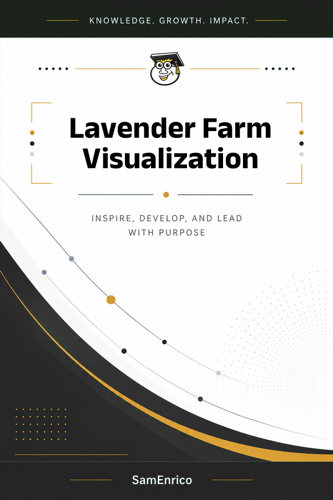
Non-FictionSelf-HelpAromatherapy
Lavender Farm Visualization eBook
Walk rows of blooming lavender, inhaling the calmi
by Hugh Kim
Walk rows of blooming lavender, inhaling the calming scent.
Formats
Free sample
Chapter 1: The Stillness Gate...-- You stand at the threshold of something you cannot yet name. The air around you carries the faintest whisper of sweetness, though you cannot see its source. Your hand hovers over a weathered wooden latch, rough with age and warm from the morning sun. Behind you, the world continues its relentless churn—the notifications, the obligations, the small and large anxieties that have become the wallpaper of your days. Ahead of you, nothing but a gate and a promise: that on the other side, there exists a version of you who breathes more slowly, who remembers what stillness feels like.This gate is not made of wood, not really.
It is made of intention. Every visualization, every journey inward, begins with a single conscious choice: to leave one world and enter another. You have made that choice simply by opening this book. Now, you will learn to make it in a single breath.The Science of the Threshold Before you open the gate, let us understand what you are about to do. The practice you are beginning is not magical thinking, nor is it wishful escape.
It is a neurobiological event—a deliberate rewiring of your brain’s default patterns through the combined power of attention, imagination, and sensory anchoring.When you visualize a place of safety and calm, your brain activates many of the same neural networks that would fire if you were physically there. The insula, responsible for interoception (your sense of your internal body state), lights up. The prefrontal cortex, which governs attention and emotional regulation, strengthens its connections to the amygdala, your brain’s alarm system. Over time, with repetition, the neural pathway to calm becomes as worn and automatic as the path to worry once was.The gate you are about to open serves a specific neurological function: it creates a boundary event. In the same way that walking through a doorway can make you forget why you entered a room (the well-known “doorway effect”), a deliberate threshold crossing signals to your brain that the rules have changed.
Beyond this gate, you are not the same person who stood before it. You are a version of yourself who has permission to rest.Preparing for Your First Crossing Before you enter the visualization, take three minutes to prepare your environment and your mind. These preparations are not optional rituals; they are the scaffolding that will support your practice until it becomes second nature.Choose your time. Morning is ideal, before the day’s demands have accumulated. But any time you can dedicate ten uninterrupted minutes will serve.
What matters is consistency—the same time, same place, same preparatory actions, day after day.Choose your space. A chair, a cushion, a corner of a sofa. It does not need to be large or beautiful. It only needs to be yours. If possible, keep a small object nearby that will anchor this practice—a smooth stone, a dried lavender sprig, a photograph of a field.
This object will become a sensory anchor, a physical reminder of your inner farm that you can touch when you are not visualizing.Set a gentle timer. Ten minutes is sufficient for this chapter. You do not want to wonder how much time has passed; wondering pulls you out of the farm. Choose an alarm sound that rises slowly—a bell, a chime, a piece of quiet music. Nothing jarring.Optional enhancement: lavender oil.
If you have access to true lavender essential oil (Lavandula angustifolia), place a single drop on your inner wrist or on a cotton ball beside you. Do not apply it yet. You will use it during the visualization as a scent bridge, a chemical key that will unlock your inner farm more quickly with each repetition. If you do not have oil, proceed without it. Your mind’s memory of lavender’s scent—sweet, herbaceous, slightly camphorous—is powerful on its own.
(For a complete guide to using scent in visualization, see the “No Oil? Try This” sidebar at the end of this chapter.)The Visualization Begins Settle into your chosen position. Close your eyes. Take three ordinary breaths—not the controlled breathing you will learn later, just the simple inhale and exhale that remind you that you are alive, that your body knows how to do this without your instruction.Now, bring your attention to the space between your eyebrows. This is not mystical; it is practical.
Focusing on this point activates the prefrontal cortex and begins to quiet the default mode network—the part of your brain that generates self-referential thoughts, worries, and the endless narrative of “me, me, me.”With your attention gathered, imagine that you are standing on a path you have never walked before. The ground beneath your feet is packed earth and small gravel. It crunches slightly when you shift your weight. Above you, the sky is the particular blue that only appears on mornings after a storm—washed clean, infinite, gently indifferent to your presence.Before you, the gate.The Gate It is weathered, this gate. The wood has silvered with age, and the iron hinges show traces of rust.
A simple latch—a wooden bar resting across two iron brackets—holds it closed. No lock. No key. The gate has never been locked. It has only been waiting for you to notice it.Reach out and touch the wood.
What do you feel? Perhaps it is smooth from years of rain and sun. Perhaps the grain rises slightly under your fingertips. Perhaps there are splinters, carefully sanded away long ago. Spend a moment here, just touching the gate.
This is not impatience; this is arrival.Now, look up. Beyond the gate, you cannot yet see the lavender. The rows are hidden by a gentle rise in the land, or by a morning mist that has not yet burned away. But you can hear them. The soft whisper of wind through plants that are not quite ready to bloom.
The distant, steady hum of bees beginning their work. The almost-sound of growing things.Your hand finds the latch. Lift it. The wooden bar comes free with a soft thunk. Place your palm flat against the gate and push.The Sound of Opening Gates make sounds.
This one makes a specific sound—the low, long creak of hinges that have been turned a thousand times before, by a thousand versions of you who came seeking the same thing you seek now. Do not rush through this sound. Let it fill your awareness. A creak means the gate is real. A creak means you are crossing.Step through.Behind you, you may choose to close the gate or leave it open.
There is no wrong answer. Closing it emphasizes the boundary, the separation between the world you left and the world you are entering. Leaving it open suggests that the farm is not a prison but a refuge—you may come and go as you please. Try both in different sessions. Discover which feels more true to you.The Path Ahead You are now inside the farm.
Before you stretches a path of packed earth and gravel, the same surface that was under your feet at the…
This is the end of the free sample. Get the eBook to keep going. Buy now
About this book
Details
- Author
- Hugh Kim
- Publisher
- SamEnrico
- Language
- English
- Genre
- Non-Fiction, Self-Help, Aromatherapy
- Released
- 2026-06-09
- Pages (approx.)
- 127
- Available as
- eBook, Audiobook

Read better in the ZLOADR app
Your eBooks on your phone or tablet. Sign in with your SamEnrico account and start reading.
More by Hugh Kim
 Nuts and Seeds LongevityHugh Kim$11.99
 The Floating Cloud InductionHugh Kim$11.99
 Cross Border FBA ProfitsHugh Kim$11.99
 The Parent Exercise Motivation GuideHugh Kim$11.99
 The Fall of the Duvaliers: Haiti's Bloody Impeachment TrialHugh Kim$11.99
 PhD and Research Graduate PRHugh Kim$12.99
 Understanding Renal GlycosuriaHugh Kim$17.99
 IT Software DeveloperHugh Kim$11.99
 Ultimate Handbook Guide to Ankara : (Turkey) Travel GuideHugh Kim$11.99
You may also like
 Hong Kong Handover 1997Dunn Johnnie$11.99
 Zumba For Postnatal Recovery CourseNeal Christian$11.99
 Zumba for BeginnersLadner Nikia$11.99
 YouTube Comment Mining GuideHumes Pandora$12.99
 Worry Box MeditationCarlin Rudy$11.99
 Workplace Stress MeditationNguyen Lynn$11.99
 Workplace Stress and Sleep RepairHawley Ivory$11.99
 Workplace Perfectionism CureDelaney Jeffry$11.99
 Workplace Injustice Anger GuideWallen Isabelle$11.99
 Work Addiction and Burnout LinkGreenwood Ester$11.99
 Women in Yoga and WellnessBeattie Galina$11.99
 Women in Stand Up ComedyChun Evangeline$11.99