
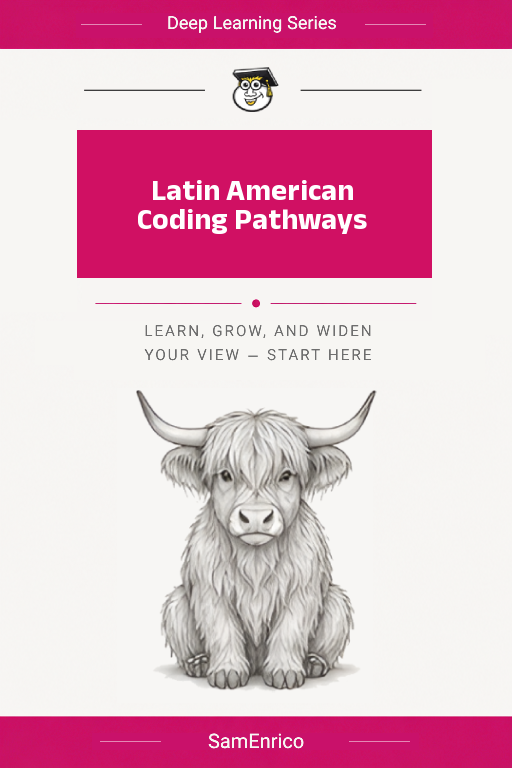
Latin American Coding Pathways
Choose between university degrees in Brazil, Mexic
Choose between university degrees in Brazil, Mexico, or Argentina versus online bootcamps for remote work.
Formats
About this book
Free sample
Chapter 1: The Fractured Ladder--–- In a small apartment on the outskirts of São Paulo, two cousins sit at the same worn wooden table, both learning to code. They are the same age, twenty-two. They both dream of escaping the gravitational pull of minimum wage, which in Brazil currently hovers around R$1,400 per month—less than three hundred US dollars. They both stare at the same screen, a decade-old laptop with a cracked corner that they share on alternating days. But their paths could not be more different, and those differences will determine not just their salaries but the entire trajectory of their lives.Camila is in her fourth year of a computer engineering degree at Universidade de São Paulo, the most prestigious university in Latin America.
She wakes at five in the morning, takes two buses, and arrives on campus by eight. She studies algorithms, data structures, compilers, and operating systems. Her professors are brilliant researchers who publish papers at top conferences. She understands how a CPU processes instructions at the transistor level. She can prove the time complexity of a sorting algorithm in her sleep.
She has never deployed a website to the cloud, never used Git for a collaborative project, never written a line of React or Node.js. Her curriculum was last updated in 2009.Rafael is a bootcamp graduate. He completed a sixteen-week intensive program at Trybe, paying nothing upfront in exchange for an Income Share Agreement that takes seventeen percent of his salary for three years once he finds work. He learned Java Script, React, Node.js, Express, Postgre SQL, and deployment on Vercel. He built five portfolio projects: a weather app, an e-commerce frontend, a task manager API, a real-time chat application, and a clone of Twitter's basic functionality.
He has never studied time complexity beyond the surface level. He cannot explain the difference between a mutex and a semaphore. He does not know what a compiler does. But his Git Hub profile is immaculate, with a long streak of green squares, detailed READMEs, and live deployment links for every project.Here is…
This is the end of the free sample. Get the eBook to keep going. Buy now
Contents
- Chapter 1
- Chapter 2
- Chapter 3
- Chapter 4
- Chapter 5
- Chapter 6
- Chapter 7
- Chapter 8
- Chapter 9
- Chapter 10
- Chapter 11
- Chapter 12
Details
- Author
- Hargrove Elodia
- Publisher
- SamEnrico
- Language
- English
- Genre
- Non-Fiction, Student's Shortcut, Latin American Education
- Released
- 2026-05-29
- Pages (approx.)
- 145
- Available as
- eBook, Audiobook

Read better in the ZLOADR app
Your eBooks on your phone or tablet. Sign in with your SamEnrico account and start reading.
More by Hargrove Elodia
 High Yield Bond RisksHargrove Elodia$11.99
 Self Doubt Athletic Performance GuideHargrove Elodia$11.99
 Inherited Career ExpectationsHargrove Elodia$11.99
 Distraction Proof Home Office GuideHargrove Elodia$11.99
 Anger in Long Term RelationshipsHargrove Elodia$11.99
 Low Carb Budget Meal PlanHargrove Elodia$11.99
 John Lee Hooker BoogieHargrove Elodia$11.99
 Earplugs Sleep Memory BoostHargrove Elodia$11.99
 The Last King of the Golden Triangle: Khun Sa's Shadow EmpireHargrove Elodia$11.99
 The Bombay Spy Game: Cricket, Espionage, and the Birth of India's Sporting RevolutionHargrove Elodia$11.99
 Understanding Globoid Cell LeukodystrophyHargrove Elodia$11.99
 WIPO Madrid International ClassesHargrove Elodia$12.99