
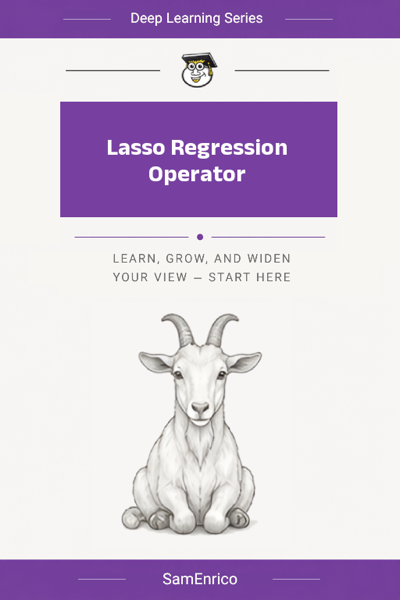
Non-FictionInformativeEducational
Lasso Regression Operator eBook
A Coursebook on Lasso Regression Operator
by Dozier Asia
A Coursebook on Lasso Regression Operator
Formats
Free sample
Chapter 1: The Broken Equation--– In the autumn of 2015, a team of geneticists at the Broad Institute of MIT and Harvard faced an impossible puzzle. They had sequenced the entire genomes of 1,200 cancer patients, measuring the expression levels of over 20,000 genes for each person. Their goal was simple to state but maddeningly difficult to achieve: identify which handful of genes actually drove the progression of a particularly aggressive form of breast cancer. They had twenty thousand predictors, twelve hundred observations, and the weight of human lives pressing on every line of code they wrote.They tried ordinary least squares regression, the workhorse of statistical modeling for over two hundred years. The result was catastrophic.
The algorithm cheerfully returned a model with 20,000 coefficients, each one bouncing between positive and negative infinity, explaining the training data with perfect accuracy and predicting nothing of value on new patients. The model had learned the noise. It had memorized the genetic equivalent of random static.They tried subset selection, manually winnowing down candidates based on prior biological knowledge. This was slow, subjective, and almost certainly missing novel genes that hadn't yet appeared in the literature. They tried ridge regression, which stabilized the estimates but kept all twenty thousand genes in the model, producing a final equation so dense and uninterpretable that no clinician would ever trust it.What they needed, and what did not yet exist in any standard textbook, was a method that could do three things simultaneously: handle more predictors than observations, automatically select a small subset of truly important variables, and produce stable, interpretable coefficients that would generalize to new patients.
They needed the lasso.But before we can understand how the lasso rescued the geneticists—and how it has since transformed fields from finance to neuroscience to marketing analytics—we must first understand what breaks inside ordinary least squares when the world becomes high-dimensional. We must confront the broken equation that lurks at the heart of modern data analysis, and why every data scientist eventually hits a wall where traditional methods simply cannot go.The Promise and Peril of Ordinary Least Squares Ordinary least squares regression, invented by Carl Friedrich Gauss in the early nineteenth century and refined by Legendre and Galton, rests on a beautiful and seductive idea. Suppose we have a set of predictor variables x1,x2,…,xpx_1, x_2, \ldots, x_px1,x2,…,xp and a response variable yyy that we wish to predict. OLS finds the coefficients β1,β2,…,βp\beta_1, \beta_2, \ldots, \beta_pβ1,β2,…,βp that minimize the sum of squared errors between the predicted values and the actual observations. In matrix notation, where X\mathbf{X}X is an n×pn \times pn×p matrix of predictors and y\mathbf{y}y is an n×1n \times 1n×1 vector of responses, the solution is β^OLS=(XTX)−1XTy\hat{\beta}_{OLS} = (\mathbf{X}^T\mathbf{X})^{-1}\mathbf{X}^T\mathbf{y}β^OLS=(XTX)−1XTy.
Elegant. Analytical. And, under certain conditions, provably optimal.What are those conditions? The matrix XTX\mathbf{X}^T\mathbf{X}XTX must be invertible, which requires that p≤np \leq np≤n and that no predictor is a perfect linear combination of others. The errors should be independent and identically distributed with constant variance.
And perhaps most critically, the number of observations nnn should be substantially larger than the number of predictors ppp.For most of the twentieth century, this was the natural order of things. In a classic agricultural experiment, a researcher might measure a dozen soil characteristics (p=12p = 12p=12) across a hundred different plots (n=100n = 100n=100). In a pharmaceutical trial, a company might track ten biomarkers (p=10p = 10p=10) for five hundred patients (n=500n = 500n=500). The world was n>pn > pn>p, and OLS reigned supreme.But somewhere around the turn of the millennium, the world changed. Digital sensors became cheap.
Genomic sequencing became routine. Web browsers began recording every click, every hover, every hesitation. Suddenly, data scientists routinely faced situations where ppp was in the thousands, tens of thousands, or even millions, while nnn remained stubbornly modest—a few hundred patients, a thousand website sessions, a three-year panel of economic indicators.In this new world, OLS does not just struggle. It collapses.Why OLS Fails When p > n Let us understand exactly what breaks. When p>np > np>n, the matrix XTX\mathbf{X}^T\mathbf{X}XTX is singular—it has rank at most nnn, which is less than ppp.
This means there is no unique inverse. The OLS solution (XTX)−1XTy(\mathbf{X}^T\mathbf{X})^{-1}\mathbf{X}^T\mathbf{y}(XTX)−1XTy simply does not exist. There are infinitely many coefficient vectors that perfectly fit the training data, each one producing zero residual sum of squares. Which one should you choose? The data, tragically, do not tell you.Even when ppp is close to nnn but still less than nnn, a more subtle pathology emerges.
The matrix XTX\mathbf{X}^T\mathbf{X}XTX may be invertible mathematically, but it is often ill-conditioned. Its eigenvalues become extremely small, its condition number (the ratio of the largest eigenvalue to the smallest) skyrockets, and the variance of the OLS estimates explodes. A tiny change in the data—adding one new patient, removing an outlier—produces a wild swing in the coefficients.Consider a simple simulation. Generate n=100n = 100n=100 observations with p=80p = 80p=80 predictors drawn from a standard normal distribution, with only the first 5 predictors truly related to the response. Run OLS.
The average squared error on new test data will be astronomically high, often worse than simply predicting the mean. The estimated coefficients for the irrelevant 75 predictors will wander randomly, sometimes taking values of ±10, ±50, or even ±200, despite the true coefficient being zero. This is overfitting in its most dramatic form.And yet, the model will report beautiful R-squared values on the training data—often 99% or higher. It will seem to fit perfectly. That is precisely the danger.The Bias-Variance Tradeoff: A Balancing Act To understand why lasso succeeds where OLS fails, we need to internalize one of the most fundamental concepts in all of statistical learning: the bias-variance tradeoff.
Every predictive model has three sources of error.Bias is the error from approximating a real-world problem (which may be enormously complex) with a simplified model. A linear model applied to a curved relationship suffers from high bias. Variance is the error from sensitivity to small fluctuations in the training data. A wiggly, high-degree polynomial that passes exactly through every training point suffers from high variance. The irreducible error is the noise inherent in the phenomenon itself—the measurement error, the unmeasured causes, the fundamental unpredictability.The total expected prediction error at a new point x0x_0x0 decomposes as:E[(y0−f^(x0))2]=Bias2(f^(x0))+Var(f^(x0))+σ2E[(y_0 - \hat{f}(x_0))^2] = \text{Bias}^2(\hat{f}(x_0)) + \text{Var}(\hat{f}(x_0)) + \sigma^2E[(y0−f^(x0))2]=Bias2(f^(x0))+Var(f^(x0))+σ2Ordinary least squares, when ppp is modest relative to nnn, produces unbiased estimates.
The bias term is zero. This is usually considered a virtue. But when ppp is large, the variance term explodes. The model becomes unstable, overfits the…
This is the end of the free sample. Get the eBook to keep going. Buy now
About this book
Details
- Author
- Dozier Asia
- Publisher
- SamEnrico
- Language
- English
- Genre
- Non-Fiction, Informative, Educational
- Released
- 2026-05-06
- Pages (approx.)
- 156
- Available as
- eBook, Audiobook

Read better in the ZLOADR app
Your eBooks on your phone or tablet. Sign in with your SamEnrico account and start reading.
More by Dozier Asia
 Project Manager Stress GuideDozier Asia$11.99
 The Math Anxiety WorkbookDozier Asia$11.99
 Dreams And Stalking TraumaDozier Asia$11.99
 The Syndication Legal Structures GuideDozier Asia$11.99
 DBT For ActivistsDozier Asia$11.99
 The Dubai Phantom: The $20 Million Luxury Car Heist That Shook the UAEDozier Asia$11.99
 Pop Up Staffing LondonDozier Asia$12.99
 Carbon Credit Mastery for MultinationalsDozier Asia$12.99
 Understanding Taste DisorderDozier Asia$17.99
 How to Start a Absorptiometer (non-electronic) Business (Beginners Guide)Dozier Asia$11.99
You may also like
 Hong Kong Handover 1997Dunn Johnnie$11.99
 Zumba For Postnatal Recovery CourseNeal Christian$11.99
 Zumba for BeginnersLadner Nikia$11.99
 YouTube Comment Mining GuideHumes Pandora$12.99
 Worry Box MeditationCarlin Rudy$11.99
 Workplace Stress MeditationNguyen Lynn$11.99
 Workplace Stress and Sleep RepairHawley Ivory$11.99
 Workplace Perfectionism CureDelaney Jeffry$11.99
 Workplace Injustice Anger GuideWallen Isabelle$11.99
 Work Addiction and Burnout LinkGreenwood Ester$11.99
 Women in Yoga and WellnessBeattie Galina$11.99
 Women in Stand Up ComedyChun Evangeline$11.99