
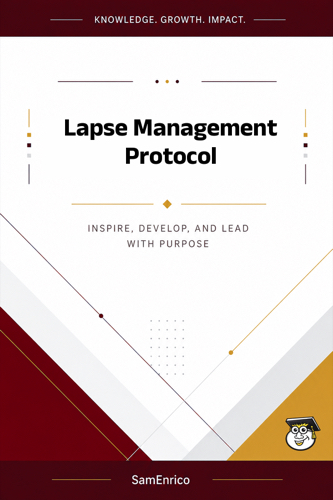
Non-FictionHealth & WellnessLapse
Lapse Management Protocol eBook
Stop a single eating slip from becoming a full rel
Stop a single eating slip from becoming a full relapse with rapid response.
Formats
Free sample
Chapter 1: The Dopamine Hijack--–- Let me tell you about the worst night of my dieting life. It was a Tuesday, which feels appropriate—Tuesdays have no business being as hard as they are. There's none of Monday's fresh-start energy, none of Wednesday's "hump day" relief. Just the long, flat grind of the week stretching ahead. I had been "good" for eleven days.
Eleven days of weighing chicken breast. Eleven days of saying no to the break room donuts. Eleven days of that low-grade hunger that becomes background noise, like a refrigerator hum you stop noticing until someone points it out.Then a coworker brought in a sleeve of Oreos. Not even a special occasion. Just a Tuesday with cookies.I took one.
I told myself it was fine. One Oreo is 53 calories. I had walked an extra flight of stairs that morning. The math worked. Except here is what I did not know at the time: the moment that cookie touched my tongue, a biological cascade began that had nothing to do with math, nothing to do with willpower, and everything to do with a brain system that evolved millions of years before the first diet was ever written.Thirty minutes later, I had eaten the entire sleeve.
Then a half-gallon of ice cream. Then several spoonfuls of peanut butter, eaten directly from the jar while standing in front of the open freezer, crying. Not sad-crying exactly. Confused-crying. Because I had watched myself do every bit of it, and I had felt powerless to stop.
It was like being a passenger in my own body, shouting instructions that no one was following.That night, I thought I was broken. I thought there was something fundamentally wrong with me—a missing piece of self-control that other people had. I thought about every diet I had ever failed, every "start over Monday" that turned into "start over next month," and I believed the common denominator was my own weakness.Here is what I actually was: a human being with a normally functioning brain having a normal neurochemical event that no amount of "just say no" could have prevented.The 53-Calorie Lie Before we go any further, I need you to understand something that every diet industry executive knows and every diet book conveniently forgets to mention. The difference between a person who stops at one cookie and a person who eats the whole sleeve is not willpower. It is not character.
It is not moral superiority. It is neurochemistry, timing, and whether that person's particular brain has been primed by a history of restriction to overreact to sugar and refined carbohydrates.Here is what happens in the first three to five seconds after a trigger food hits your tongue.Your taste buds send a signal to your brain stem, which routes it to multiple regions simultaneously. One of those regions is the nucleus accumbens—sometimes called the brain's reward center. The nucleus accumbens does not care about your diet. It does not care about your jeans size or your New Year's resolution or the fact that you promised yourself you would be "good" this week.
The nucleus accumbens cares about one thing: detecting reward opportunities and making sure you repeat the behaviors that led to them.When sugar or refined carbohydrates hit your system, the nucleus accumbens releases dopamine. Not a little dopamine. A flood. For some people, the dopamine response to sugar is comparable to the response to certain drugs of abuse. This is not metaphor.
This is measurable brain chemistry.Dopamine has many jobs, but its most relevant job here is this: it suppresses the prefrontal cortex.The prefrontal cortex is the part of your brain that reads the nutrition label. It calculates calorie deficits. It remembers that you have a wedding in six weeks and you want to fit into that dress. It plans for the future, weighs consequences, and inhibits impulses. It is, in many ways, the part of you that is "on a diet."And when dopamine floods your system, the prefrontal cortex gets quieter.
Not destroyed. Not permanently damaged. Just... outvoted. The reward center is louder.
The impulse is faster. The future becomes abstract; the cookie in your hand becomes very, very real.This is called the dopamine hijack, and it happens in roughly three to five minutes. You have that long—maybe three hundred seconds—between the moment the food touches your tongue and the moment your prefrontal cortex loses the argument.The Five-Minute Window Let me say that again because it is the single most important concept in this entire book.From the first bite of a trigger food, you have approximately three to five minutes before the dopamine surge makes rational thought functionally impossible. Not actually impossible—you can still think. But the part of your brain that says "stop" is now competing with a part of your brain that says "more," and the "more" part has chemical reinforcements.This is the Five-Minute Window.Inside that window, you still have a choice.
Outside that window, the choice becomes exponentially harder. Not impossible—nothing about human behavior is impossible. But you are now asking your prefrontal cortex to fight against a chemical tide, and that is a fight it will lose more often than it wins.Most diet advice pretends this window does not exist. "Just say no," they tell you. "Just have one and stop." This is like telling someone in a flood to just not get wet.
The advice is not wrong; it is just useless without a protocol for the moment the water rises.Here is what the Five-Minute Window feels like from the inside.Minute One: You take a bite. It tastes good. You are still in control. You think, "I'll just have this one." Your prefrontal cortex is still online.Minute Two: The dopamine starts to build. The cookie tastes better than you remembered.
You take another bite without consciously deciding to. You think, "Well, one more won't hurt."Minute Three: The prefrontal cortex starts to fade. The future—your diet, your goals, your wedding dress—feels distant and abstract. The cookie feels immediate and real. You think, "I deserve this."Minute Four: You are eating faster.
You are not tasting anymore. You are feeding the dopamine loop. You think, "I already messed up, so..."Minute Five: The prefrontal cortex has been outvoted. You are on autopilot. You are not thinking at all.
You are simply eating.This is not a character flaw. This is neuroscience.The Time Compression Trap There is another piece of this puzzle that makes the Five-Minute Window even more dangerous, and it is something I call time compression.When you are in a dopamine hijack, your brain literally processes time differently. The past collapses: your eleven days of perfect eating suddenly feel irrelevant, like they happened to someone else. The future collapses: your goals feel impossibly far away, and the version of you who set those goals feels like a stranger. The present expands: the only thing that exists is the food in front of you and the chemical demand for more.This is why a single cookie can feel like a complete moral failure.…
This is the end of the free sample. Get the eBook to keep going. Buy now
About this book
Details
- Author
- Escobar Lorriane
- Publisher
- SamEnrico
- Language
- English
- Genre
- Non-Fiction, Health & Wellness, Lapse
- Released
- 2026-06-06
- Pages (approx.)
- 141
- Available as
- eBook, Audiobook

Read better in the ZLOADR app
Your eBooks on your phone or tablet. Sign in with your SamEnrico account and start reading.
More by Escobar Lorriane
 Greta's Family Support SystemEscobar Lorriane$11.99
 Support Group Conversation GuideEscobar Lorriane$11.99
 Nobel Laureates In LasersEscobar Lorriane$11.99
 Walking Meditation for BoundariesEscobar Lorriane$11.99
 The Lost Giants of Lake Mungo: Uncovering Australia's Ancient AncestorsEscobar Lorriane$11.99
 Ragnarok’s Unfinished Symphony: The Aesir’s Last StandEscobar Lorriane$11.99
 Understanding Gordon SyndromeEscobar Lorriane$17.99
 How to Become a Scraper-loader OperatorEscobar Lorriane$11.99
 Digital Wallet Payout GuideEscobar Lorriane$12.99
 Freemium to Premium FunnelEscobar Lorriane$12.99
 Quality Assurance Technician (Food)Escobar Lorriane$11.99
You may also like
 Hong Kong Handover 1997Dunn Johnnie$11.99
 Zumba For Postnatal Recovery CourseNeal Christian$11.99
 Zumba for BeginnersLadner Nikia$11.99
 YouTube Comment Mining GuideHumes Pandora$12.99
 Worry Box MeditationCarlin Rudy$11.99
 Workplace Stress MeditationNguyen Lynn$11.99
 Workplace Stress and Sleep RepairHawley Ivory$11.99
 Workplace Perfectionism CureDelaney Jeffry$11.99
 Workplace Injustice Anger GuideWallen Isabelle$11.99
 Work Addiction and Burnout LinkGreenwood Ester$11.99
 Women in Yoga and WellnessBeattie Galina$11.99
 Women in Stand Up ComedyChun Evangeline$11.99