
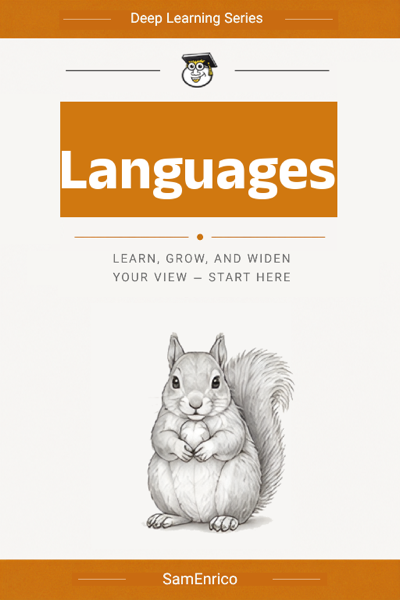
Non-FictionInformativeEducational
Languages eBook
A Coursebook on Languages
by Stine Melony
A Coursebook on Languages
Formats
Free sample
Chapter 1: The Infinite Game...--– Imagine, for a moment, that you are a Martian linguist landing on Earth for the first time. You have no preconceptions about human civilization, no knowledge of Shakespeare, no memory of text messages or political speeches or lullabies. All you have is a recording device and an insatiable curiosity. You point your antennae toward a playground in Tokyo, a market in Marrakech, a kitchen in Kentucky, and a bus stop in Buenos Aires. What you hear is chaos: a torrent of sounds—clicks, hisses, hums, pops—spilling out of the faces of hairless apes.
And yet, within minutes, you notice something astonishing. These sounds are not random. They are structured, patterned, and infinitely varied. A three-year-old in Osaka produces sequences she has never heard before and will never hear again, yet the adult next to her understands instantly. A grandmother in Naples shouts a single word, and a room full of people laughs, cries, or storms out.
No other species on this planet does anything remotely like this. This book is about that miracle.What This Chapter Will Do for You By the end of this chapter, you will understand what language is in a way that goes far beyond the dictionary definition you learned in school. You will be able to distinguish human language from animal communication, computer code, and mere information transfer. You will encounter the most influential—and controversial—theory in the modern study of language: Noam Chomsky’s claim that you were born with a grammatical blueprint already installed in your brain. And you will test that theory on yourself with a hands-on activity that reveals your own hidden linguistic instincts.
Most importantly, you will begin a journey that moves from the smallest click of the tongue to the largest sweep of human history, with this first chapter serving as the foundation for everything that follows.The First Misconception: Language Is Not Vocabulary If you ask a random person on the street, “What is language?” they will likely say something like, “Words. It’s the words we use to communicate.” This is understandable. Words are the most visible part of language. They appear in dictionaries, flashcards, and subtitle tracks. But words are to language what bricks are to a cathedral: necessary, but not sufficient.
You can memorize ten thousand words of Japanese and still sound like a malfunctioning robot because you lack the rules for assembling those words into meaningful sequences. Conversely, a four-year-old native speaker of English knows only a few thousand words but can produce sentences she has never heard before, adapting effortlessly to new situations. “I goed to the store” is wrong by adult standards, but notice what the child has done: she has extracted a rule (“add -ed for past tense”) and applied it productively, even to an irregular verb. That is the essence of language—not the memorized unit, but the generative rule.Language, then, is not a collection of items. It is a system of rules that allows a finite set of elements to generate an infinite set of expressions.
The linguist Wilhelm von Humboldt captured this perfectly in the early nineteenth century when he wrote that language “makes infinite use of finite means.” You have a finite vocabulary (even the most educated adult knows fewer than 100,000 words) and a finite set of grammatical rules (noun phrases contain determiners and nouns, verbs agree with subjects, etc.), yet you can produce and understand a literally infinite number of sentences. No one has ever spoken the sentence you are about to read next, yet you will understand it instantly: “The purple elephant that my grandmother dreamed about last Tuesday after eating pickled herring has, against all odds, begun to tango.” You have never encountered that sentence before. You never will again. But you parse it without conscious effort because your brain automatically applies rules you never studied.The Second Misconception: Writing Is Not Language Another common mistake is to confuse language with writing. Writing is a magnificent invention—perhaps humanity’s greatest after language itself—but it is a secondary technology.
Human beings have spoken language for at least 150,000 years, probably longer. Writing emerged only about 5,000 years ago, independently in Mesopotamia, Egypt, China, and Mesoamerica. Every healthy human being acquires spoken language naturally, without formal instruction. Writing must be explicitly taught, and for most of human history, the vast majority of people never learned to read or write. Illiterate societies are not “without language”; they are fully linguistic communities with complex grammars, rich vocabularies, and sophisticated oral literatures.
The linguist Leonard Bloomfield put it bluntly: “Writing is not language, but merely a way of recording language by means of visible marks.”This has profound implications for how we study language. A transcript of a conversation is not the conversation. A grammar book is not the grammar. The real object of inquiry is the mental system that allows a speaker of Navajo or Swahili or Catalan to produce and understand novel utterances in real time. That system exists in the brain, not on the page.
When you hear someone say, “I ain’t done nothing,” a prescriptivist might wince, but a linguist recognizes a perfectly regular grammatical rule of certain dialects: negative concord, or “double negation,” which was standard in older English (Chaucer used it) and remains standard in French, Spanish, and many other languages. The speaker is following rules—just not the rules of the standard dialect that happened to win the lottery of history.The Third Misconception: There Is No “Correct” Grammar This brings us to the most emotionally charged misconception: that some ways of speaking are inherently better, more logical, or more correct than others. Every language has a grammar—a set of unconscious rules that speakers follow. But “grammar” in this sense has nothing to do with the pet peeves of style guides or the complaints of English teachers. When a linguist says a sentence is “grammatical,” they mean that a native speaker would produce it spontaneously and judge it as acceptable, not that it conforms to some abstract standard of propriety.
“Who did you give it to?” is grammatical for the vast majority of English speakers. “To whom did you give it?” is grammatical for a smaller, stylistically restricted subset. Neither is “more correct” in any scientifically meaningful sense. They are different registers for different contexts.The famous linguist John Mc Whorter likes to point out that the rule against splitting infinitives (“to boldly go”) was invented in the nineteenth century by grammarians who thought Latin was superior to English. In Latin, infinitives are single words (amare “to love”) and cannot be split.
English infinitives are two words (“to love”), and splitting them has been common for centuries, used by Chaucer, Shakespeare, and every competent writer since. The rule is a ghost—a superstition. Real grammar, the kind your brain actually uses, has nothing to do with not ending sentences with prepositions or not starting them with conjunctions. Those are stylistic preferences, not rules of the English language.So if language is not vocabulary, not writing, and not the pet peeves of pedants, what is it? Let us build a definition from the ground up…
This is the end of the free sample. Get the eBook to keep going. Buy now
About this book
Details
- Author
- Stine Melony
- Publisher
- SamEnrico
- Language
- English
- Genre
- Non-Fiction, Informative, Educational
- Released
- 2026-05-04
- Pages (approx.)
- 159
- Available as
- eBook, Audiobook

Read better in the ZLOADR app
Your eBooks on your phone or tablet. Sign in with your SamEnrico account and start reading.
More by Stine Melony
 Workplace Trauma DreamsStine Melony$11.99
 The Small Talk Audacity CourseStine Melony$11.99
 Stress and Retirement TogetherStine Melony$11.99
 The Audition Survival KitStine Melony$11.99
 The Last Heist of the Rosetta StoneStine Melony$11.99
 How to Start a Physiologist Business (Beginners Guide)Stine Melony$11.99
 Bank Account for Offshore CompaniesStine Melony$12.99
 How to Produce a Bean HarvesterStine Melony$11.99
You may also like
 Hong Kong Handover 1997Dunn Johnnie$11.99
 Zumba For Postnatal Recovery CourseNeal Christian$11.99
 Zumba for BeginnersLadner Nikia$11.99
 YouTube Comment Mining GuideHumes Pandora$12.99
 Worry Box MeditationCarlin Rudy$11.99
 Workplace Stress MeditationNguyen Lynn$11.99
 Workplace Stress and Sleep RepairHawley Ivory$11.99
 Workplace Perfectionism CureDelaney Jeffry$11.99
 Workplace Injustice Anger GuideWallen Isabelle$11.99
 Work Addiction and Burnout LinkGreenwood Ester$11.99
 Women in Yoga and WellnessBeattie Galina$11.99
 Women in Stand Up ComedyChun Evangeline$11.99