
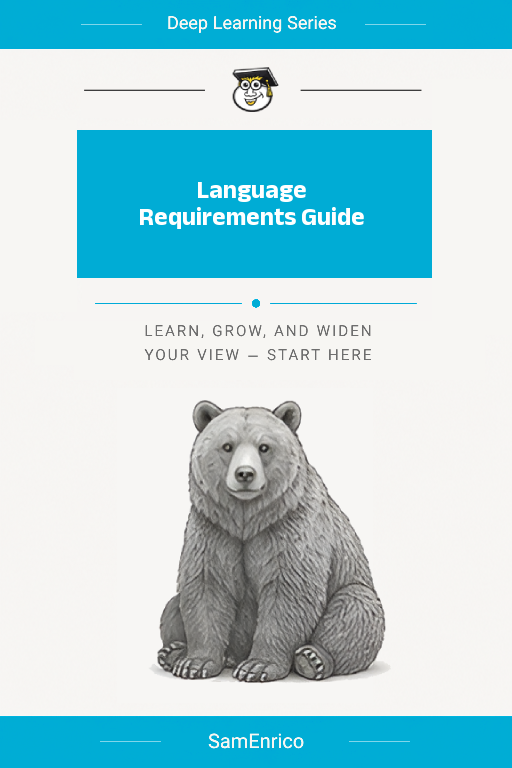
Non-FictionStudent's ShortcutLanguage Testing
Language Requirements Guide eBook
Compare IELTS, TOEFL, and PTE score requirements a
by Cherry Maye
Compare IELTS, TOEFL, and PTE score requirements and English support services for non-native speakers.
Formats
Free sample
Chapter 1: The Score Mirage--–- Maria had done everything right. She had spent eight months in a test-prep center in Mumbai, memorizing 3,000 academic words, perfecting her IELTS speaking templates, and taking twenty-three mock exams. Her final score was a 7.5—well above the minimum requirement for her dream program at the University of Melbourne. When her acceptance letter arrived, she celebrated with her family. She was ready.Six weeks into her first semester, Maria sat alone in a campus library stall, crying.
Not because she failed an exam. She hadn't failed anything. Her grades were average. But she had just walked out of a group project meeting where four classmates had debated, laughed, disagreed, and reached a consensus—all in rapid-fire Australian English with heavy slang and overlapping sentences. Maria had understood perhaps forty percent.
When she tried to speak, her perfectly rehearsed test phrases felt stiff and strange. One teammate had interrupted her mid-sentence, not rudely, but with a casual "Hang on, let me finish." Maria didn't know how to respond. She smiled, nodded, and later found out the group had assigned her the data entry portion of the project—the least intellectually demanding role. No one had been cruel. They had simply assumed she had nothing to contribute.Maria's story is not rare.
It is, in fact, so common that university international student offices have a name for it: the "high score, low integration" phenomenon. Students who clear the language requirement with flying colors but struggle to navigate the actual social and academic waters of a foreign university. And here is the truth that no test-prep book will tell you: passing the test is not the same as being ready for the university.This chapter exists because that distinction—between test English and life English—is the single most important concept you will learn in this book. Without it, you risk becoming Maria. You risk spending thousands of dollars and hundreds of hours preparing for the wrong target.
With it, you gain something far more valuable than a score report: you gain a roadmap to genuine academic and social fluency.The Gatekeeper You Didn't Know Existed Universities do not set language requirements to be cruel. They do not profit from your retake fees. In fact, most universities would prefer to admit more international students—you pay higher tuition, after all. So why the gatekeeping? The answer is simple, brutal, and hidden in plain sight: retention rates.Every university tracks how many first-year students return for second year.
This number—retention—directly affects rankings, funding, and reputation. A student who drops out costs the university money and a statistical blemish. Over decades of data, universities have discovered a clear, uncomfortable pattern: students who score below certain language thresholds are statistically far more likely to drop out. Not because they are less intelligent. Not because they are less hardworking.
But because they cannot keep up with the sheer speed and complexity of real academic communication.Let me give you a concrete example. A 2018 study of fifty thousand international students across thirty British universities found that students with an IELTS score below 6.0 had a first-year dropout rate of nearly thirty percent. Students with a 7.0 or above had a dropout rate of just six percent. The minimum requirement for most universities sits somewhere in the middle—6.5 is common. That is not an arbitrary number.
It is the result of regression analysis, retention modeling, and decades of trial and error. When a university says "we require IELTS 6.5," they are really saying: "Based on our data, students below this level are unlikely to survive academically."But here is where the system breaks down. The same data shows that a student with an 8.0 can still fail—not academically, but socially and professionally. And a student with a 6.0 can thrive. Because the test measures something real but incomplete.
It measures your ability to sit in a quiet room, follow instructions, and produce correct answers under timed conditions. It does not measure your ability to decode a professor's dry sarcasm, negotiate a disagreement in a group project, or send an email that does not accidentally sound demanding or confused.This is the gatekeeper you didn't know existed. It is not the score on your report. It is the gap between that score and the chaotic, messy, beautiful reality of a university classroom and campus.Test English vs. Academic and Social English To understand this gap, you need a vocabulary for it.
Throughout this book, we will use two critical terms:Test English is the language of proficiency exams. It is slow, careful, and rule-governed. It uses formal vocabulary and predictable sentence structures. It rewards memorization, templates, and avoiding mistakes. When you speak Test English, you are performing.
You are showing an examiner that you know the difference between "affect" and "effect," that you can use the third conditional correctly, that you can describe a graph's trends. Test English is important—do not misunderstand me. You need it to get the score. But Test English is a museum piece. It is preserved, framed, and artificial.Academic and Social English is the language of lived university life.
It is fast, messy, and context-dependent. It uses slang, contractions, interruptions, and unfinished sentences. It rewards speed, confidence, and the ability to read social cues. It is the language of a seminar where three people talk over each other and somehow still understand each other. It is the language of a professor saying "That's an...
interesting take" when they mean "that is completely wrong." It is the language of an email that begins "Hey" instead of "Dear Professor."Here is the trap: Test English and Academic English are related, like a piano scale is related to a jazz improvisation. You need the scales. But playing scales perfectly does not make you a jazz musician. And passing the IELTS does not make you fluent in the university.Let me give you a concrete example. On the TOEFL speaking section, you might receive a prompt like: "State whether you agree or disagree with the following statement: Universities should require all students to take at least one online course.
Use specific reasons and examples to support your answer." You have fifteen seconds to prepare and forty-five seconds to speak. The scoring rubric rewards clear organization, vocabulary range, and grammatical accuracy. A high-scoring response sounds like this: "I strongly agree that universities should require online courses. First, online courses develop crucial time-management skills. For example, when I took an online course in high school, I had to schedule my own study time without a professor's supervision.
Second, online courses prepare students for modern workplaces, where remote collaboration is increasingly common. Therefore, I believe this requirement would benefit all students."That is a perfect Test English response. Now compare it to what you might actually say in a university seminar discussion about the same topic. A professor asks: "So, what do you all think about the new online course requirement proposal?" A native-speaking student might say: "Honestly? I think it's a waste of time.
Like, we already have too many requirements. Maybe for some majors, but not everyone needs to know how to use Zoom." Another student jumps…
This is the end of the free sample. Get the eBook to keep going. Buy now
About this book
Details
- Author
- Cherry Maye
- Publisher
- SamEnrico
- Language
- English
- Genre
- Non-Fiction, Student's Shortcut, Language Testing
- Released
- 2026-05-30
- Pages (approx.)
- 134
- Available as
- eBook, Audiobook

Read better in the ZLOADR app
Your eBooks on your phone or tablet. Sign in with your SamEnrico account and start reading.
More by Cherry Maye
 Dream Journal for DepressionCherry Maye$11.99
 Russian Criminal SubcultureCherry Maye$11.99
 Financial Therapy For Shopaholics WorkbookCherry Maye$11.99
 Mindfulness for Sleep InsomniaCherry Maye$11.99
 Sugar Addiction Dental Health GuideCherry Maye$11.99
 The Sky Whisperers: How a 19th-Century Balloonist Secretly Mapped the World’s Forgotten WarsCherry Maye$11.99
 How to Start a Auxiliary Power Unit for Aircraft Business (Beginners Guide)Cherry Maye$11.99
 Loader OperatorCherry Maye$11.99
 Shared Access Business ModelsCherry Maye$12.99
 Understanding Congenital Aplastic AnemiaCherry Maye$17.99
You may also like
 Hong Kong Handover 1997Dunn Johnnie$11.99
 Zumba For Postnatal Recovery CourseNeal Christian$11.99
 Zumba for BeginnersLadner Nikia$11.99
 YouTube Comment Mining GuideHumes Pandora$12.99
 Worry Box MeditationCarlin Rudy$11.99
 Workplace Stress MeditationNguyen Lynn$11.99
 Workplace Stress and Sleep RepairHawley Ivory$11.99
 Workplace Perfectionism CureDelaney Jeffry$11.99
 Workplace Injustice Anger GuideWallen Isabelle$11.99
 Work Addiction and Burnout LinkGreenwood Ester$11.99
 Women in Yoga and WellnessBeattie Galina$11.99
 Women in Stand Up ComedyChun Evangeline$11.99