
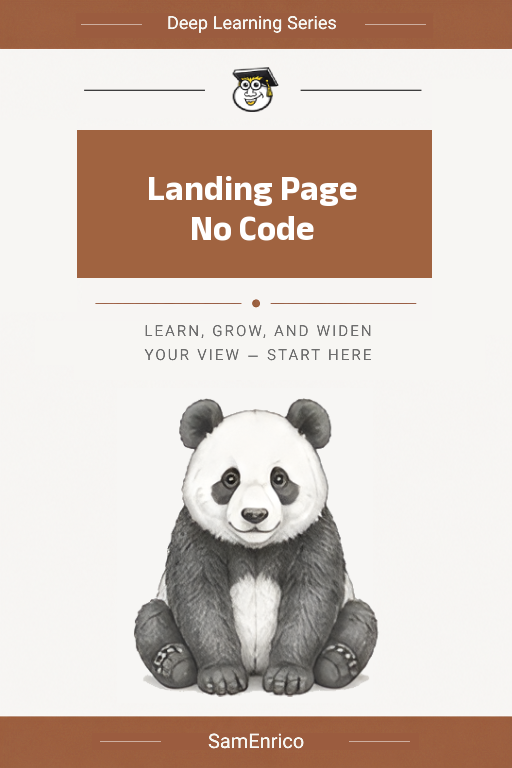
Non-FictionStartup GuideNo-Code ToolsWaitlist Building
Landing Page No Code eBook
Build a free Carrd or Google Sites page with a wai
Build a free Carrd or Google Sites page with a waitlist signup button in 2 hours.
Formats
Free sample
Chapter 1: The Learning Machine--–- It was 3:47 AM when Sarah deleted her entire MVP codebase for the third time that week. Six months of nights and weekends, two thousand dollars in hosting fees, and zero customers. She wasn't building a product. She was building a monument to her own fear.The cursor blinked on her empty terminal. Somewhere across the internet, her potential customers were complaining about the exact problem she was trying to solve.
They were posting in Reddit threads, tweeting their frustrations, joining Slack communities to commiserate. And she had never once asked them what they actually wanted.She had assumed. She had guessed. She had built.And now she was starting over.This book exists because Sarah's story is not an exception. It is the rule.
Every single day, thousands of founders, creators, and dreamers pour months of their lives into products that nobody asked for, nobody wants, and nobody will buy. They do it because the cultural myth of entrepreneurship says that real work means building something "tangible." That a landing page is somehow less legitimate than a codebase. That asking for permission is weakness.That myth is poison.The most valuable thing you can build is not a product. It is a learning machine. And the simplest, fastest, most powerful learning machine ever invented is a landing page with a waitlist button.The Great Inversion: Why Most Founders Have It Backwards Let me ask you a question that sounds obvious but is almost always answered incorrectly: What is your first job as a founder?If you said "build a great product," you are wrong.
If you said "raise money," you are even more wrong. If you said "hire a team," you have been reading too many tech blogs.Your first and only job is to learn what people actually want before you spend significant time or money building it.This is called the Great Inversion. Most founders believe the sequence looks like this:text Copy Download Idea → Build → Launch → Learn → Pivot But that sequence is a lie. Or more precisely, it is a luxury reserved for people with unlimited time and unlimited money. For the rest of us—the solo creators, the side-hustlers, the bootstrappers—the correct sequence looks like this:text Copy Download Idea → Learn → Build → Launch → Learn Again Notice the difference.
In the second sequence, learning happens before building. It happens in order to inform building. The product becomes the output of learning, not the input to it.A landing page with a waitlist button is how you learn. It is your research instrument. It is your hypothesis tester.
It is your canary in the coal mine.The False God of the MVPThe term "Minimum Viable Product" has been corrupted almost beyond recognition. When Eric Ries coined it in The Lean Startup, he meant something very specific: the smallest thing you can build to test a hypothesis and learn something about your customers.What has happened instead is that "MVP" has become an excuse for shipping broken, incomplete, embarrassing software while calling it "lean." Founders spend three months building something that barely works, launch it to a collective shrug, and then conclude that the market is the problem.But here is the truth that technology incubators will never tell you: An MVP is almost always too much, too late.By the time you have coded an MVP, you have already made hundreds of assumptions. You have assumed which features matter. You have assumed the pricing model. You have assumed the user interface.
You have assumed the onboarding flow. You have assumed the problem itself.And because you spent months building, you are now emotionally invested in those assumptions being correct. You will ignore data that contradicts them. You will rationalize poor adoption. You will pivot slowly, painfully, and expensively.The waitlist page inverts this entirely.
It makes almost no assumptions. It costs almost nothing. It takes almost no time. And it tells you, within days, whether there is enough demand to justify building anything at all.The Three Things a Waitlist Page Actually Tests A properly constructed waitlist page does not just collect emails. It runs three simultaneous experiments.Experiment One: Problem Validation Does anyone recognize the problem you are solving as their problem?This sounds trivial, but it is not.
Most founders build solutions to problems that do not exist, or that exist only for a tiny sliver of humanity. The waitlist page forces you to articulate the problem clearly and then measures whether anyone cares enough to give you their email address.An email address is not free. It is a small act of trust, a tiny investment of attention. When someone gives you their email, they are saying, "I am willing to hear more about this." That is not nothing. That is a signal.Experiment Two: Solution Interest Even if people recognize the problem, do they believe your specific solution will solve it?This is where the value proposition comes in (Chapter 2 will cover this in depth).
Your headline, your three bullet points, your "magic button" text—these are all hypotheses about what will convince someone that your solution is the right one.When people sign up, they are validating your solution hypothesis. When they do not, they are falsifying it. Both outcomes are valuable data.Experiment Three: Willingness to Wait This is the experiment that most founders forget entirely.Even if someone wants your solution, are they willing to wait for it? Or do they need it right now, this week, this month?A waitlist page with a queue position ("You are #234 in line") and a countdown timer ("Launching in 45 days") tests patience. If people sign up despite knowing they will have to wait, that is strong validation.
If they bounce when they see the wait, you have discovered that your solution is not urgent enough to command attention.This is not bad news. It is good news. It means you should either accelerate your timeline or pivot to a more urgent problem.Why "No Code" Changes Everything Before 2018, building a landing page required either learning HTML and CSS, hiring a developer, or tolerating the clunky templates of early website builders. The friction was high enough that many founders never got past the idea stage.That world is dead.Tools like Carrd, Google Sites, and dozens of others have reduced the cost of launching a waitlist page to near zero. Not just financial cost—cognitive cost, emotional cost, time cost.
You can go from an idea to a live, signup-collecting page in an afternoon. In the time it takes to watch a movie, you can run a market experiment.This is revolutionary because it changes the math of failure.In the old world, failure meant months of wasted time and thousands of dollars. That hurt. That discouraged. That made founders give up entirely.In the new world, failure means an afternoon and nineteen dollars.
That is not failure. That is tuition. You learned something valuable for the price of a pizza.The only tragedy now is not running the experiment at all.The 2-Hour Core Build (And What Comes After)Let me be very specific about what this book promises and what…
This is the end of the free sample. Get the eBook to keep going. Buy now
About this book
Details
- Author
- Waterman Porfirio
- Publisher
- SamEnrico
- Language
- English
- Genre
- Non-Fiction, Startup Guide, No-Code Tools, Waitlist Building
- Released
- 2026-06-01
- Pages (approx.)
- 136
- Available as
- eBook, Audiobook

Read better in the ZLOADR app
Your eBooks on your phone or tablet. Sign in with your SamEnrico account and start reading.
More by Waterman Porfirio
 Loneliness Crisis Hotline WorkWaterman Porfirio$11.99
 Coming Out ConversationsWaterman Porfirio$11.99
 Relationship Building for AccountantsWaterman Porfirio$11.99
 Senior Driving TransitionWaterman Porfirio$11.99
 Phone Lock Box TechniqueWaterman Porfirio$11.99
 Burnout Recovery for First RespondersWaterman Porfirio$11.99
 Dental Anxiety HypnosisWaterman Porfirio$11.99
 Antwerp Heist MotiveWaterman Porfirio$11.99
 The Ranger Station BlackoutWaterman Porfirio$11.99
 The Shadow Cabinet: How Dick Cheney Redefined PowerWaterman Porfirio$11.99
 The Scorched Earth: Saddam's Gamble and the Birth of Modern Asymmetric Warfare (1980-1988)Waterman Porfirio$11.99
 Black Flag: The Unseen Betrayal of the 1980 Moscow OlympicsWaterman Porfirio$11.99
You may also like
 Hong Kong Handover 1997Dunn Johnnie$11.99
 Zumba For Postnatal Recovery CourseNeal Christian$11.99
 Zumba for BeginnersLadner Nikia$11.99
 YouTube Comment Mining GuideHumes Pandora$12.99
 Worry Box MeditationCarlin Rudy$11.99
 Workplace Stress MeditationNguyen Lynn$11.99
 Workplace Stress and Sleep RepairHawley Ivory$11.99
 Workplace Perfectionism CureDelaney Jeffry$11.99
 Workplace Injustice Anger GuideWallen Isabelle$11.99
 Work Addiction and Burnout LinkGreenwood Ester$11.99
 Women in Yoga and WellnessBeattie Galina$11.99
 Women in Stand Up ComedyChun Evangeline$11.99