
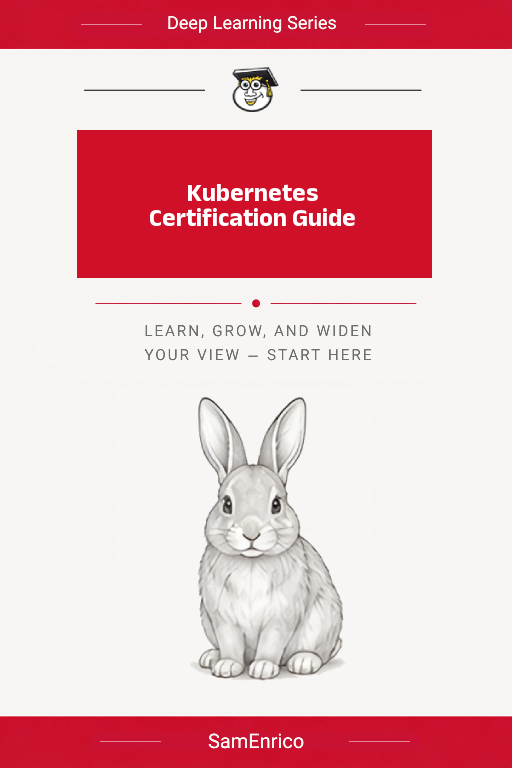
Kubernetes Certification Guide Audiobook
Earn CKA or CKAD for container orchestration roles
by Link Keren
Earn CKA or CKAD for container orchestration roles through online training.
Formats
Free sample
Chapter 1: From Containers to Clusters...--The first question every aspiring Kubernetes professional asks is deceptively simple: “Why do I need Kubernetes at all if I already know Docker?”It’s a fair question. You’ve mastered docker run, docker build, and docker-compose. Your applications run containers locally without issue. So why add a whole new platform with a steep learning curve, new terminology (pods, services, ingress, operators), and a certification exam that demands months of study?The answer lies in a single word: scale.This chapter answers the “why” before any “how.” By the final page, you will understand the evolutionary pressure that created Kubernetes, the Linux kernel features that make containers possible, and—most importantly—you will have a working multi-node cluster running on your own machine. No cloud credits required.
No complex installations. Just you, your terminal, and a live Kubernetes environment ready for the labs in subsequent chapters.But let’s start with a story.The Monolith That Couldn’t Imagine an e-commerce company in 2010. Its entire application—user authentication, product catalog, shopping cart, payment processing, order history, and shipping notifications—lives inside a single codebase deployed as one massive process. This is a monolithic architecture.For a small team, the monolith works beautifully. Deploy once, and everything runs.
But as the company grows, problems emerge.Slow deployments: Changing one line of code in the shipping module requires rebuilding and redeploying the entire application. A 45-minute deployment becomes the bottleneck for every feature.Scaling inefficiency: The payment module needs more CPU during holiday sales, but the monolith forces you to scale everything—including the rarely-used shipping status page.Single point of failure: A memory leak in the product catalog crashes the entire site. The whole company stops.Technology lock-in: Every team must use the same programming language, libraries, and framework. Innovation stalls.The solution, embraced by companies like Netflix, Amazon, and Uber, was microservices.Each module becomes its own small, independent service running in its own process. The authentication service communicates with the user profile service over HTTP.
The payment service calls the fraud detection service via g RPC. Each team owns a handful of services, deploys independently, and scales only what needs scaling.But microservices introduce a new problem: orchestration.The Orchestration Gap When you have twenty microservices, each running multiple copies (for redundancy), you need something to manage them. The questions multiply:Where does each service run? Which…
This is the end of the free sample. Get the Audiobook to keep going. Buy now
About this book
Details
- Author
- Link Keren
- Publisher
- SamEnrico
- Language
- English
- Genre
- Non-Fiction, Student's Shortcut, Kubernetes
- Released
- 2026-06-01
- Pages (approx.)
- 149
- Available as
- eBook, Audiobook

Listen in the VoxFlicks app
Audiobooks and audio dramas wherever you go. Sign in with your SamEnrico account and press play.
More by Link Keren
 Equipment Breakdown InsuranceLink Keren$11.99
 Metta for Creative Blocks CourseLink Keren$11.99
 Healing Loneliness Through PetsLink Keren$11.99
 Beginner Fitness PeriodizationLink Keren$11.99
 Universal Design Housing GuideLink Keren$11.99
 Frozen Echoes: The Last Days of the Terra Nova ExpeditionLink Keren$11.99
 The Alchemist and the Sultan: Ibn al-Nadim and the Ethics of KnowledgeLink Keren$11.99
 Understanding D-glycerate Dehydrogenase DeficiencyLink Keren$17.99
 Bankruptcy And CTA ComplianceLink Keren$12.99
 Virtual Assistant Service BusinessLink Keren$11.99