
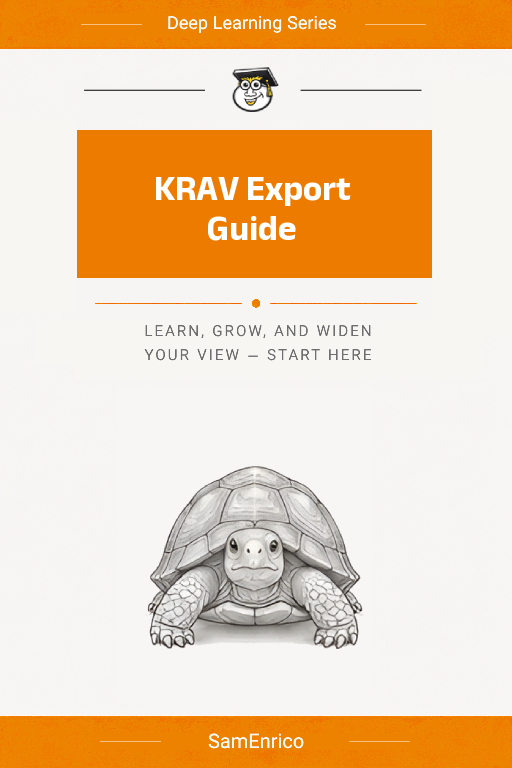
KRAV Export Guide eBook
Get KRAV organic certification for exports to Swed
Get KRAV organic certification for exports to Swedish and Scandinavian markets.
Formats
Free sample
Chapter 1: Beyond the Leaf--–- The first time Erik Sundström rejected an entire shipping container of organic quinoa, the Bolivian exporter didn't believe him. "But it has the EU Organic certificate," the exporter protested over a crackling satellite phone connection. "It's the same product we sell to Germany and France. What more do you want?"Erik, a procurement manager for a mid-sized Swedish organic wholesaler, had heard this question hundreds of times. He pulled the KRAV standards document from his desk drawer—a document thicker and more detailed than any EU Organic regulation his suppliers had ever seen.
"You gave me organic," he explained patiently. "But my customers demand KRAV. There's a difference, and until you understand what that difference is, your quinoa will sit at the port of Gothenburg."That container never made it to Swedish shelves. The exporter, who had spent €15,000 on shipping and customs clearance, eventually sold the quinoa at a loss to a conventional buyer in Poland. He had learned an expensive lesson: in Sweden, organic is not simply organic.This book exists because that story repeats itself dozens of times each year.
Exporters from six continents assume that the European Union's organic certification—a rigorous standard in its own right—opens every door in Europe. And for most of Europe, it does. Germany, France, Italy, Spain, the Netherlands—these markets accept EU Organic as the gold standard. But Scandinavia, and Sweden in particular, operates by a different set of rules.Sweden's KRAV certification adds layer upon layer of requirements that go far beyond what the EU mandates. Social responsibility audits for every worker in your supply chain.
Climate action targets that affect how you transport your goods. Animal welfare standards that make EU Organic look like conventional farming by comparison. A 98 percent consumer recognition rate that gives KRAV-labeled products a pricing power that standard organic simply cannot match.This chapter will answer the most important question you face as an exporter considering the Scandinavian market: Why should you pursue KRAV certification at all? What makes it worth the time, the expense, and the operational headache? And critically, what happens if you try to sell into Sweden without it?By the end of this chapter, you will understand not just the mechanics of KRAV certification but the market forces that make it indispensable for any serious exporter targeting Sweden, Norway, Denmark, or Finland.
You will see why the extra requirements—what this book calls the "KRAV Premium"—represent not a burden but an opportunity. And you will have a clear framework for deciding whether this path makes sense for your product, your supply chain, and your business goals.The Myth of the Single Organic Standard Let us begin by dispelling a myth that costs exporters millions of euros every year. The myth is this: organic certification is a single, globally harmonized standard that any country will accept.The reality is far messier. The European Union operates under Regulation (EU) 2018/848, a comprehensive set of rules governing organic production, labeling, and trade. But within the EU, individual member states and private organizations have layered their own additional requirements on top of this baseline.
Germany has Naturland and Bioland. France has Bio Cohérence. Switzerland has Bio Suisse. And Sweden has KRAV.These private labels are not merely marketing gimmicks. They are legally enforceable certification schemes with their own inspection protocols, their own standards documents, and their own consequences for non-compliance.
A product that carries only the EU Organic leaf is perfectly legal to sell anywhere in the European Union. But a product that carries the KRAV label—or that a Swedish retailer expects to carry the KRAV label—must meet KRAV's specific requirements, regardless of whether it also meets EU Organic standards.This distinction matters because Swedish consumers have been trained to look for the KRAV label. Not the EU leaf. Not a generic "organic" claim. The specific green-and-white KRAV mark.
According to KRAV's own market research, 98 percent of Swedish consumers recognize the label, and 84 percent trust it completely. By comparison, recognition of the standard EU Organic leaf hovers around 60 percent in Sweden, and trust levels are significantly lower.What this means in practical terms is that Swedish retailers—the Coops, the ICAs, the Axfoods of the world—do not treat EU Organic and KRAV as interchangeable. A product with only EU Organic certification may still find its way onto Swedish shelves, but it will compete in a different tier. It will sit next to conventional products, not next to KRAV-certified premium offerings. It will command a lower price, sometimes dramatically lower.
And it will not benefit from the marketing campaigns that Swedish retailers run around the KRAV label during peak shopping seasons.The exporter who understands this dynamic has a choice. Accept the lower margins and reduced visibility of standard EU Organic in Sweden. Or invest the time and resources to achieve KRAV certification and access the premium tier. This book exists to help you make the second choice successfully.The Three Pillars of KRAV's Extra Requirements To understand why KRAV matters, you must understand what KRAV adds beyond EU Organic. The KRAV standards rest on three pillars that go significantly beyond the baseline organic regulations.
Each pillar represents a set of verifiable requirements that your supply chain must meet. And each pillar creates a competitive advantage once you achieve compliance.Pillar One: Ecological Production Beyond the Baseline The first pillar is the most familiar to organic producers. KRAV requires compliance with EU Organic standards as a foundation. But then KRAV adds restrictions that the EU does not impose.Consider greenhouse production. EU Organic allows hydroponic and container-based growing systems under certain conditions.
KRAV generally requires permanent soil beds. The difference reflects a philosophical commitment to soil-based agriculture that the EU's more technocratic approach does not share. For a greenhouse operator in the Netherlands or Spain, this distinction can mean the difference between certification and rejection.Consider plant protection. EU Organic permits a range of naturally derived pesticides under specific conditions. KRAV permits a narrower subset, banning substances that the EU allows.
A fruit grower who has built their pest management strategy around spinosad—perfectly legal under EU Organic—will discover that KRAV prohibits it. The same applies to copper-based fungicides, which KRAV restricts more tightly than the EU.Consider seed sourcing. EU Organic requires organic seeds when available, but allows significant flexibility for producers to self-declare unavailability. KRAV requires organic seeds in almost all circumstances, with exemptions granted only through the Swedish Board of Agriculture—a process that takes months, not days. A grain exporter who assumes they can substitute conventional seed for an unavailable organic variety will find their application rejected.These differences may seem technical, even nitpicky.
But they reflect a fundamental reality: KRAV is not simply "EU Organic plus extra paperwork." It is a distinct ecological standard with its own logic, its own history, and its own enforcement mechanisms. Exporters who treat it as an afterthought—who assume that their EU Organic certification automatically qualifies them for KRAV—are setting themselves up for the same disappointment as the Bolivian quinoa exporter.Pillar Two: Social Responsibility Across the Supply Chain The second pillar is where KRAV…
This is the end of the free sample. Get the eBook to keep going. Buy now
About this book
Details
- Author
- Sargent Kathaleen
- Publisher
- SamEnrico
- Language
- English
- Genre
- Non-Fiction, Business Brief, KRAV
- Released
- 2026-06-01
- Pages (approx.)
- 160
- Available as
- eBook, Audiobook

Read better in the ZLOADR app
Your eBooks on your phone or tablet. Sign in with your SamEnrico account and start reading.
More by Sargent Kathaleen
 Overcoming Loneliness After Pet LossSargent Kathaleen$11.99
 Arthritis Parent Care GuideSargent Kathaleen$11.99
 Sleep Apnea Emotional BluntingSargent Kathaleen$11.99
 Menopause And Nail HealthSargent Kathaleen$11.99
 Teaching Improv GuideSargent Kathaleen$11.99
 From Immigrant to CEOSargent Kathaleen$11.99
 Mindful Bedtime RoutineSargent Kathaleen$11.99
 Fear of Failure for High AchieversSargent Kathaleen$11.99
 The Golden Hops of the Rhine: How German Brewers Shaped the WorldSargent Kathaleen$11.99
 The Elephant Kings: Jayavarman VII's War for Khmer SurvivalSargent Kathaleen$11.99
 How to Produce Ladder CartsSargent Kathaleen$11.99
 Service Providers Guide to Children's TransportationSargent Kathaleen$11.99