
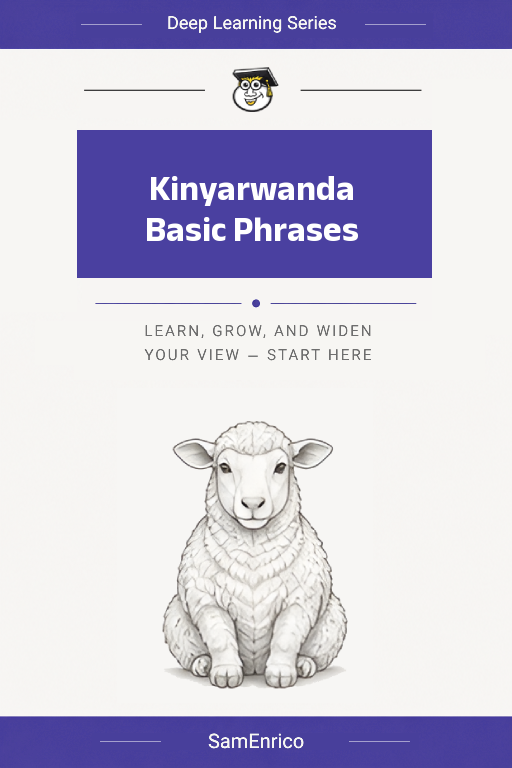
Kinyarwanda Basic Phrases eBook
Learns essential Kinyarwanda greetings and phrases
Learns essential Kinyarwanda greetings and phrases for daily interaction with locals, building cultural connection during your studies.
Formats
Free sample
Chapter 1: The Silent Doorway--You have just landed at Kigali International Airport. The air is cool and clean – unusually clean for an African capital, you notice, because Rwanda banned plastic bags years before most of the world followed. You collect your bag, walk through the glass doors, and see your host family waiting. An elderly woman in a colorful ikitenge dress smiles. A man in his forties nods.
A teenager glances at her phone. You have studied your phrasebook on the plane. You know one word: Muraho.You say it. Muraho. The man’s face transforms.
Not just polite recognition – a genuine, surprised smile. He steps forward, extends his hand, and begins speaking rapidly in Kinyarwanda. You understand nothing except that your single word has opened a door you didn’t even know was closed.Now imagine the opposite. You walk through those same doors, avoid eye contact, mumble a quiet “hello” in English, and keep walking. You will still be picked up.
You will still be driven to your guesthouse. But something will be missing. The warmth will be delayed. You will have failed the first and most sacred test of Rwandan social life: the greeting.Why This Chapter Exists This book could have started with the alphabet. It could have started with verb conjugation tables or a list of nouns.
Most language books do that, and most language learners quit by page twenty. This chapter starts here – with a story about a doorway and a single word – because Kinyarwanda is not first a grammar. It is first a relationship.Before you learn how to say “I am going to the market,” you must learn why a Rwandan will judge your entire character by how you enter a room. Before you memorize numbers, you must understand that skipping a greeting is not a minor oversight. It is, in rural areas especially, interpreted as an act of hostility.
Silence upon entry is louder than any insult.This chapter establishes the foundational philosophy of this book: communication is the door, but effort is the key. You will not become fluent by reading these pages. No book can do that. But you will become effective. You will learn to greet with confidence, to read the social room, and to understand why your first word in Kinyarwanda matters more than your hundredth.The Three Tiers of Connection Before we learn a single new phrase, you need a framework.
Throughout this book, every phrase will be color-coded into one of three tiers. Think of these as social distances – like rings around a target. The closer you get to the center, the more intimate and heartfelt the language becomes.🔵 Tier One: Polite (Strangers, Elders, Officials)This is your default setting when you are unsure. Use polite language with:Anyone significantly older than you Government officials, police, bank tellers Professors, doctors, religious leaders Shopkeepers you have never met The parent of a friend (unless they invite informality)Polite language is characterized by plural forms. In Kinyarwanda, addressing someone with the plural pronoun (like the French vous or German Sie) shows respect.
You will also use slightly longer greeting sequences and more formal vocabulary.🟢 Tier Two: Friendly (Classmates, Neighbors, Regulars)This is the tier for people you see often but do not know intimately. Friendly language includes:Fellow students at university The shopkeeper you buy from every week Neighbors who wave when you pass Coworkers at your job or volunteer placement People your own age in casual settings Friendly language uses singular pronouns and shorter greeting sequences. It assumes a basic level of comfort but not deep emotional intimacy.🟡 Tier Three: Heartfelt (Close Friends, Host Family, Mentors)This is the innermost circle. Use heartfelt language only with people who have welcomed you into their personal lives. This includes:Your host mother or father (after trust is established)Close friends you have known for months A mentor or teacher who has become a confidant Romantic partners Heartfelt language includes expressions of emotion, vulnerability (Ndarokomeje – I am trying), and physical affection in words.
Using heartfelt language too early is not offensive – it is just strange, like hugging a stranger. Let the relationship dictate the tier.The Sacred Word: Muraho Let us return to that airport doorway. The word you said was Muraho (moo-RAH-ho). It is your most important word. Memorize it.
Practice it. Dream it.Muraho serves two functions:Formal greeting – When speaking to an elder, a professor, or a group of people Plural greeting – When addressing two or more people simultaneously The singular, friendly version is Uraho (oo-RAH-ho), which we will cover in Chapter 3. For now, use Muraho for everyone. It is never wrong to be too polite. It is often wrong to be too casual.Pronunciation Breakdown Let us dissect this word so you sound like someone who tried, not someone who guessed.Mu – Like the “moo” in “moo” (a cow sound), but shorter.
Do not draw it out.ra – A tapped ‘r’, similar to the Spanish ‘r’ in pero. Your tongue flicks the roof of your mouth once. It is not the English ‘r’ (back of the throat) and not the rolled ‘r’ of Italian.ho – Like the “ho” in “ho-ho-ho,” but softer. The ‘h’ is gentle, almost a whisper.Stress falls on the second syllable: mu-RA-ho. Not MU-ra-ho (too flat).
Not mu-ra-HO (too sing-song). mu-RA-ho.Practice this five times aloud before reading further. Say it like you mean it. Say it like you are opening a door.When to Say Muraho The easy answer is “always.” But let us be specific.Say Muraho when:Entering a shop (before you look at products)Boarding a taxi-bus (to the driver and passengers collectively)Entering a classroom (to the professor and students)Passing an elder on the street (even if you do not stop)Answering your phone (before identifying yourself)Beginning any conversation with anyone over thirty Do NOT say Muraho when:Someone is actively grieving or crying (a nod and silence is better)You are interrupting a private conversation (wait for a pause)It is very late at night (a soft Muraho is fine; a loud one is not)When in doubt, say it. I have watched foreign students enter a room silently, sit down, and feel the temperature drop ten degrees.
Then I have watched them realize their mistake, stand up, say Muraho to everyone individually, and watch the room thaw. It is that powerful.The Response: Ni Meza After you say Muraho, the other person will likely respond with Muraho in return. Then they will ask a question. You will not understand the question yet. That is fine.
You have one safe response that works in almost every situation for the first week of your stay.Ni meza (nee MEH-zah) means “I am well” or “It is good.”This phrase is your shield and your bridge. When someone asks Amakuru? (what’s the news?), you say Ni meza. When they ask Uraho? (are you well?), you say Ni meza.
When they ask Warakose? (did you sleep?), you say Ni meza – even if you did not sleep. The expected answer is always positive. Rwandans do not typically use greetings as therapy sessions. Save your struggles for…
This is the end of the free sample. Get the eBook to keep going. Buy now
About this book
Details
- Author
- Skinner Taren
- Publisher
- SamEnrico
- Language
- English
- Genre
- Non-Fiction, Student's Shortcut, Local Language
- Released
- 2026-05-30
- Pages (approx.)
- 149
- Available as
- eBook, Audiobook

Read better in the ZLOADR app
Your eBooks on your phone or tablet. Sign in with your SamEnrico account and start reading.
More by Skinner Taren
 Elder Respect Culture GuideSkinner Taren$11.99
 Walking Meditation For TeensSkinner Taren$11.99
 D Delegation EisenhowerSkinner Taren$11.99
 The Osteoarthritis Diet HandbookSkinner Taren$11.99
 Eisenhower Matrix For ProcrastinatorsSkinner Taren$11.99
 The Siege of the Tower: Scotland Yard's Secret Rescue in Victorian LondonSkinner Taren$11.99
 Mechanic ElectricianSkinner Taren$11.99
 UAE Zero Rated VAT GuideSkinner Taren$12.99
 Understanding Richieri–Costa–guion–Almeida Acrofacial DysostosisSkinner Taren$17.99
 How to Become a Plug WirerSkinner Taren$11.99