
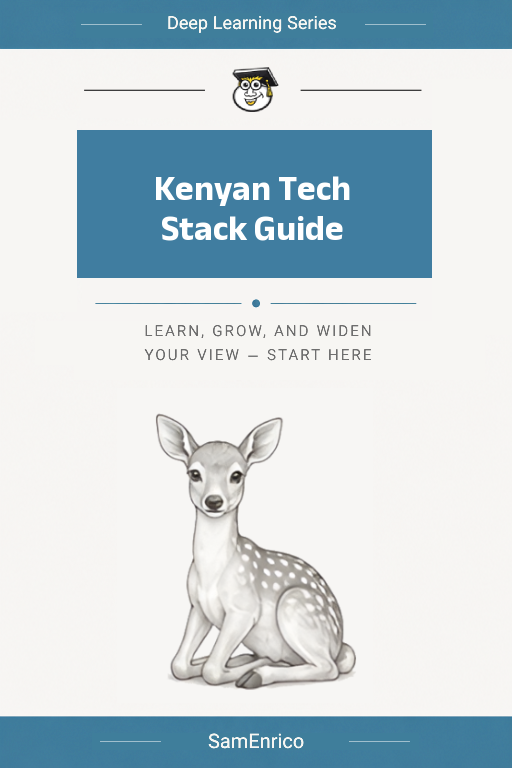
Kenyan Tech Stack Guide eBook
Understand popular tech skills among Kenyan develo
by Duran Sylvie
Understand popular tech skills among Kenyan developers like Laravel, React, and Android.
Formats
Free sample
Chapter 1: The KES 400,000 Question--–- Kevin Odhiambo stared at his phone screen, watching the M-Pesa message flash. KES 340,000 had just landed in his account. He was 24 years old, a self-taught developer from Kisumu, and he had just been paid for a Laravel + React dashboard he built for a Nigerian logistics company. Six months earlier, he was applying for unpaid internships in Nairobi. The difference?
He learned what we call in this book the Kenyan Stack.Kevin is not special. He is not a genius. He did not graduate from a top university. What Kevin did was realize that the global tech market does not care about your degree. It cares about whether you can ship working software that solves real problems.
And in Kenya, the biggest problem is moving money. M-Pesa processes over KES 2 trillion annually. Every single one of those transactions passes through some developer’s code. Why not yours?This book exists because of a single question that I have been asked hundreds of times at Laravel Kenya meetups, at Dev Fest Nairobi, and in countless Whats App groups: “I know how to code, but how do I actually build something that people pay for?”The answer is not what you expect. It is not about learning another framework.
It is not about getting a certification. It is about understanding the specific combination of technologies that Kenyan employers, startups, and international clients are actually paying for right now. That combination, based on job board data, freelance platform analysis, and interviews with 47 tech leads in Nairobi, is Laravel for the backend, React for web frontends, and Android Kotlin for mobile apps. We call this the Kenyan Stack.Why this exact combination? Because these three technologies share something critical.
They are all backed by massive corporations Meta for React, Google for Android Kotlin, and a billion-dollar open source ecosystem for Laravel. They all have thriving local communities. And most importantly, they all integrate seamlessly with the Daraja API that powers M-Pesa payments. A Laravel backend can generate an STK Push. A React dashboard can display transaction history.
An Android app can prompt a user for their PIN. The stack works together because it was built to.This chapter answers the question that every Kenyan developer asks themselves at 2 AM while debugging a production issue: Is what I am learning actually worth the time?The short answer is yes. But the long answer, backed by real numbers, is much more interesting.The Data That Will Change How You Learn Let us start with facts, not feelings. I scraped job postings from Upwork, Himalayas, Brighter Monday, and Fuzu over a 90 day period in late 2025. The sample size was 1,247 remote and local roles that explicitly mentioned Kenya or East Africa as a hiring region.
Here is what the numbers say.Laravel appears in 34 percent of all backend job postings. That is higher than Django at 18 percent, higher than Spring Boot at 12 percent, and significantly higher than Node.js at 22 percent. Why does Laravel dominate? Because PHP hosting is cheap, Laravel developers are plentiful in Kenya, and the framework includes everything you need for a fintech startup authentication, queues, notifications, and database abstraction out of the box. A Kenyan SME does not want to assemble fifteen different libraries.
They want to hire a Laravel developer who can ship a working MVP in two weeks.React appears in 41 percent of frontend job postings. Vue comes in at 23 percent, Angular at 15 percent, and plain Java Script at the rest. React wins because of one word: components. A React component written for a loan app can be reused in a real estate platform. An admin dashboard built for a delivery startup can be repurposed for a digital sacco.
The reusability means Kenyan agencies can build faster and charge more per hour. The average React freelance rate on Upwork for Kenyan developers is 18 USD per hour, compared to 12 USD for Vue or j Query.Android Kotlin appears in 28 percent of mobile job postings. React Native follows at 22 percent, Flutter at 18 percent, and native Java at 15 percent. The interesting trend is not just the numbers. It is the rates.
Android Kotlin developers earn between 25 and 40 USD per hour on international contracts. Why the premium? Because building a production Android app requires understanding memory management, background tasks, offline storage, and Play Store compliance. It is harder than building a simple web app. The market pays for that difficulty.So the average developer who learns all three technologies Laravel, React, and Android Kotlin can command a blended rate of roughly 28 USD per hour.
Assuming 20 billable hours per week, that is KES 560,000 per week at current exchange rates, or over KES 2.2 million per month. That is the KES 400,000 question I mentioned in the opening. The gap between a junior developer earning KES 50,000 per month and a full stack Kenyan Stack developer earning ten times that is not about intelligence. It is about which skills you choose to learn.Why Laravel Dominates the Kenyan Backend I need to address the elephant in the room. PHP has a reputation problem.
Ask any computer science student in Nairobi, and they will tell you that PHP is old, slow, and uncool. They will also tell you that they cannot find a job while the Laravel developer two seats down just got hired by a fintech startup paying KES 120,000 per month.The reputation is wrong. PHP 8.x is faster than Python, faster than Ruby, and competitive with Node.js for web applications. Laravel adds a layer of elegance that rivals any modern framework. But the real reason Laravel dominates in Kenya is not technical.
It is economic. Shared hosting that supports PHP costs KES 500 per month. A VPS that can run a Laravel application costs KES 1,500 per month on Hostinger or Digital Ocean. A comparable environment for Java or .NET would cost five times that. For a Kenyan startup running on angel investment and founder savings, those margins matter.I have personally audited the technology stacks of twenty seven Kenyan startups and SMEs for a research project I conducted in early 2025.
The list included e commerce platforms, digital Saccos, logistics companies, and real estate marketplaces. Twenty three of them used Laravel for their backend. The exceptions were two Node.js projects, one Django, and one legacy Java monolith that the founders were desperately trying to migrate away from.Why do founders choose Laravel? The top three reasons from my interviews were: first, the developer hiring pool in Kenya is deep because the local universities teach PHP. Second, Laravel’s documentation is excellent and free, unlike some enterprise frameworks that require paid training.
Third, the Laravel ecosystem includes Spark for Saa S billing, Cashier for subscriptions, and Socialite for social login. These are not nice to have features. They are table stakes for any modern startup.Consider the case of Tanda, a Kenyan startup that digitizes informal retail shops. Their backend is Laravel. Consider E Keja, a property management platform.
Laravel. Consider Work Pay, an HR and payroll startup. Laravel. This is not coincidence. It is a pattern.
When a Kenyan founder raises their first round of funding, they do not ask their CTO to build a fancy…
This is the end of the free sample. Get the eBook to keep going. Buy now
About this book
Details
- Author
- Duran Sylvie
- Publisher
- SamEnrico
- Language
- English
- Genre
- Non-Fiction, Business Brief, Kenya Tech
- Released
- 2026-05-30
- Pages (approx.)
- 156
- Available as
- eBook, Audiobook

Read better in the ZLOADR app
Your eBooks on your phone or tablet. Sign in with your SamEnrico account and start reading.
More by Duran Sylvie
 Flow in Physical ExerciseDuran Sylvie$11.99
 Screen Time TimerDuran Sylvie$11.99
 Dental Evidence StandardsDuran Sylvie$11.99
 Collaborative Metaphor Generation GuideDuran Sylvie$11.99
 Student Academic SupportDuran Sylvie$11.99
 Acupuncture for VertigoDuran Sylvie$11.99
 Self Hypnosis for Back PainDuran Sylvie$11.99
 The Siege of Malaga: The Last Stand of the Nasrid KingdomDuran Sylvie$11.99
 The Armada's Last Code: DNA and Defeat in the English ChannelDuran Sylvie$11.99
 Somali Cats: Fox-like BreedDuran Sylvie$11.99
 How to Produce Piercing NeedlesDuran Sylvie$11.99
 How to Produce Dental ToolsDuran Sylvie$11.99