
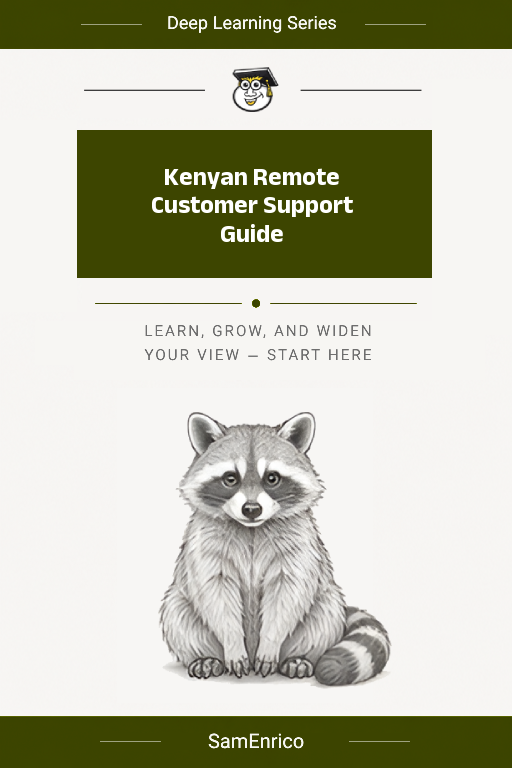
Non-FictionBusiness BriefCustomer Operations
Kenyan Remote Customer Support Guide eBook
Build 24/7 support teams in Kenya leveraging neutr
Build 24/7 support teams in Kenya leveraging neutral accents, written English skills, and growing call center infrastructure.
Formats
Free sample
Chapter 1: The Silicon Savannah--–- In 2005, a man named Nick Nesbitt made a bet that most business leaders dismissed as foolish. He opened Ken Call, Kenya's first dedicated BPO center, in a country with unreliable electricity, expensive internet, and a workforce that had never handled a customer service call for a foreign client. His competitors in India and the Philippines laughed. Within three years, Ken Call was handling millions of calls for British Airways, American hotels, and European telecoms. The bet paid off because Nesbitt understood something his critics missed: raw talent and cultural adaptability matter more than infrastructure, and infrastructure can be built, but a work ethic rooted in Harambee cannot be imported.This chapter is the foundation of everything that follows.
Before you recruit a single agent, purchase a single headset, or sign a single contract, you must understand the landscape you are entering. Kenya is not India. It is not the Philippines. It is not a cheaper clone of any existing BPO hub. It is a unique ecosystem with its own history, its own strengths, and its own traps for the uninformed.
This chapter provides the historical context, the current state of the industry, the key players, and the critical decision framework that will determine whether your operation thrives or collapses.The Birth of an Industry: From Ken Call to a Nation of Agents The story of Kenyan BPO begins in the mid-2000s, but the seeds were planted a decade earlier. In 1995, Kenya had less than one telephone line per hundred people. The internet was a luxury reserved for universities and multinational corporations. The concept of a "call center" was alien. Two things changed the trajectory.
First, the liberalization of the telecommunications sector in 1999 broke the monopoly of the state-owned Kenya Post and Telecommunications Corporation. Private investment flooded in, led by Safaricom (founded in 1997) and followed by Airtel (then Kencell) in 2000. Within five years, mobile phone penetration jumped from near zero to over 15 percent. Second, the undersea fiber optic cables—TEAMS, EASSy, and SEACOM—landed in Mombasa between 2009 and 2012, slashing bandwidth costs by more than 90 percent overnight. A connection that had cost 5,000permegabitpermonthdroppedto5,000 per megabit per month dropped to 5,000permegabitpermonthdroppedto200.
Suddenly, Kenya was connected to the global internet backbone at speeds competitive with any Asian or European hub.Ken Call was the pioneer, but it was not alone for long. By 2010, a handful of firms had emerged: Horizon Contact Centre (founded 2006), Technobrain (2007), and later CCI Global (2014). Each brought different strengths. Horizon specialized in high-volume, low-complexity campaigns like telecom customer care. Technobrain focused on technical support for software companies.
CCI Global, a South African giant that entered Kenya in 2014, built a 3,500-seat facility in Tatu City—the largest BPO campus in East Africa. Today, the Kenyan BPO sector employs approximately 50,000 people directly, with another 100,000 in adjacent roles like logistics, training, and quality assurance. The industry generates over $500 million annually in export revenue, a figure that has grown at 15 percent year-over-year since 2018.But the numbers tell only part of the story. The real transformation is qualitative. In 2005, a Kenyan agent was a novelty—a curiosity that Western customers found exotic.
In 2024, that same agent is indistinguishable in skill from a counterpart in Kansas City or Manchester, except for two advantages we will explore throughout this book: a lower cost base and a work ethic that outperforms almost every other global hub.The Silicon Savannah: Why Tech Startups Are Your Best Training Ground You cannot understand Kenyan customer support without understanding the "Silicon Savannah." The term was coined in 2012 to describe Nairobi's emergence as a technology hub, but the phenomenon predates the label. M-Pesa, the mobile money platform launched by Safaricom in 2007, is the single most important piece of technology infrastructure in Kenya. It is not merely a payment system; it is a way of life. More than 90 percent of Kenyan adults use M-Pesa to send money, pay bills, take loans, and buy goods. The platform handles over $300 billion in transactions annually.
And here is the critical insight for this book: every single Kenyan agent you will hire has used M-Pesa. They have navigated its menus, resolved its errors, and explained it to their own parents. That experience is not replicable in any training program.The tech ecosystem that grew around M-Pesa includes incubators like i Hub (founded 2010), accelerators like Nailab (2011), and venture capital firms like Novastar (2014). These organizations have produced thousands of startups in fintech, logistics, healthtech, and edtech. Companies like Twiga Foods (B2B logistics), Sendy (last-mile delivery), and Koko Networks (clean energy) have raised hundreds of millions of dollars and built sophisticated customer support operations to serve their users.
The agents who staffed those support desks have since moved on to other firms, bringing with them experience in live chat, CRM systems, data analytics, and omnichannel routing. They are not raw recruits. They are battle-tested veterans of the African tech boom.What does this mean for you? It means you are not building a team from scratch. You are tapping into an existing pool of agents who already understand how to handle payment disputes, troubleshoot app errors, and de-escalate angry customers.
The training you provide will be refinement, not basic education. This is the single biggest difference between Kenya and the Philippines, where the BPO industry developed in isolation from a domestic tech sector. In Kenya, customer support is not an export industry—it is a domestic necessity that happens to have export potential.The Harambee Work Ethic: More Than a Slogan Every book about Kenya mentions Harambee. Most of them treat it as a footnote. That is a mistake.
Harambee means "pulling together" in Swahili. It originated as a slogan of national unity under Kenya's first president, Jomo Kenyatta, but it predates independence. For generations, Kenyan communities used Harambee to organize collective labor for building schools, digging wells, and funding burials. It is a cultural script that says: the group succeeds when every individual contributes, and every individual is responsible for the group.In a customer support context, Harambee manifests in measurable ways. First, peer accountability: Kenyan agents rarely let a teammate fail silently.
If an agent is struggling with a technical issue or a difficult customer, another agent will step in to help without being asked. This is not formal escalation—it is spontaneous collaboration. Second, low absenteeism: Kenyan agents show up. The cultural cost of letting down your team is higher than the economic cost of losing a day's pay. Third, high effort: Harambee discourages minimum viable work.
Agents take pride in resolving the issue completely, not just hitting their handle time target.But there is a shadow side to Harambee, and ignoring it will cost you dearly. The same collectivist culture that produces loyalty also produces burnout. Agents who feel responsible for their teammates will take on extra work. They will skip breaks. They will stay late.
They will absorb customer abuse without escalating. And then, without warning, they will resign. The attrition paradox—low turnover under good management, high turnover under poor management—is the central challenge of managing Kenyan teams. We will spend Chapter 9 on this topic. For now, understand that Harambee is a double-edged sword.
It gives you a workforce that cares deeply. That caring must be managed carefully or it will consume itself.The Corporate…
This is the end of the free sample. Get the eBook to keep going. Buy now
About this book
Details
- Author
- Moniz Brittney
- Publisher
- SamEnrico
- Language
- English
- Genre
- Non-Fiction, Business Brief, Customer Operations
- Released
- 2026-06-01
- Pages (approx.)
- 140
- Available as
- eBook, Audiobook

Read better in the ZLOADR app
Your eBooks on your phone or tablet. Sign in with your SamEnrico account and start reading.
More by Moniz Brittney
 Murdoch Sunday Times AcquisitionMoniz Brittney$11.99
 Humming to Calm Nerves ProtocolMoniz Brittney$11.99
 Prioritization for Political CampaignsMoniz Brittney$11.99
 Emotion Function Awareness WorkbookMoniz Brittney$11.99
 Mindfulness for the Angry ParentMoniz Brittney$11.99
 The Pink Panther Caper: The Heist That Shocked the Art WorldMoniz Brittney$11.99
 The Lost Caravan: A Castaway’s Odyssey in the Karakum DesertMoniz Brittney$11.99
 Zoo Animal Party PerformerMoniz Brittney$11.99
 Understanding Bone Marrow FailureMoniz Brittney$17.99
 Amazon Vine Reviewer ProgramMoniz Brittney$12.99
 10 Ways to Use Crabs (Recipe Book)Moniz Brittney$11.99
You may also like
 Hong Kong Handover 1997Dunn Johnnie$11.99
 Zumba For Postnatal Recovery CourseNeal Christian$11.99
 Zumba for BeginnersLadner Nikia$11.99
 YouTube Comment Mining GuideHumes Pandora$12.99
 Worry Box MeditationCarlin Rudy$11.99
 Workplace Stress MeditationNguyen Lynn$11.99
 Workplace Stress and Sleep RepairHawley Ivory$11.99
 Workplace Perfectionism CureDelaney Jeffry$11.99
 Workplace Injustice Anger GuideWallen Isabelle$11.99
 Work Addiction and Burnout LinkGreenwood Ester$11.99
 Women in Yoga and WellnessBeattie Galina$11.99
 Women in Stand Up ComedyChun Evangeline$11.99