
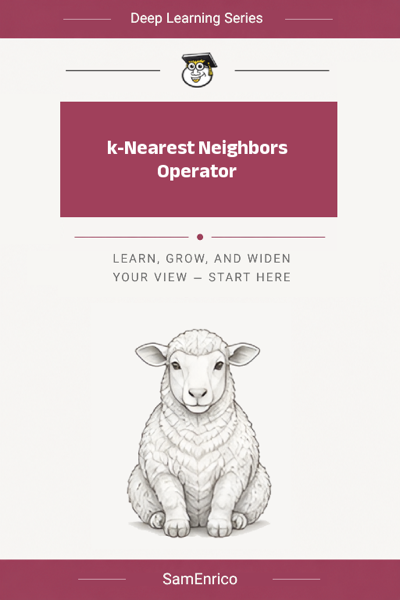
Non-FictionInformativeEducational
k-Nearest Neighbors Operator
A Coursebook on k-Nearest Neighbors Operator
A Coursebook on k-Nearest Neighbors Operator
Formats
About this book
Free sample
Chapter 1: The Lazy Genius--–- In the autumn of 1951, two researchers at the University of Texas set in motion an idea that would defy the dominant statistical tradition of their era. Evelyn Fix and Joseph Hodges were not trying to be revolutionary. They were simply grappling with a practical problem: how to classify new observations when your dataset is small, messy, and refuses to fit the neat parametric assumptions that textbooks demanded. Their solution—the nearest neighbor rule—was almost embarrassingly simple. Yet within sixteen years, Thomas Cover and Peter Hart would prove that this lazy, almost naive approach carries a remarkable guarantee: its error rate asymptotically approaches at most twice the optimal possible error.
No complex optimization. No iterative training. Just stored examples and a ruler.This is the paradox of the k-Nearest Neighbors Operator. It is simultaneously the simplest algorithm in the machine learning canon and one of the most geometrically profound. It requires no training phase, yet it can approximate arbitrary decision boundaries.
It stores every single data point, making it memory-hungry, yet it offers perfect interpretability. It has only one real hyperparameter—the number of neighbors, kkk—yet mastering that single dial demands a deep understanding of bias, variance, and the very geometry of high-dimensional spaces.This book is called k-Nearest Neighbors Operator: A Comprehensive Coursebook for a reason. The word "operator" is deliberate. In mathematics, an operator is a mapping from one space to another—a function that takes an input and produces an output according to a fixed rule. For KNN, that rule is deceptively simple: given a query point, find the kkk closest stored examples and let them vote (or average) to produce your answer.
Yet this operator sits at the intersection of non-parametric statistics, computational geometry, and information theory. Understanding it fully means understanding not just how to run the code, but why it works, when it fails, and how to rescue it from its own weaknesses.In this opening chapter, we will establish the philosophical and historical foundations of the KNN operator. We will define what it means to be a "lazy…
This is the end of the free sample. Get the eBook to keep going. Buy now
Contents
- Chapter 1
- Chapter 2
- Chapter 3
- Chapter 4
- Chapter 5
- Chapter 6
- Chapter 7
- Chapter 8
- Chapter 9
- Chapter 10
- Chapter 11
- Chapter 12
Details
- Author
- Nesmith Rebekah
- Publisher
- SamEnrico
- Language
- English
- Genre
- Non-Fiction, Informative, Educational
- Released
- 2026-05-04
- Pages (approx.)
- 152
- Available as
- eBook, Audiobook

Read better in the ZLOADR app
Your eBooks on your phone or tablet. Sign in with your SamEnrico account and start reading.
More by Nesmith Rebekah
 The Degrees' Long WaitNesmith Rebekah$11.99
 Life Review And Meaning CourseNesmith Rebekah$11.99
 Imposter Syndrome Dismantling GuideNesmith Rebekah$11.99
 Peruvian Business GuideNesmith Rebekah$11.99
 The Power Nap Optimization GuideNesmith Rebekah$11.99
 The Vanishing of Farah Fawcett: Egypt's Unsolved Starlet Mystery (1979)Nesmith Rebekah$11.99
 Operations Role Promotion CaseNesmith Rebekah$12.99
 FlutterFlow MVP Development GuideNesmith Rebekah$12.99
 Understanding Van Der Woude Syndrome 2Nesmith Rebekah$17.99
 How to Become a GathererNesmith Rebekah$11.99
You may also like
 Hong Kong Handover 1997Dunn Johnnie$11.99
 Zumba For Postnatal Recovery CourseNeal Christian$11.99
 Zumba for BeginnersLadner Nikia$11.99
 YouTube Comment Mining GuideHumes Pandora$12.99
 Worry Box MeditationCarlin Rudy$11.99
 Workplace Stress MeditationNguyen Lynn$11.99
 Workplace Stress and Sleep RepairHawley Ivory$11.99
 Workplace Perfectionism CureDelaney Jeffry$11.99
 Workplace Injustice Anger GuideWallen Isabelle$11.99
 Work Addiction and Burnout LinkGreenwood Ester$11.99
 Women in Yoga and WellnessBeattie Galina$11.99
 Women in Stand Up ComedyChun Evangeline$11.99