
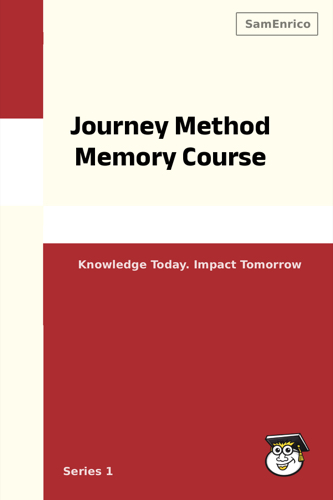
Journey Method Memory Course eBook
Walk through mental routes storing items at each s
by Love Marion
Walk through mental routes storing items at each stop for sequential recall.
Formats
Free sample
Chapter 1: The Forgetting Epidemic--–- You have already forgotten most of what you learned yesterday. Not because you are lazy, not because you are getting older, and certainly not because your brain is broken. You have forgotten because you were never taught how memory actually works. Schools drill you on what to remember—dates, formulas, vocabulary—but never the mechanics of remembering itself. It is like being handed a pile of bricks and told to build a cathedral without ever seeing a blueprint.This chapter will reveal why your memory seems to fail at the worst possible moments, why the solution has been hiding in plain sight for over two thousand years, and how a simple shift in approach can turn your mind from a sieve into a steel trap.
By the end of this chapter, you will understand the single greatest error that most people make when trying to remember anything—and you will never make it again.The Morning You Lost Your Keys (And Your Confidence)Let us start with a confession. Yesterday morning, you probably misplaced something. Your phone, your keys, a grocery list, the name of a song stuck in your head. Perhaps you walked into a room and forgot why. Maybe you met someone new and within three seconds could not recall their name.
These moments feel small individually, but they accumulate into a quiet, persistent fear: that your memory is declining, that you are not as sharp as you used to be, that something is wrong with you.Nothing is wrong with you. What you experienced is not a failure of memory. It is a failure of method.Consider this: you can likely describe the layout of your childhood home with stunning detail. The creaky floorboard in the hallway, the height of the kitchen counter, the view from your bedroom window. You have not lived there in years, perhaps decades, yet those spatial memories remain vivid.
Meanwhile, you cannot remember the three bullet points from a meeting that ended two hours ago. The difference is not time. The difference is that one set of information was embedded in space and the other was not.Your brain is not a computer. It does not store files in neat alphabetical folders. It evolved over millions of years to prioritize one thing above all else: survival in a physical world.
Our ancestors did not need to remember quadratic equations. They needed to remember where the berry bushes were, which path led to water, and which cave contained a predator. Those who could navigate space survived. Those who could not, did not.The Multi-Billion Dollar Lie The self-help industry has sold you a fantasy. The fantasy is that memory is about willpower, repetition, and discipline.
Just study harder. Just focus more. Just repeat the information fifty times. The underlying message is that if you cannot remember, you did not try hard enough.This is not merely unhelpful. It is false.Research in cognitive psychology has demonstrated repeatedly that rote repetition—simply reading information over and over—is one of the least effective ways to encode memory.
Yet it remains the dominant strategy used by students, professionals, and lifelong learners around the world. We have been taught to hammer information into our brains like nails into wood, wondering why the wood keeps splitting.The truth is that your brain is already a memory machine of extraordinary power. It just speaks a different language than the one you have been using. Your brain’s native language is spatial, sensory, and emotional. It understands locations, images, movements, sounds, smells, and feelings.
It does not understand abstract lists, disconnected facts, or passive reading. When you try to memorize by reading a list ten times, you are speaking French to a Mandarin speaker. You are both trying, but no communication is happening.The Man Who Remembered Everything (Until He Didn't)In 2006, a science journalist named Joshua Foer attended the USA Memory Championship expecting to write a humorous exposé of eccentric competitors. Instead, he became fascinated by what they could do—memorizing the order of shuffled decks of cards in under two minutes, recalling hundreds of random digits after a single hearing, learning entire poems in minutes rather than hours.Foer assumed these competitors had genetically superior memories. He was wrong.
When he subjected himself to brain scans and cognitive testing, his results were entirely average. What the champions possessed was not better hardware. They had better software. They had learned a technique that anyone can learn, and within one year of practice, Foer went from average to winning the USA Memory Championship himself.The technique he learned was not a pill, not a supplement, not a brain-training app. It was a method over two thousand years old, first documented in ancient Greece, used by Roman orators, medieval scholars, and modern memory athletes alike.
It requires no equipment, no special intelligence, and no genetic luck. It requires only that you understand one fundamental principle: your brain remembers space better than almost anything else.The technique is called the Method of Loci, the Memory Palace, or as we will call it throughout this book, the Journey Method. And it works because it speaks your brain’s native language.Why Most Memory Training Fails Before we build your first journey, we must clear away three common misconceptions that sabotage most people’s attempts to improve their memory.Misconception One: Memory is a single thing. Most people speak of memory as if it were one faculty, like eyesight or hearing. In reality, your brain has multiple memory systems that operate independently.
The journey method primarily engages spatial memory and episodic memory (memory for events and sequences). It does not directly engage semantic memory (memory for facts) or procedural memory (memory for skills). Understanding this distinction matters because it explains why you can remember how to ride a bicycle (procedural) but forget a phone number (verbal) — different systems, different rules.Misconception Two: Forgetting is failure. Your brain is designed to forget. Forgetting is not a bug; it is a feature.
Without forgetting, you would be overwhelmed by irrelevant information—the color of every car you passed on your commute, the pattern of every carpet you have ever seen, the exact wording of every advertisement you have ever ignored. Forgetting is your brain’s garbage disposal, clearing out what your conscious mind has not marked as important. The journey method works by marking information as spatially important, bypassing the usual forgetting filters.Misconception Three: Repetition creates memory. Repetition alone is weak. What creates strong memory is elaboration—connecting new information to what you already know, embedding it in rich sensory detail, and giving it a spatial home.
A fact repeated ten times in isolation might last a day. A fact placed on a single vivid journey stop can last a lifetime. The difference is not effort. The difference is architecture.The Science of Spatial Memory Let us get specific about why the journey method is not just a clever trick but a neurologically optimized system.In your brain, the hippocampus acts as the central switchboard for memory formation. Nearby, the entorhinal cortex contains grid cells and place cells—neurons that fire specifically…
This is the end of the free sample. Get the eBook to keep going. Buy now
About this book
Details
- Author
- Love Marion
- Publisher
- SamEnrico
- Language
- English
- Genre
- Non-Fiction, Self-Help
- Released
- 2026-06-09
- Pages (approx.)
- 111
- Available as
- eBook, Audiobook

Read better in the ZLOADR app
Your eBooks on your phone or tablet. Sign in with your SamEnrico account and start reading.
More by Love Marion
 Stress And Immune SuppressionLove Marion$11.99
 UAE Consumer Luxury GuideLove Marion$11.99
 Workplace Trauma TriggersLove Marion$11.99
 Influence for Remote Teams GuideLove Marion$11.99
 The Grand Illusion: How a Forgotten Hotel Empire Built the Modern HoneymoonLove Marion$11.99
 Understanding Overgrowth Syndrome Type FryerLove Marion$17.99
 How to Start a Packaging Machinery Manufacturing BusinessLove Marion$11.99
 Art TherapistLove Marion$11.99
 Facebook Ad Placement Strategy GuideLove Marion$12.99
 Elon Musk Leadership GuideLove Marion$12.99
You may also like
 Hong Kong Handover 1997Dunn Johnnie$11.99
 Zumba For Postnatal Recovery CourseNeal Christian$11.99
 Zumba for BeginnersLadner Nikia$11.99
 YouTube Comment Mining GuideHumes Pandora$12.99
 Worry Box MeditationCarlin Rudy$11.99
 Workplace Stress MeditationNguyen Lynn$11.99
 Workplace Stress and Sleep RepairHawley Ivory$11.99
 Workplace Perfectionism CureDelaney Jeffry$11.99
 Workplace Injustice Anger GuideWallen Isabelle$11.99
 Work Addiction and Burnout LinkGreenwood Ester$11.99
 Women in Yoga and WellnessBeattie Galina$11.99
 Women in Stand Up ComedyChun Evangeline$11.99