
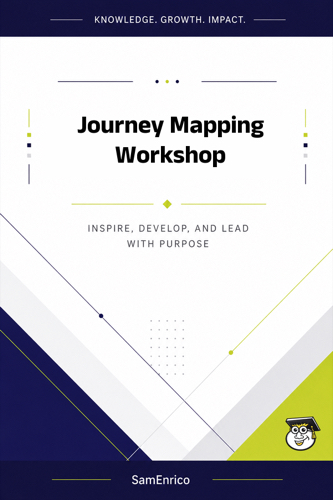
Non-FictionSelf-HelpJourney Mapping
Journey Mapping Workshop eBook
Visualizes the user's end-to-end experience to ide
by Cheung Ami
Visualizes the user's end-to-end experience to identify pain points.
Formats
Free sample
Chapter 1: The Living Map...--–- When Jennifer, a seasoned product manager at a mid-sized Saa S company, facilitated her first journey mapping workshop, she did everything by the book. She reserved the conference room, bought four colors of sticky notes, printed customer personas, and even baked brownies. Twelve enthusiastic colleagues from sales, support, and engineering spent four intense hours sketching a beautiful, detailed map of their new user onboarding experience. They laughed, they argued, they achieved consensus. Jennifer took a photo, cleaned the whiteboard, and sent the polished PDF to her boss.
The map was gorgeous. And absolutely nothing changed.Three months later, a different team ran a different kind of workshop. They had no brownies. Their map was ugly, handwritten, and pinned to a corkboard in a hallway. But every Tuesday at 10:00 AM, five people gathered around that corkboard for exactly fifteen minutes.
They checked the previous week’s customer support tickets against the map’s red zones. They moved one sticky note from “pain point” to “fixed.” They added two new pain points that had emerged. The map evolved weekly. Within six months, their onboarding abandonment rate dropped by 34 percent.The first workshop produced an artifact. The second produced a living map.
This book exists to help you run the second kind.The 66 Percent Problem Let us begin with a statistic that should unsettle you. According to research published in the Journal of Customer Experience Management, approximately two out of every three journey maps created inside organizations fail to drive any measurable change. Not “some change.” Any change. These maps are drawn, presented, applauded, and then quietly retired to a network drive or a forgotten Confluence page, where they join the corporate graveyard of good intentions.Why does this happen? The most common answer—and the one most facilitators want to hear—is that the data was bad, or the stakeholders were difficult, or leadership didn’t care.
These are convenient fictions. The real answer is both simpler and more uncomfortable: most journey maps are built as final deliverables rather than starting points. They are treated like paintings to be hung, not like software to be deployed.Consider the difference between a map and a GPS. A paper map is beautiful. It can be framed.
It shows you every road in the county. But it is static. It does not know about the accident on Highway 101 or the new stoplight installed yesterday or the fact that your favorite coffee shop moved across the street. A GPS, by contrast, is alive. It updates.
It learns your habits. It recalculates when you miss a turn. The most successful journey maps function like GPS systems for customer experience: they are never truly finished, they incorporate new data continuously, and they guide real-time decisions rather than documenting past assumptions.This book will teach you how to build living maps. But before we get to the mechanics of sticky notes and facilitation scripts, we must rewire how you think about the entire endeavor. A workshop is not an event.
It is the beginning of a rhythm.The Three Non-Negotiable Outcomes Every successful journey mapping workshop produces three specific outcomes. If you walk out of a session without all three, you have not run a workshop. You have run a very expensive, very collaborative meeting that will produce nothing but a PDF.The first outcome is Empathy. This is the most misunderstood word in the customer experience vocabulary. Empathy is not “feeling bad for the customer.” It is not a sentiment.
Empathy is a structural understanding of the gap between what a customer expects and what your organization delivers. When a workshop builds genuine empathy, participants stop saying “the customer should have read the FAQ” and start saying “why did we bury the answer on page four?” Empathy is measurable: you know you have it when your engineers volunteer to sit through support calls and your marketers stop using the phrase “user error.”The second outcome is Alignment. Before a journey mapping workshop, most organizations operate like a rowing team where every rower faces a different direction. Sales thinks the problem is product. Product thinks the problem is support.
Support thinks the problem is onboarding. Onboarding thinks the problem is sales. Each department has its own version of the truth, its own metrics, and its own grievances. A successful workshop does not resolve these tensions—that would be naive—but it surfaces them in a shared visual language. When the map is on the wall, everyone can point to the same red zone and say, “That is where we are losing customers.” Alignment is not agreement.
Alignment is shared visibility.The third outcome is Prioritization (and pay close attention here, because this will be distinguished from solution prioritization later in the book). Most teams emerge from mapping sessions with a list of thirty or forty problems. This is useless. You cannot fix forty problems. You cannot even remember forty problems.
Prioritization means ruthlessly identifying the top three pain points that, if addressed, would produce the greatest improvement in customer experience. Note the phrasing: pain points, not solutions. At this stage, you are not deciding how to fix anything. You are deciding what to fix. The “how” comes in Chapter 8.
Mistaking problem prioritization for solution prioritization is the fastest way to leave a workshop with a list of unactionable, unowned, unmeasured ideas.Artifact vs. Living Map: A Diagnostic Before we go further, diagnose your organization’s current relationship with journey mapping. Answer these five questions honestly:One. Does your organization have a journey map that is more than six months old and has never been updated?Two. Was the last journey map created by a single person or a single department (usually marketing or UX) rather than a cross-functional team?Three.
Does your leadership team reference customer journey data in weekly reviews, or is it a “quarterly presentation” topic?Four. When something breaks in the customer experience (a form stops working, a support script confuses customers), does anyone consult the journey map to understand the ripple effects?Five. Do you have a named person responsible for keeping the journey map current?If you answered “yes” to questions one or two, you have an artifact. If you answered “no” to questions three, four, or five, you have an artifact. If you answered “yes” to all five questions, you already have a living map and this chapter is a refresher.
For everyone else, the remainder of this book will show you how to transform your practice.A living map has five characteristics that distinguish it from a static artifact. First, it is cross-functionally owned. No single department “approves” the map. It belongs to the entire organization, which means everyone has the right—and the obligation—to challenge and update it. Second, it is data-informed, not data-driven.
A living map respects quantitative metrics (CSAT, NPS, drop-off rates) but does not worship them. The numbers tell you where to look; the workshop tells you why. Third, it is temporally alive. It has a last-updated timestamp and a next-review calendar invite. Fourth, it is connected to action.
Every pain point on a living map has an associated DRI (Directly Responsible Individual) and a target resolution date. Fifth…
This is the end of the free sample. Get the eBook to keep going. Buy now
About this book
Details
- Author
- Cheung Ami
- Publisher
- SamEnrico
- Language
- English
- Genre
- Non-Fiction, Self-Help, Journey Mapping
- Released
- 2026-06-07
- Pages (approx.)
- 150
- Available as
- eBook, Audiobook

Read better in the ZLOADR app
Your eBooks on your phone or tablet. Sign in with your SamEnrico account and start reading.
More by Cheung Ami
 Grandparent Death DreamsCheung Ami$11.99
 Postpartum Anemia Recovery GuideCheung Ami$11.99
 A Priority Daily Action GuideCheung Ami$11.99
 The Confident Speaker HandbookCheung Ami$11.99
 Sam Sheppard Polygraph FightCheung Ami$11.99
 Bipolar and RoutineCheung Ami$11.99
 Dream Incubation for ScientistsCheung Ami$11.99
 Wings Over the Lost Kingdoms: The Aerial Cartography Revolution of Southeast AsiaCheung Ami$11.99
 The Great Airline Heist: The 2018 Cathay Pacific Data BreachCheung Ami$11.99
 The Secret Service Tapes: Reagan’s Assassination Attempt Cover-UpCheung Ami$11.99
 The Dancer's Guide to Progressive Double TwoCheung Ami$11.99
 Marketplace Vendor AcquisitionCheung Ami$11.99
You may also like
 Hong Kong Handover 1997Dunn Johnnie$11.99
 Zumba For Postnatal Recovery CourseNeal Christian$11.99
 Zumba for BeginnersLadner Nikia$11.99
 YouTube Comment Mining GuideHumes Pandora$12.99
 Worry Box MeditationCarlin Rudy$11.99
 Workplace Stress MeditationNguyen Lynn$11.99
 Workplace Stress and Sleep RepairHawley Ivory$11.99
 Workplace Perfectionism CureDelaney Jeffry$11.99
 Workplace Injustice Anger GuideWallen Isabelle$11.99
 Work Addiction and Burnout LinkGreenwood Ester$11.99
 Women in Yoga and WellnessBeattie Galina$11.99
 Women in Stand Up ComedyChun Evangeline$11.99