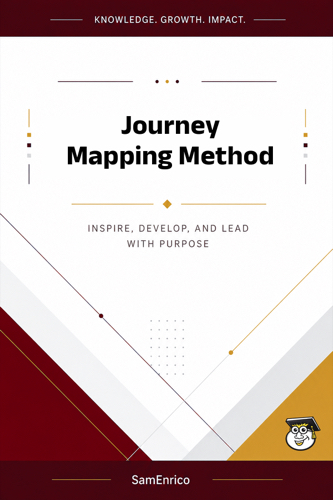
Journey Mapping Method eBook
Visualize user experience across touchpoints.
by Armenta Else
Visualize user experience across touchpoints.
Formats
Free sample
Chapter 1: The $80,000 Poster--“Presenting our comprehensive customer journey map,” Maya said, clicking to the final slide. The boardroom at Nimbus Technologies fell silent. She had spent six months and $80,000 on research, workshops, and design hours. The map was beautiful—a twelve-foot digital rendering with color-coded phases, detailed personas, and a perfectly curved emotional timeline. She had printed a poster version for the wall outside her office.The CEO, a sixty-two-year-old former sales executive named Richard, leaned forward.
He studied the map for twenty seconds. Then he asked a question that would haunt Maya for the next year of her professional life.“This is gorgeous,” Richard said. “What do I do with it?”The CFO, seated to Richard’s left, added the killing stroke: “We spent eighty thousand dollars. What’s the return?”Maya opened her mouth. Nothing came out.
She had prepared for questions about methodology, sample size, statistical significance, and persona validation. She had not prepared for What do I do with it? Because the honest answer was devastating: she didn’t know.She had followed every best practice. She had read the books, attended the workshops, and hired the consultants. She had interviewed thirty-seven customers, synthesized four hundred sticky notes, and facilitated three full-day mapping sessions.
The map was technically flawless. And yet, in the moment of truth, she could not tell the CEO what action to take, which problem to fix first, or how much money any of it would save.The meeting ended with polite applause and a directive: “Great work, Maya. Let’s circle back next quarter.”She walked back to her office, past the beautiful poster on the wall, and closed the door. That night, she sent a text to a mentor: I think I just failed at my own job.The 67% Mortality Rate What happened to Maya is not unusual. It is, in fact, the most common outcome of journey mapping in corporate environments.
After synthesizing data from over two thousand organizations, researcher and practitioner Jim Tincher arrived at a startling conclusion: sixty-seven percent of journey maps fail to drive any measurable change. They become posters. They become slide decks. They become artifacts of wasted effort. They do not become action.Let me be explicit about what I mean by failure.
Throughout this book, when I say a journey map has failed, I am using a very specific definition: A failed journey map is one that does not lead to at least one implemented change within ninety days of its completion.Not “inspired a conversation.” Not “raised awareness.” Not “helped the team empathize.” Those are all valuable outcomes, but they are not change. A change means something is different in the world: a feature is rebuilt, a policy is reversed, a touchpoint is added or removed, a handoff between departments is redesigned. If your map does not produce at least one of those outcomes within three months, you have failed by this definition.This is a high bar. It is meant to be. Journey mapping is not an academic exercise.
It is not a design deliverable. It is a business intervention. And like any business intervention, it must be judged by its results, not its beauty.Maya’s map failed by this definition. Six months later, when she finally resigned from Nimbus, the poster was still on the wall. No changes had been implemented.
The $80,000 had purchased nothing but a very expensive decoration.The Four Maps (And Why You’re Using the Wrong One)Before we can understand why maps fail, we must understand what a map actually is. Most practitioners use the term “journey map” to describe several distinct tools. This is like using the word “vehicle” to describe a bicycle, a sedan, a cargo ship, and a rocket. They all transport something, but they are not interchangeable.Here are the four maps you need to distinguish. Misidentifying which map you need is the first and most common failure mode.User Journey Map A User Journey Map focuses exclusively on digital screen flows.
It documents what a user clicks, taps, or types within a software application. The unit of analysis is the interface. The output is typically a sequence of wireframes or screen captures connected by arrows showing navigation paths.When to use it: You are redesigning a specific feature or flow within an existing digital product. You need to understand where users drop off, where they hesitate, and where they make errors.When not to use it: The problem involves phone calls, in-person interactions, physical spaces, or anything that happens outside the screen. A user journey map will actively mislead you about these channels because it omits them entirely.Customer Journey Map A Customer Journey Map covers the end-to-end lifecycle of the relationship between a person and an organization.
It includes digital, physical, human, and social channels. The unit of analysis is the customer’s experience across time, not the interface. The output is typically a matrix with phases on the horizontal axis and data layers (actions, thoughts, emotions, pain points, opportunities) on the vertical axis.When to use it: You are trying to understand the complete relationship, from first awareness through ongoing retention and advocacy. You care about how channels interact and where handoffs fail.When not to use it: You only care about a single digital feature. A full customer journey map will overwhelm you with irrelevant data.Service Blueprint A Service Blueprint maps what happens backstage to enable the customer’s experience.
It shows the people, processes, and systems that support each frontstage touchpoint. The unit of analysis is the organization’s operations. The output is a layered diagram with a “line of interaction” (customer actions), a “line of visibility” (what the customer can see), and a “line of internal interaction” (backstage handoffs).When to use it: You have already identified a problem on a customer journey map, and now you need to understand why that problem is happening. The cause is almost always backstage.When not to use it: You have not yet mapped the customer journey. A service blueprint without a customer journey is like diagnosing a disease without examining the patient.Spatial Map A Spatial Map overlays experience data onto physical environments: floor plans, building layouts, public spaces.
The unit of analysis is place. The output is a diagram showing how emotions, pain points, and opportunities vary across physical locations. (We will explore spatial mapping in depth in Chapter 7.)When to use it: The experience happens in a physical space: a hospital, a retail store, an airport, an office. Chronological maps break down in these environments because users do not move linearly through time; they move linearly through space, and space can be revisited.When not to use it: The entire experience happens on a screen or over the phone. A spatial map adds no value to a purely digital journey.Maya’s mistake at Nimbus was using a customer journey map when she needed a service blueprint.
She documented the user’s pain points beautifully, but she never mapped the internal processes causing those pain points. The CEO asked “What do I do with it?” because the map showed symptoms without revealing causes. Causes live…
This is the end of the free sample. Get the eBook to keep going. Buy now
About this book
Details
- Author
- Armenta Else
- Publisher
- SamEnrico
- Language
- English
- Genre
- Non-Fiction, Self-Help, Journey Mapping
- Released
- 2026-06-06
- Pages (approx.)
- 155
- Available as
- eBook, Audiobook

Read better in the ZLOADR app
Your eBooks on your phone or tablet. Sign in with your SamEnrico account and start reading.
More by Armenta Else
 Creative Confidence for IntrovertsArmenta Else$11.99
 Accounting Job Loss RecoveryArmenta Else$11.99
 Thunberg Family Climate SupportArmenta Else$11.99
 Come From Away GanderArmenta Else$11.99
 Giving Difficult FeedbackArmenta Else$11.99
 Asking for Raise ConfidenceArmenta Else$11.99
 Remote Employee RecognitionArmenta Else$11.99
 The Lost Treasures of Zanzibar: The 1983 Stone Town Art HeistArmenta Else$11.99
 The Last Empress of the SunArmenta Else$11.99
 A Collector's Handbook to the Sunbeam Mk IiisArmenta Else$11.99
 Multi City Pop Up LogisticsArmenta Else$12.99
 Business Phone Number Mobile App GuideArmenta Else$12.99