
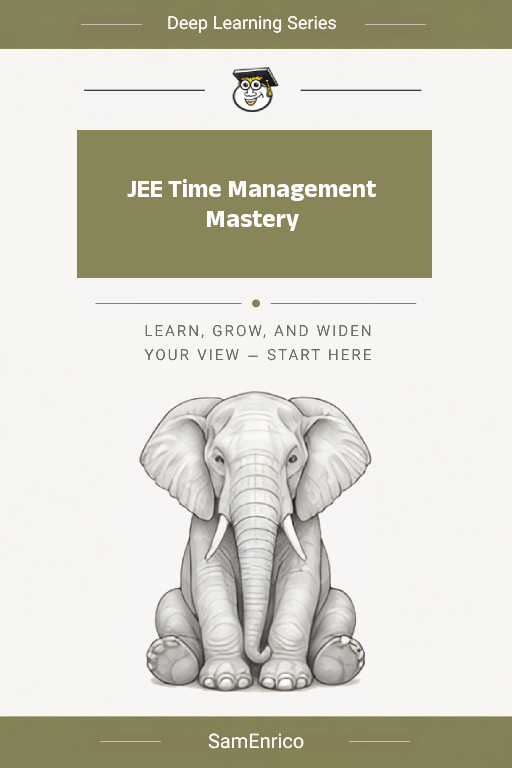
JEE Time Management Mastery eBook
Allocate minutes per question and practice speed w
Allocate minutes per question and practice speed without sacrificing accuracy.
Formats
Free sample
Chapter 1: The 1.8-Minute Wall--–- Arjun was not a lazy student. In fact, he was the opposite. Over six months of dedicated preparation, he had solved over 3,000 problems across Physics, Chemistry, and Mathematics. He had attended every coaching class, completed every module, and never missed a Sunday mock test. His parents had spent lakhs on tuition.
His teachers assured him he had the potential for a top 5,000 rank. And yet, his mock scores had flatlined stubbornly between 140 and 160 for three consecutive months.–- The problem was not his intelligence. The problem was not his knowledge. The problem, which Arjun could not see because he was looking everywhere else, was his relationship with time. He treated every question as if it deserved the same attention.
He started each mock with enthusiasm, spent eight minutes on a difficult Calculus problem in the first fifteen minutes, got it wrong anyway, and then panicked through the remaining 165 minutes. By the time he reached the Chemistry section—which he actually knew well—he was mentally exhausted and making careless errors on questions he could have solved in his sleep.–- Arjun’s story is not unique. It is the story of thousands of JEE aspirants who mistake effort for strategy. This book exists because of a single, uncomfortable truth that most coaching institutes will not tell you: you cannot practice your way out of a broken time management system. Practice without a quantitative framework merely reinforces existing habits.
If your current habits are wasting minutes, more practice will only make you faster at wasting minutes.–- This chapter demolishes the vague, well-intentioned advice of “try to be faster” and replaces it with a mathematical, measurable, and actionable time budget. By the time you finish reading, you will know exactly how many seconds you can afford to spend on every question in the JEE Main exam. You will understand why top rankers think differently about time. And you will have your first concrete tool: a personalized Time Budget Card that will sit on your study desk and guide every practice session, every mock test, and ultimately, your exam day.The Myth of “Fast Enough”–- Most JEE aspirants believe that speed comes with practice. Solve enough problems, the logic goes, and eventually your brain will just work faster.
This is only half true. Speed does come with practice—but only targeted practice that respects a specific time budget. Without a numerical target, “practicing speed” is like telling a runner to “run faster” without ever using a stopwatch. The runner might improve slightly through sheer will, but they will never approach their true potential.–- Consider two students: Riya and Karan. Both have identical conceptual knowledge.
Both solve the same number of practice problems. But Riya has a Time Budget Card taped to her desk that tells her: “Trivial questions: 30 seconds. Easy questions: 60 seconds. Medium questions: 90 seconds. Hard questions: 180 seconds.” Karan has no such budget; he simply tries to “be fast.”–- When Riya encounters a medium-difficulty Physics numerical, she gives herself 90 seconds.
If she cannot solve it within that window, she marks it for review and moves on. She knows exactly when to stop. Karan, by contrast, has no internal stopwatch. He might spend three minutes on a medium question, then five minutes on the next hard question, then rush through three easy questions that deserved more attention. By the end of the exam, Karan has answered the same number of questions as Riya, but his accuracy on easy questions is lower because he rushed them, and his time on hard questions was largely wasted.–- The difference between Riya and Karan is not talent.
It is a quantitative time budget. This chapter gives you Riya’s system.Reverse-Engineering a Top Rank: The Mathematics of 250/300–- Let us begin with the destination and work backward. The JEE Main exam consists of 300 marks. A score of 250 marks—which typically corresponds to a rank under 5,000 in a competitive year—requires approximately 83% of the available marks. But because of negative marking, the relationship between attempted questions and final score is not linear.–- Here is the exact mathematics.
Each correct answer gives you +4 marks. Each incorrect answer gives you -1 mark. Unanswered questions give you 0. If your target is 250 marks, you need a combination of correct and incorrect answers that sums to 250. Let us assume a realistic accuracy of 85% on attempted questions—a benchmark achieved by serious aspirants after structured preparation.–- If you attempt 230 questions at 85% accuracy, you will have approximately 196 correct answers and 34 incorrect answers.
Your score will be (196 × 4) - (34 × 1) = 784 - 34 = 750 out of a possible 300? Wait. That calculation is wrong because 196 correct answers at 4 marks each is 784 marks, but the exam only has 300 total marks. This reveals an important point: the JEE Main has 75 questions (25 per subject) worth 4 marks each, for a total of 300 marks. So 196 correct answers is impossible because there are only 75 questions.–- Let us correct the mathematics.
The JEE Main has 75 questions total. Each correct answer is +4 marks, each incorrect is -1. If you answer all 75 questions with 85% accuracy, you will have approximately 64 correct and 11 incorrect. Your score would be (64 × 4) - (11 × 1) = 256 - 11 = 245 marks. That is very close to the 250 target.
To reach 250, you would need approximately 66 correct and 9 incorrect: (66 × 4) - (9 × 1) = 264 - 9 = 255 marks.–- Therefore, a top rank requires answering approximately 66-70 questions correctly out of 75, with very few incorrect answers. This means you can afford to leave 5-9 questions unanswered, but you cannot afford many negative marks. The implication for time management is profound: you must spend enough time on each question to ensure accuracy, but not so much time that you cannot attempt enough questions.–- Now let us calculate the average time per attempted question. The exam lasts 180 minutes (10,800 seconds). If you attempt 70 questions, your average time per question is 10,800 ÷ 70 ≈ 154 seconds, or approximately 2.6 minutes per question.
But this average is misleading because it assumes you spend the same time on every question. In reality, you will spend far less time on easy questions and far more time on hard questions.–- This is why a variable time budget is essential. You cannot afford to spend 2.6 minutes on every question. You must spend 30-60 seconds on trivial and easy questions, 90 seconds on medium questions, and up to 180 seconds on hard questions. If you do the math, a typical paper might have 20 trivial/easy questions (30-60 seconds each = 10-20 minutes), 30 medium questions (90 seconds each = 45 minutes), and 15 hard questions (180 seconds each = 45 minutes).
The total comes to 100-110 minutes, leaving 70-80 minutes for revision, checking, and strategic guessing.–- The exact numbers will vary by exam, but the principle is universal: you need a per-question time budget that varies by difficulty.The Unified Difficulty Taxonomy (Your North Star)–- Throughout this book, we will use a consistent, four-level difficulty classification. This is not arbitrary; it is derived from analyzing thousands of JEE Main questions and timing how long top performers take to solve each type. Commit this taxonomy to memory. It is your north star.–- Trivial (30 seconds): These questions require pure recall or a single, obvious step. Examples include Inorganic Chemistry facts directly from NCERT (“What is the color of copper sulfate solution?”), a direct formula application…
This is the end of the free sample. Get the eBook to keep going. Buy now
About this book
Details
- Author
- Gilbert Rachel
- Publisher
- SamEnrico
- Language
- English
- Genre
- Non-Fiction, Student's Shortcut
- Released
- 2026-06-01
- Pages (approx.)
- 142
- Available as
- eBook, Audiobook

Read better in the ZLOADR app
Your eBooks on your phone or tablet. Sign in with your SamEnrico account and start reading.
More by Gilbert Rachel
 Tennis Elbow Prevention GuideGilbert Rachel$11.99
 Metta For Environmental GriefGilbert Rachel$11.99
 Blocked Mergers CasebookGilbert Rachel$11.99
 The Stress Physiology WorkbookGilbert Rachel$11.99
 The Anger LogGilbert Rachel$11.99
 Indigo Planters AbusesGilbert Rachel$11.99
 Anxious Parent Child ImpactGilbert Rachel$11.99
 Reactive Devaluation GuideGilbert Rachel$11.99
 The Last Flight of the Iron PhoenixGilbert Rachel$11.99
 The Angels of Bastogne: Surgeons Under Fire in the ArdennesGilbert Rachel$11.99
 The Bitcoin Bubble: When Digital Dreams Turned to GoldGilbert Rachel$11.99
 Growing LophomyrtusGilbert Rachel$11.99
You may also like
 Hong Kong Handover 1997Dunn Johnnie$11.99
 Zumba For Postnatal Recovery CourseNeal Christian$11.99
 Zumba for BeginnersLadner Nikia$11.99
 YouTube Comment Mining GuideHumes Pandora$12.99
 Worry Box MeditationCarlin Rudy$11.99
 Workplace Stress MeditationNguyen Lynn$11.99
 Workplace Stress and Sleep RepairHawley Ivory$11.99
 Workplace Perfectionism CureDelaney Jeffry$11.99
 Workplace Injustice Anger GuideWallen Isabelle$11.99
 Work Addiction and Burnout LinkGreenwood Ester$11.99
 Women in Yoga and WellnessBeattie Galina$11.99
 Women in Stand Up ComedyChun Evangeline$11.99