
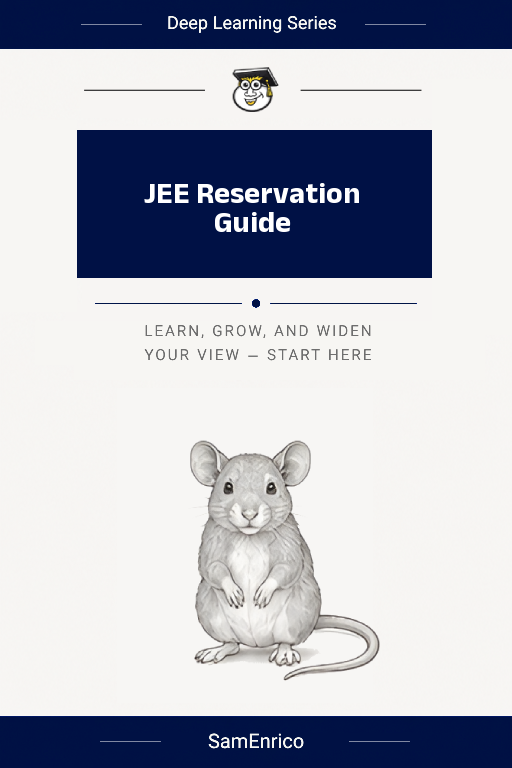
JEE Reservation Guide
Understand OBC, SC, ST, EWS, and PWD quota benefit
by Norris Shawn
Understand OBC, SC, ST, EWS, and PWD quota benefits and how to claim category correctly for JEE.
Formats
About this book
Free sample
Chapter 1: The 50% Lie...–- Every year, nearly fifteen thousand reserved-category students lose their legitimate seat in the JEE counselling process. Not because they scored poorly. Not because they lacked talent. But because they believed a myth. The myth that reservation cannot exceed 50%.
The myth that a certificate from last year is still valid. The myth that any caste certificate works as long as the name matches. This chapter dismantles those myths at the foundation. Before you fill a single form, before you approach a tehsildar, before you calculate your parents' income, you must understand one thing: reservation is not a single slab of 50%. It is a layered, overlapping, mathematically precise system.
And if you misunderstand the layers, you will lose your seat to someone who understood them better.The Most Dangerous Number in Indian Education Walk into any coaching class conversation, any parent-teacher meeting, any Telegram group for JEE aspirants, and you will hear the same statement repeated with absolute certainty: "Reservation can never exceed 50 percent. The Supreme Court said so."This statement is not entirely false. But it is dangerously incomplete.The Indra Sawhney judgment of 1992 indeed established that reservation should not exceed 50% of total seats under normal circumstances. The Supreme Court was concerned about creating a situation where reserved categories become a majority, potentially defeating the purpose of merit-based competition. However, the same judgment explicitly carved out exceptions for technical and practical reasons.
Educational institutions, particularly engineering colleges with multiple overlapping quotas, are one of those exceptions.Here is what the 50% ceiling actually means. It applies to vertical reservation considered in isolation. Vertical reservation means the separate quotas for SC, ST, OBC-NCL, and EWS as distinct, non-overlapping pools. When you add 15% for SC, 7.5% for ST, 27% for OBC-NCL, and 10% for EWS, the total comes to 59.5%. That number exceeds 50% on paper.
But that is not how the actual seat allocation works in practice.The reason the 50% myth persists is that people misunderstand the difference between a mathematical sum and an operational allocation. In the actual Jo SAA software that allocates seats to IITs, NITs, and IIITs, these percentages are not…
This is the end of the free sample. Get the eBook to keep going. Buy now
Contents
- Chapter 1
- Chapter 2
- Chapter 3
- Chapter 4
- Chapter 5
- Chapter 6
- Chapter 7
- Chapter 8
- Chapter 9
- Chapter 10
- Chapter 11
- Chapter 12
Details
- Author
- Norris Shawn
- Publisher
- SamEnrico
- Language
- English
- Genre
- Non-Fiction, Student's Shortcut, Reservation Policy
- Released
- 2026-06-01
- Pages (approx.)
- 134
- Available as
- eBook, Audiobook

Read better in the ZLOADR app
Your eBooks on your phone or tablet. Sign in with your SamEnrico account and start reading.
More by Norris Shawn
 Navigating Political DividesNorris Shawn$11.99
 Deep Work for Government EmployeesNorris Shawn$11.99
 Retirement Home Energy Efficiency CourseNorris Shawn$11.99
 French Resistance Allied Air DropsNorris Shawn$11.99
 Remote Retreats Photography ConsentNorris Shawn$11.99
 Nefertiti's Lost Legacy: The Queen Who Vanished in StoneNorris Shawn$11.99
 Research EngineerNorris Shawn$11.99
 How to Start a Auto Insurance Claims BusinessNorris Shawn$11.99
 Vendor Due Diligence ChecklistNorris Shawn$12.99
 Understanding Chromosome 1, Monosomy 1p31 P22Norris Shawn$17.99