
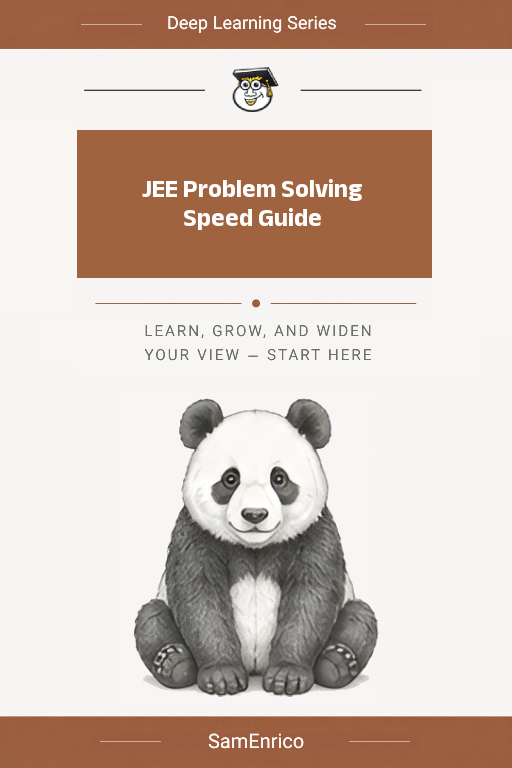
Non-FictionStudent's ShortcutSpeed Solving
JEE Problem Solving Speed Guide Audiobook
Develops rapid problem identification, solution pa
Develops rapid problem identification, solution path selection, and execution speed through pattern recognition practice.
Formats
Free sample
Chapter 1: The 15-Second Scan--–- Most students read a JEE question like a novel—start at the beginning, move word by word, reach the end, and only then begin to think about what it’s asking. By that point, nearly a minute has vanished. Top scorers do the opposite. They attack the question like a detective scanning a crime scene: eyes darting to key locations, ignoring irrelevant details, forming a hypothesis in seconds. This chapter teaches you that specific skill—the 15-Second Scan—which transforms you from a slow, linear reader into a rapid pattern-recognition machine.The difference between a 60-second reader and a 15-second scanner is not intelligence.
It is not mathematical ability. It is a trained habit of visual prioritization. This chapter will install that habit. By the time you finish the 50-question drill at the end, you will never look at a JEE question the same way again.The Fundamental Insight: Questions Have Skeletons, Not Stories Every JEE question, regardless of how much decorative language surrounds it, has a hidden skeleton. That skeleton consists of exactly four components: the Unknown (what you must find), the Givens (what numbers, equations, or conditions you already have), the Hidden Constraints (the silent rules that limit your approach), and the Archetype (the structural family the question belongs to).
Top scorers extract these four components in under 15 seconds. Then they spend the remaining time executing. Weak students extract them slowly—or never extract them at all, diving straight into algebraic manipulation without knowing where they are going.Consider this seemingly wordy JEE question:*"A particle of mass 2 kg moves along the x-axis under the influence of a position-dependent force F(x) = -4x Newtons, where x is in meters. If the particle is released from rest at x = 3 meters, find the speed of the particle when it passes through x = 1 meter."*A slow reader processes the story: particle, mass, x-axis, force, released from rest. A 15-Second Scanner sees only:Unknown: Speed at x=1Givens: m=2 kg, F(x)=-4x, v=0 at x=3Hidden Constraints: Force is position-dependent (not constant), so kinematics formulas won't work.
Use work-energy or solve differential equation.Archetype: Application with Variables (requires integration or energy method)The story is noise. The skeleton is signal. This entire chapter trains you to ignore the noise and grab the skeleton.The Three-Pass First Glance Protocol The 15-Second Scan is not one action but three…
This is the end of the free sample. Get the Audiobook to keep going. Buy now
About this book
Details
- Author
- Cheung Alethia
- Publisher
- SamEnrico
- Language
- English
- Genre
- Non-Fiction, Student's Shortcut, Speed Solving
- Released
- 2026-05-30
- Pages (approx.)
- 112
- Available as
- eBook, Audiobook

Listen in the VoxFlicks app
Audiobooks and audio dramas wherever you go. Sign in with your SamEnrico account and press play.
More by Cheung Alethia
 Seasonal Nature ObservationCheung Alethia$11.99
 The Teen Driver Anger CourseCheung Alethia$11.99
 Divorce and Spiritual HealingCheung Alethia$11.99
 Definition Essay GPT PromptsCheung Alethia$11.99
 The Sleep Hygiene Memory GuideCheung Alethia$11.99
 The Cosmic Wisdom of Anton Wilhelm Amo: Africa's Enlightenment Philosopher in EuropeCheung Alethia$11.99
 Understanding Pinheiro–freire–maia–miranda SyndromeCheung Alethia$17.99
 Assistant EditorCheung Alethia$11.99
 How to Start a Cheese Press Business (Beginners Guide)Cheung Alethia$11.99
You may also like
 Hong Kong Handover 1997Dunn Johnnie$11.99
 Zumba For Postnatal Recovery CourseNeal Christian$11.99
 Zumba for BeginnersLadner Nikia$11.99
 YouTube Comment Mining GuideHumes Pandora$12.99
 Worry Box MeditationCarlin Rudy$11.99
 Workplace Stress MeditationNguyen Lynn$11.99
 Workplace Stress and Sleep RepairHawley Ivory$11.99
 Workplace Perfectionism CureDelaney Jeffry$11.99
 Workplace Injustice Anger GuideWallen Isabelle$11.99
 Work Addiction and Burnout LinkGreenwood Ester$11.99
 Women in Yoga and WellnessBeattie Galina$11.99
 Women in Stand Up ComedyChun Evangeline$11.99