
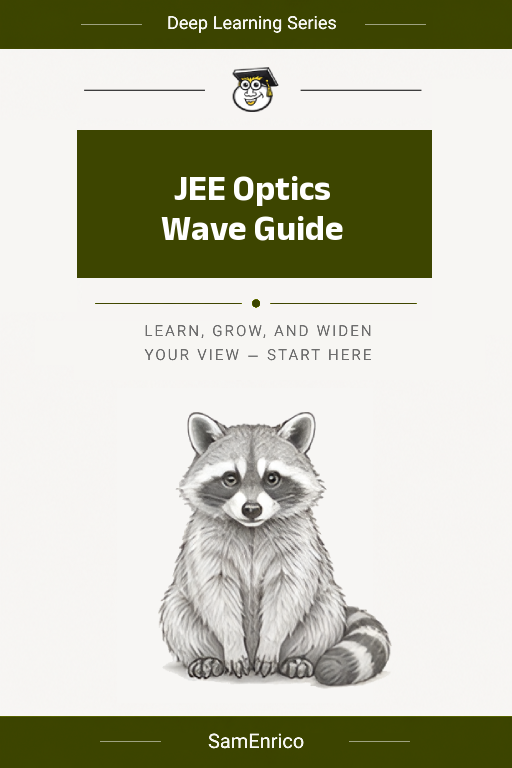
JEE Optics Wave Guide Audiobook
Apply ray optics and wave optics formulas for quic
by King Johanna
Apply ray optics and wave optics formulas for quick lens and mirror problems.
Formats
Free sample
Chapter 1: The Sign Stealer--–- Imagine losing 15 marks in a JEE exam not because you don't know the formula, but because you wrote +20 instead of –20. Every year, thousands of students solve the mirror and lens equations perfectly—yet get the final answer wrong. The culprit? A tiny, overlooked minus sign. This chapter is not about physics.
It is about hunting down and executing that error before it steals your rank.Welcome to the first chapter of JEE Optics Wave Guide. Unlike every other textbook you have seen, we are not starting with the history of optics, nor with a derivation of the mirror equation from first principles. We are starting with the single most practical, exam-winning skill: getting the sign right, every time, in under five seconds.In the next few pages, you will learn a system so automatic that your hand will write the correct signs before your brain has finished reading the problem statement. By the end of this chapter, you will never again ask: "Is v positive or negative here?" You will simply know.1.1 The One Mistake That Changes Everything Let us begin with a confession. Open any JEE solution booklet.
Look at the step where they write 1/f = 1/v + 1/u. Now watch what happens next. A student with strong concepts will substitute u = –30, f = –20, solve for v, and get v = –60 cm. Another student, equally bright, forgets the sign of u, writes u = +30, and gets v = +60 cm. Both students did the algebra correctly.
One answer is right. One is wrong. The difference? Not physics. Sign convention.The Cartesian sign convention is not a suggestion.
It is a rigid, unforgiving law of problem-solving in JEE optics. Here is the rule in one sentence: All distances measured from the pole (mirror) or optical center (lens) in the direction of incident light are positive; all distances measured opposite to incident light are negative.But a single sentence is not enough. You need a battle-tested, step-by-step ritual that you follow for every single problem. That is what this chapter delivers.1.2 The Two-Table System (No More Ambiguity)Most books give you one sign convention table and expect you to remember special cases for mirrors and lenses. That is a disaster waiting to happen.
Instead, we use two separate tables: one for mirrors, one for lenses. They look similar, but the subtle differences are exactly where JEE sets traps.Table 1: Sign Convention for…
This is the end of the free sample. Get the Audiobook to keep going. Buy now
About this book
Details
- Author
- King Johanna
- Publisher
- SamEnrico
- Language
- English
- Genre
- Non-Fiction, Student's Shortcut
- Released
- 2026-05-29
- Pages (approx.)
- 122
- Available as
- eBook, Audiobook

Listen in the VoxFlicks app
Audiobooks and audio dramas wherever you go. Sign in with your SamEnrico account and press play.
More by King Johanna
 Immigrant Brewery Founder Success GuideKing Johanna$11.99
 Metta For Morning RoutineKing Johanna$11.99
 The Dinner Table BombKing Johanna$11.99
 IT Band Syndrome PreventionKing Johanna$11.99
 Wholesaling Earnest Money GuideKing Johanna$11.99
 Gun Jumping Penalties ReportKing Johanna$11.99
 Refractive Index Glass MatchingKing Johanna$11.99
 Behavioral Economics MetricsKing Johanna$11.99
 Orphanage Impact Self EsteemKing Johanna$11.99
 The Timbuktu Code: Where Africa's Greatest Mathematicians Cracked the UniverseKing Johanna$11.99
 Quetzalcoatl's Feathered Serpent AscensionKing Johanna$11.99
 Whispers in the Dark: The Unseen War of the Night WitchesKing Johanna$11.99
You may also like
 Hong Kong Handover 1997Dunn Johnnie$11.99
 Zumba For Postnatal Recovery CourseNeal Christian$11.99
 Zumba for BeginnersLadner Nikia$11.99
 YouTube Comment Mining GuideHumes Pandora$12.99
 Worry Box MeditationCarlin Rudy$11.99
 Workplace Stress MeditationNguyen Lynn$11.99
 Workplace Stress and Sleep RepairHawley Ivory$11.99
 Workplace Perfectionism CureDelaney Jeffry$11.99
 Workplace Injustice Anger GuideWallen Isabelle$11.99
 Work Addiction and Burnout LinkGreenwood Ester$11.99
 Women in Yoga and WellnessBeattie Galina$11.99
 Women in Stand Up ComedyChun Evangeline$11.99