
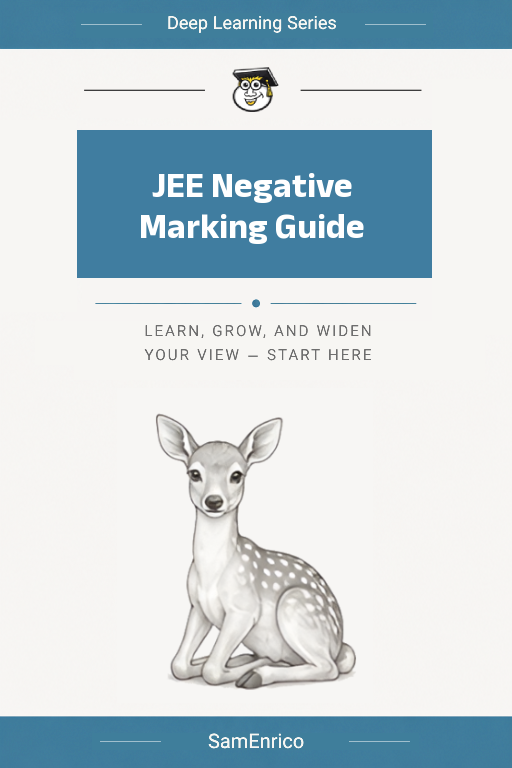
JEE Negative Marking Guide eBook
Balance attempted questions against penalty risks
by Byrd Phillip
Balance attempted questions against penalty risks for optimal net score.
Formats
Free sample
Chapter 1: The Execution Gap--Every year, over 1.2 million students sit for the JEE Main. They have studied for two years – some for longer. They have memorized formulas, solved thousands of problems, attended coaching classes, and sacrificed sleep, social lives, and sanity. And yet, when the results are announced, less than 1 percent of them will secure a seat in an IIT. The rest – the vast, silent majority – will wonder what went wrong.The standard explanation is comforting in its simplicity: They didn't study hard enough.
They didn't know enough. Someone else knew more.This explanation is also almost entirely wrong.The truth is far more unsettling. Most students who fail to clear the JEE do not lack knowledge. They have solved the same types of problems at home. They have scored well in mock tests.
They can explain concepts to their friends. But under the specific, high-stakes conditions of the actual exam – a ticking clock, a room full of strangers, the weight of parental expectation, the fear of negative marking – their knowledge becomes inaccessible. They freeze. They guess. They make silly mistakes.
They attempt questions they should have skipped and skip questions they should have attempted.This gap – between what you know in a calm room and what you can execute under pressure – is what this book calls The Execution Gap. And closing it is the single most important factor in improving your JEE rank.The Myth of Knowledge Dominance Let us begin with a simple experiment. Ask yourself this question: If the JEE were an untimed, open-book, no-negative-marking exam, what score would you get?For most students, the honest answer is: Much higher than my actual mocks. Some would double their scores. Some would triple them.
A few would score perfectly.This thought experiment reveals a profound truth. The JEE is not primarily a test of knowledge. It is a test of decision-making under uncertainty, time pressure, and penalty constraints. Knowledge is the raw material, but execution is the factory. You can have all the raw material in the world, but if your factory is inefficient – if it leaks time, if it makes errors under pressure, if it cannot distinguish between valuable and worthless inputs – your output will be low.Coaching institutes perpetuate the myth of knowledge dominance because it is profitable.
Study harder. Take more tests. Memorize more formulas. These are easy prescriptions to sell. But they ignore the uncomfortable reality that most students already know enough to score well.
What they lack is not information but a decision-making framework for the exam itself.This book provides that framework. It will not teach you a single new physics formula or chemistry reaction. Instead, it will teach you how to deploy the knowledge you already have with surgical precision – and, equally important, how to recognize when to withhold that knowledge entirely.The Two Selves: Understanding Your Inner Saboteur To understand why smart students make dumb decisions under pressure, we must first understand the architecture of the human mind under stress. The most useful model comes from an unlikely source: tennis.In his classic book The Inner Game of Tennis, Timothy Gallwey observed that every athlete has two selves. Self 1 is the conscious, verbal, judging mind.
It criticizes. It worries. It says things like "You always mess up this type of problem" or "Everyone else is solving faster than you" or "Your parents are going to be so disappointed if you fail this." Self 1 is the voice of doubt, and it is relentless.Self 2 is the unconscious, automatic, pattern-recognizing mind. It is the part of you that catches a falling glass before you consciously realize it is falling. It is the part that recognizes a familiar problem type without having to reason through first principles.
Self 2 does not speak in words. It acts. And when it is allowed to operate without interference from Self 1, it is remarkably capable.The problem is that Self 1 does not trust Self 2. When the stakes are high – like a JEE exam – Self 1 takes over. It starts second-guessing.
It demands conscious control over every step. It freezes when it encounters something unfamiliar. It is, in short, a terrible exam-taker.The goal of this book is to silence Self 1 and empower Self 2. This is not mysticism. It is training.
Just as a tennis player practices until their serve becomes automatic, you will practice decision-making until the strategies in this book become automatic. By the time you sit for the actual exam, you will not decide to skip a Red Zone question – you will simply skip it, without thought, without guilt, without the voice of Self 1 whispering "But what if you could solve it?"Opportunity Cost: The Most Important Concept You Were Never Taught Economists have a concept that is brutally relevant to the JEE: opportunity cost. The opportunity cost of a choice is the value of the best alternative you gave up by making that choice.In the context of a timed exam, the opportunity cost of spending 5 minutes on a difficult question is not just the 5 minutes. It is the 5 minutes you could have spent solving two easy questions in another section. It is the marks you lost by not using that time elsewhere.Most students think about time management in terms of speed – how fast can I solve this problem?
This is the wrong mental model. The correct model is allocation – given that I have a fixed amount of time, how should I distribute it across questions to maximize my net score?Consider two questions:Question A: Difficult. You have a 40% chance of solving it correctly. It will take 4 minutes.Question B: Easy. You have a 95% chance of solving it correctly.
It will take 1 minute.The expected value of Question A is: (0.4 × 4) + (0.6 × -1) = 1.6 – 0.6 = 1.0 mark per 4 minutes → 0.25 marks per minute.The expected value of Question B is: (0.95 × 4) + (0.05 × -1) = 3.8 – 0.05 = 3.75 marks per 1 minute → 3.75 marks per minute.Question B is 15 times more valuable per minute than Question A. Yet many students will instinctively start with Question A because it looks more interesting, or because they want to "get the hard one out of the way," or because their ego refuses to admit they cannot solve it.This is the opportunity cost trap. Every minute you spend on a low-EV question is a minute stolen from a high-EV question. And unlike money, time stolen cannot be recovered.The 3-Zone Filter: Your First Mental Tool To apply opportunity cost thinking in real time, you need a simple, rapid classification system for every question you encounter. This book introduces the 3-Zone Filter.
You will use it so often that by exam day, it will be automatic.Within 10 seconds of reading any question, you will assign it to one of three zones:Green Zone: Solve Now A Green Zone question has three characteristics:You recognize the concept immediately.You can see the complete solution path within 5 seconds.The calculation required is short (typically 2-3 steps or less).Green Zone questions are your bread and butter. They are the easiest marks on the paper. Your job in the first 60 minutes of the exam (Round 1 – see Chapter 7) is to harvest every Green Zone question you can find. Do not linger. Do not double-check unnecessarily.
Solve and move.Example of a Green Zone question: *"What is the derivative of sin(x) at x = π/2?"* You know…
This is the end of the free sample. Get the eBook to keep going. Buy now
About this book
Details
- Author
- Byrd Phillip
- Publisher
- SamEnrico
- Language
- English
- Genre
- Non-Fiction, Student's Shortcut
- Released
- 2026-06-01
- Pages (approx.)
- 128
- Available as
- eBook, Audiobook

Read better in the ZLOADR app
Your eBooks on your phone or tablet. Sign in with your SamEnrico account and start reading.
More by Byrd Phillip
 Immigrant Laundromat To Empire GuideByrd Phillip$11.99
 Active Listening In Couples GuideByrd Phillip$11.99
 Fear of Failure CreativityByrd Phillip$11.99
 Cool Down Recovery ProtocolByrd Phillip$11.99
 Highway Confrontation EscapeByrd Phillip$11.99
 The Laptop SmashByrd Phillip$11.99
 Wholesaling Email Campaign GuideByrd Phillip$11.99
 Social Exclusion Child WorthByrd Phillip$11.99
 Baldwin Dynasty - Daniel BaldwinByrd Phillip$11.99
 The Merger That Shook the World: How a Corporate Marriage Reshaped Global TechByrd Phillip$11.99
 The Kiwi Sound: How a Small Label Shaped a Nation's MusicByrd Phillip$11.99
 Dwarka: The Sunken City Beneath the WavesByrd Phillip$11.99
You may also like
 LSE Online Program LengthAgee Letisha$11.99
 Harvard Extension School for Working AdultsRoush Yer$11.99
 LSE Online Reading ListAshford Ludivina$11.99
 LSE Online Language RequirementsWhitten Daphine$11.99
 LSE Online Class SizeHughey Garret$11.99
 LSE Online Alumni MentorshipWild Lyla$11.99
 London School of Economics Alumni NetworkDutton Chantal$11.99
 Harvard Extension School Student SupportCantrell Christene$11.99
 Harvard Extension School Library AccessSantana Adah$11.99
 Harvard Extension School Degree CompletionBray Wyatt$11.99
 Harvard Extension School Course AuditingAbbott Craig$11.99
 Harvard Extension School Extension DiplomaNew Joane$11.99