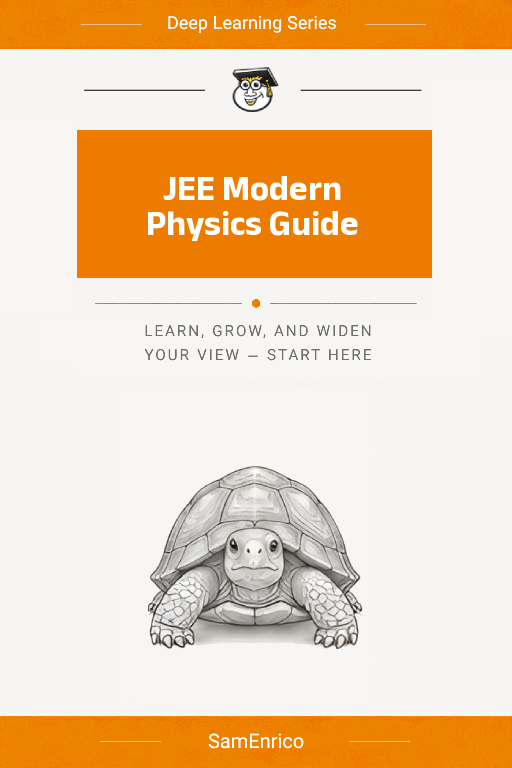
JEE Modern Physics Guide
Master photoelectric effect, atomic models, nuclea
Master photoelectric effect, atomic models, nuclear physics, and semiconductor devices with concept application.
Formats
About this book
Free sample
Chapter 1: The Ultraviolet Catastrophe--–- In the waning years of the nineteenth century, the great lords of physics sat comfortably in their chairs. They believed the universe had been decoded. Newton had given them the laws of motion and gravity. Maxwell had unified electricity, magnetism, and light into a single elegant set of equations. Thermodynamics had explained heat, work, and energy with mathematical precision.
The mechanical universe—a grand clockwork of particles moving according to deterministic laws—seemed complete. Lord Kelvin, one of the most respected scientists of his age, famously declared that the edifice of physics was essentially finished. Only two small clouds remained on the horizon, he said—minor puzzles to be swept away by future students. Those two clouds would soon unleash a thunderstorm that would shatter classical physics forever and give birth to the quantum revolution. One of those clouds led to Einstein's theory of relativity.
The other—the problem of black body radiation—led to the discovery that energy itself comes in discrete packets called quanta. This chapter tells the story of that second cloud, why it terrified the physicists of 1900, and why every JEE aspirant must understand it to master photoelectric effect, atomic models, nuclear physics, and semiconductor devices.1.1 The Grand Illusion: Why Classical Physics Was a House of Cards By 1890, classical physics had achieved remarkable successes that seemed almost divine in their precision. Newton's laws explained the orbits of planets with such accuracy that astronomers could predict eclipses centuries in advance. When the planet Uranus showed slight deviations from its predicted path, two mathematicians—John Couch Adams and Urbain Le Verrier—independently calculated the position of an unknown planet causing the disturbance. When telescopes pointed to those coordinates, Neptune was discovered.
This was the power of classical physics.Maxwell's equations, completed in 1873, revealed that light was an electromagnetic wave traveling at a speed determined by the fundamental constants of electricity and magnetism. The fact that this theoretical speed matched the measured speed of light was no coincidence—it was a triumph. Radio waves, X-rays, and gamma rays would all later be shown to be…
This is the end of the free sample. Get the eBook to keep going. Buy now
Contents
- Chapter 1
- Chapter 2
- Chapter 3
- Chapter 4
- Chapter 5
- Chapter 6
- Chapter 7
- Chapter 8
- Chapter 9
- Chapter 10
- Chapter 11
- Chapter 12
Details
- Author
- Sparkman Mose
- Publisher
- SamEnrico
- Language
- English
- Genre
- Non-Fiction, Student's Shortcut, Modern Physics
- Released
- 2026-05-29
- Pages (approx.)
- 160
- Available as
- eBook, Audiobook

Read better in the ZLOADR app
Your eBooks on your phone or tablet. Sign in with your SamEnrico account and start reading.
More by Sparkman Mose
 Neuroplasticity Study GuideSparkman Mose$11.99
 Housing Coop Share Resale ManualSparkman Mose$11.99
 Remote Retreats Annual RhythmSparkman Mose$11.99
 Norwegian Resistance Church GuideSparkman Mose$11.99
 Deep Work for HR ProfessionalsSparkman Mose$11.99
 The Last Council of the Druids: A Forgotten Debate Over Roman RuleSparkman Mose$11.99
 The Ghost in the Machine: How a Forgotten Engineer Exposed the AI Arms RaceSparkman Mose$11.99
 How to Become a InspectorSparkman Mose$11.99
 Understanding Choroiditis, SerpiginousSparkman Mose$17.99
 Principal Enterprise ArchitectSparkman Mose$11.99
 Budget Reconciliation GuideSparkman Mose$12.99