
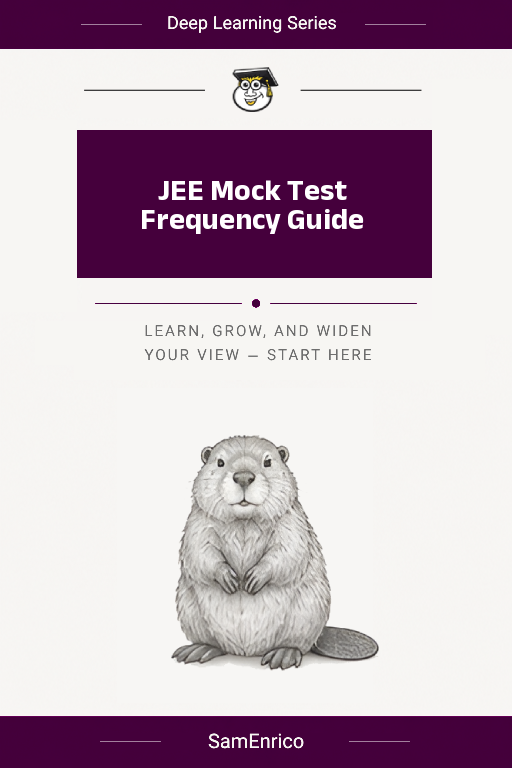
JEE Mock Test Frequency Guide eBook
Determine optimal number and timing of mock tests
Determine optimal number and timing of mock tests before the actual exam.
Formats
Free sample
Chapter 1: The 35-Test Ceiling--–- Rohan had done everything right. He had joined a prestigious coaching institute, attended every lecture, solved thousands of problems, and in the final six months before JEE Main 2023, he attempted an astonishing 67 full-length mock tests. His parents were proud. His teachers were impressed. Rohan himself felt invincible.
When he walked into the exam hall, he had memorized every formula, every shortcut, every trick in the book. He finished the paper with fifteen minutes to spare. He was confident. Ten days later, the results arrived. Rohan scored 142 marks out of 300.
His percentile was 87.2. He did not qualify for JEE Advanced.–- Across town, another student named Ananya had followed a different path. She had taken exactly 34 mock tests over the same six-month period. But after each test, she spent hours dissecting every mistake, maintaining a meticulous error log, and refusing to move on until she understood why she had gotten a question wrong. Her mock scores had started at 89 and gradually climbed to 198.
On the actual JEE Main, she scored 212 marks—98.6 percentile. She had taken nearly half as many tests as Rohan. What was her secret? It wasn't intelligence. It wasn't luck.
It was understanding something that 90% of JEE aspirants get tragically wrong: the relationship between mock test frequency and performance is not linear. Beyond a certain point, more tests do not help you. They actively hurt you.–- This book is built on a single, counterintuitive, data-driven premise: there is an optimal number of mock tests you should take before the JEE, and taking even one test beyond that number can reduce your final score. For 95% of students, that optimal number falls between 24 and 40, depending on whether you are a school-going student or a full-time dropper. Beyond this range, the law of diminishing returns does not just plateau—it reverses.
Scores drop. Confidence crumbles. Burnout sets in. And yet, the overwhelming culture around JEE preparation screams the opposite: "More tests! More practice!
More, more, more!"–- This chapter will dismantle that myth. It will introduce you to the science of performance under pressure, the mathematical reality of diminishing returns, and a revolutionary metric called the Test Quality Index (TQI) that predicts your final JEE score more accurately than the number of tests you take. By the end of this chapter, you will understand why Rohan failed despite his 67 tests, why Ananya succeeded with only 34, and—most importantly—exactly how many tests you should aim for based on your unique circumstances.The Inverted U: Why Your Brain Cannot Handle Unlimited Testing–- Imagine a graph. On the horizontal axis, place the number of mock tests a student takes. On the vertical axis, place their actual JEE Main score.
Most students, if asked to draw this relationship, would sketch a straight line going up and to the right: more tests equals higher scores. This intuition feels obvious. Practice makes perfect. Repetition builds mastery. But human performance, especially under high-stakes conditions, does not follow a straight line.
It follows an inverted U.–- This is the Yerkes-Dodson Law, a century-old finding in psychology that has been validated in contexts ranging from Olympic athletics to surgical performance to, most relevantly, high-stakes standardized testing. The law states that performance increases with physiological and mental arousal (stress, activation, effort) only up to a certain point. After that optimal point, further increases in arousal cause performance to decline. Too little stress, and you are under-stimulated, prone to boredom and careless errors. Too much stress, and you enter a state of over-arousal: anxiety narrows your focus, working memory deteriorates, and fine motor skills suffer.–- In the context of JEE mock tests, the "arousal" is the combination of mental fatigue, time pressure, and emotional investment.
Each mock test you take depletes a finite reservoir of cognitive resources. The first few tests in a given week sharpen your skills, improve your time management, and calibrate your expectations. But after a certain frequency—which varies by individual but follows predictable patterns—the marginal benefit of each additional test turns negative. You are no longer learning. You are merely exhausting yourself.–- The shape of this inverted U is not symmetrical.
The ascent to the peak is gradual; the descent on the far side is steep. That is, taking too few tests leaves significant improvement on the table, but taking too many tests can destroy weeks of prior progress in a matter of days. A student who takes 50 tests instead of the optimal 35 does not simply "waste time" on 15 extra tests. Those 15 extra tests actively erode the gains from the first 35. This is the hidden tragedy of the over-tester: they would have scored higher if they had stopped earlier.The Data: What 500 JEE Aspirants Teach Us About Optimal Frequency–- To move from theory to evidence, let us examine a longitudinal study conducted over the 2022–2023 JEE cycle.
Five hundred aspirants from across India were tracked for six months, from October to March. All students had completed at least 80% of the syllabus by October. All were aiming for JEE Main. The only variable that was not controlled was the number of mock tests each student chose to take. Everything else—study materials, coaching access, daily study hours—varied naturally but was recorded for statistical adjustment.–- The results were striking.
The students were divided into four groups based on the number of full-length mock tests they attempted:Group A (15–24 mocks, n=112): Average JEE Main score: 148. Average improvement from first mock to last: +51 marks. Burnout rate: 8%. Average self-reported confidence on exam day: 6.2/10.Group B (25–35 mocks, n=198): Average JEE Main score: 189. Average improvement: +68 marks.
Burnout rate: 12%. Average confidence: 7.8/10.Group C (36–45 mocks, n=142): Average JEE Main score: 184. Average improvement: +62 marks. Burnout rate: 27%. Average confidence: 6.9/10.Group D (46–60+ mocks, n=48): Average JEE Main score: 161.
Average improvement: +41 marks. Burnout rate: 43%. Average confidence: 4.5/10.–- The optimal range is clear: 25 to 35 mocks produced the highest average scores and the greatest improvement. Students who took 36 to 45 mocks scored, on average, 5 marks lower than those who took 25 to 35—despite having taken nearly ten additional tests. Students who crossed 45 mocks performed worse than every other group, including those who had taken as few as 15 tests.–- But the raw numbers tell only part of the story.
The burnout rates are perhaps more alarming. Nearly one in three students in Group C reported symptoms of moderate to severe burnout: chronic fatigue, inability to concentrate, irritability, and sleep disturbances. In Group D, nearly half of all students experienced burnout so severe that it affected their physical health. These were not weak students. Many of them had started with higher baseline scores than the average student in Group B.
They simply pushed too hard, too fast, and for too long.–- One student in Group D, whom we will call Karan, had a particularly instructive trajectory. His first mock in October scored 172—well above the cohort average. By December, after 22 tests, he had climbed to 205. He was on a trajectory that would have placed him comfortably above 220 by February. But Karan believed that if 22 tests were good, 50 tests would be better.
He increased his frequency to five tests per week. By mid-January, his scores had plateaued around 198. By February, they…
This is the end of the free sample. Get the eBook to keep going. Buy now
About this book
Details
- Author
- Mullins Michael
- Publisher
- SamEnrico
- Language
- English
- Genre
- Non-Fiction, Student's Shortcut
- Released
- 2026-05-30
- Pages (approx.)
- 135
- Available as
- eBook, Audiobook

Read better in the ZLOADR app
Your eBooks on your phone or tablet. Sign in with your SamEnrico account and start reading.
More by Mullins Michael
 Wholesaling Hard Money LendersMullins Michael$11.99
 Sorry for the SlamMullins Michael$11.99Sorry for the SlamMullins Michael$11.99
 Immigrant Home Health Care Business GuideMullins Michael$11.99
 High Performer Confidence PlanMullins Michael$11.99
 Glass Density Gradient GuideMullins Michael$11.99
 Canadian Competition Act FinesMullins Michael$11.99
 Finger Dislocation RecoveryMullins Michael$11.99
 Assertiveness For CreativesMullins Michael$11.99
 Behavioral Economics GlossaryMullins Michael$11.99
 Phantom Freeway: The Unsolved Mystery of the I-5 Phantom KillerMullins Michael$11.99
 Fenrir’s Oath: The Wolf and the King’s ShadowMullins Michael$11.99
You may also like
 Hong Kong Handover 1997Dunn Johnnie$11.99
 Zumba For Postnatal Recovery CourseNeal Christian$11.99
 Zumba for BeginnersLadner Nikia$11.99
 YouTube Comment Mining GuideHumes Pandora$12.99
 Worry Box MeditationCarlin Rudy$11.99
 Workplace Stress MeditationNguyen Lynn$11.99
 Workplace Stress and Sleep RepairHawley Ivory$11.99
 Workplace Perfectionism CureDelaney Jeffry$11.99
 Workplace Injustice Anger GuideWallen Isabelle$11.99
 Work Addiction and Burnout LinkGreenwood Ester$11.99
 Women in Yoga and WellnessBeattie Galina$11.99
 Women in Stand Up ComedyChun Evangeline$11.99