
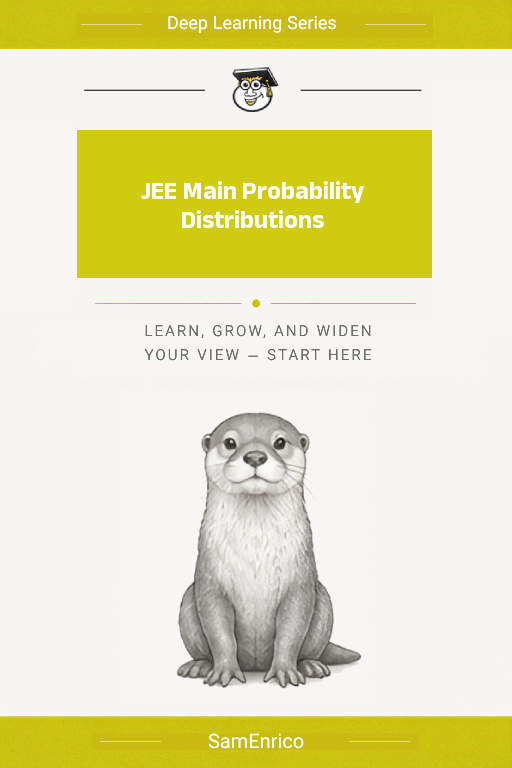
JEE Main Probability Distributions eBook
Solve binomial Poisson and normal distribution pro
by Stout Kelle
Solve binomial Poisson and normal distribution problems for advanced probability questions.
Formats
Free sample
Chapter 1: The Mindset Shift--–- Most JEE aspirants lose marks on probability distributions not because the mathematics is difficult, but because they are thinking about the problem incorrectly. They approach a distribution question the same way they approach a coin-and-dice problem from Class 11—listing outcomes, counting favorable cases, dividing by total possibilities. And then they stare at the answer options, confused why none of their calculations match.The problem is not your algebra. The problem is not your ability to compute combinations or factorials. The problem is that you are trying to solve a distribution question using event-based thinking.
And those two paradigms do not mix any better than oil and water.This chapter engineers the single most important shift in your probability preparation: moving from “What is the probability of this event?” to “What is the probability distribution of this random variable?” Master this shift, and every subsequent chapter—Binomial, Poisson, Normal, approximations, mixtures—will feel like a natural extension of a single unified framework. Miss this shift, and you will spend the next six months memorizing formulas that never seem to fit the problems you actually face in the exam.Let us begin.1.1 The Fundamental Problem with Event-Based Thinking In Class 11, you learned probability in its classical form. For an experiment with equally likely outcomes, the probability of an event E was:P(E)=Number of outcomes favorable to ETotal number of possible outcomes P(E) = \frac{\text{Number of outcomes favorable to E}}{\text{Total number of possible outcomes}}P(E)=Total number of possible outcomes Number of outcomes favorable to EThis works beautifully for dice, coins, cards, and balls drawn from urns. The sample space is finite, the outcomes are symmetric, and you can count everything explicitly. A typical problem: “Two dice are thrown.
Find the probability that the sum is 7.” Total outcomes = 36. Favorable outcomes = 6 (1+6,2+5,3+4,4+3,5+2,6+1). Answer = 6/36 = 1/6.Now consider a different problem: “A factory produces light bulbs. The probability that a bulb lasts more than 1000 hours is 0.3. Five bulbs are tested.
What is the probability that exactly two bulbs last more than 1000 hours?”Stop. Try to solve this using only event-based thinking.What is the sample space? The “outcome” is not a single bulb. It is a sequence of five bulbs, each either “success” (lasts >1000 hours) or “failure” (does not). That gives 2⁵ = 32 possible sequences.
But here is the catch: the problem does not care about the order of successes and failures—only the count. And unlike the dice problem, the outcomes are not equally likely if you just list sequences without considering probabilities.Event-based thinking breaks down here because:The “outcomes” are not equally likely unless p = 0.5.The question asks for a probability about a numerical summary of the experiment (the count of successes), not about a specific sequence.To get the answer, you need a function that assigns probabilities to each possible count.That function is a probability distribution. And the thing whose behavior you are studying—the count of successes—is a random variable.1.2 What Exactly Is a Random Variable?A random variable is not a “variable” in the algebraic sense—it is not x that you solve for. It is a rule, a function, that takes each outcome of an experiment and assigns it a real number.Let that sink in. A random variable is a function from the sample space to the real numbers.Definition (formal but simple):Let S be the sample space of a random experiment.
A random variable (RV) X is a function X: S → ℝ that assigns a unique real number to every outcome s in S.Why do we need this? Because most real-world experiments produce outcomes that are not naturally numeric. “The bulb lasted more than 1000 hours” is a verbal description. To do mathematics with it, we convert it to a number: let X = 1 if the bulb lasts more than 1000 hours, X = 0 otherwise. Now we can compute averages, variances, and probabilities of ranges—things that are impossible with raw verbal outcomes.Example 1.1 (Discrete RV):Toss a coin three times.
The sample space S = {HHH, HHT, HTH, HTT, THH, THT, TTH, TTT}. Define a random variable X = “number of heads in the three tosses.” Then:X(HHH) = 3X(HHT) = X(HTH) = X(THH) = 2X(HTT) = X(THT) = X(TTH) = 1X(TTT) = 0X takes values in {0, 1, 2, 3}. This is a discrete random variable because its possible values form a countable set (here, finite).Example 1.2 (Continuous RV):Measure the exact lifetime of a light bulb in hours. The sample space is all positive real numbers. Define X = “lifetime in hours.” X can take any value in (0, ∞).
This is a continuous random variable because the set of possible values is uncountable (an interval of real numbers).The crucial distinction for JEE Main:Discrete RV: Countable values (often 0,1,2,…,n or 0,1,2,…). Probability is given by a probability mass function (PMF) P(X = x).Continuous RV: Uncountable values (an interval). Probability is given by a probability density function (PDF) f(x), and probabilities are computed as integrals: P(a < X < b) = ∫_a^b f(x) dx.Do not memorize this as jargon. Internalize the idea: discrete = count, continuous = measure.1.3 The Probability Distribution: The Complete Picture A probability distribution is the complete description of a random variable—it tells you, for every possible value of X, what the probability (or probability density) is.For a discrete random variable, the distribution is given by a table, a formula, or a graph where:P(X=xi)≥0for all i P(X = x_i) \geq 0 \quad \text{for all } i P(X=xi)≥0for all i∑i P(X=xi)=1\sum_{i} P(X = x_i) = 1i∑P(X=xi)=1The second condition—the unit-sum condition—is the most powerful and most frequently tested tool in JEE Main distribution problems.Example 1.3 (The Missing Probability Trap):A random variable X takes values 0, 1, 2, 3 with probabilities:x0123P(X=x)0.2k0.30.1Find the value of k.Solution:Sum of probabilities = 0.2 + k + 0.3 + 0.1 = 0.6 + k.Set equal to 1: 0.6 + k = 1 ⇒ k = 0.4.This is trivial. But JEE Main does not stay trivial.
The missing probability might be expressed as an algebraic expression in x, and you will need to sum a series.Example 1.4 (Algebraic Missing Probability):A discrete random variable X takes values 1, 2, 3, 4 with probabilities P(X=x) = c·(x² + 1). Find c.Solution:Sum_{x=1 to 4} c·(x² + 1) = c·[(1²+1)+(2²+1)+(3²+1)+(4²+1)]= c·[2 + 5 + 10 + 17] = c·34 = 1 ⇒ c = 1/34.Why JEE Main loves this: It tests your ability to handle algebraic sums (often arithmetic or geometric progressions) while checking the fundamental condition that all probability distributions must satisfy.For a continuous random variable, the condition is:∫−∞∞f(x) dx=1\int_{-\infty}^{\infty} f(x) \, dx = 1∫−∞∞f(x)dx=1where f(x) ≥ 0 for all x.Example 1.5 (Continuous PDF with unknown constant):A continuous random variable X has PDF f(x) = k(2x – x²) for 0 ≤ x ≤ 2, and f(x)=0 elsewhere. Find k.Solution:∫_0^2 k(2x – x²) dx = k[ x² – x³/3 ]_0^2 = k[ (4 – 8/3) – 0 ] = k(12/3 – 8/3) = k(4/3) = 1 ⇒ k = 3/4.1.4 Why “Random Variable” Is Not an Event (The Most Common JEE Trap)Here is a mistake that appears in over 40% of student answers, according to an…
This is the end of the free sample. Get the eBook to keep going. Buy now
About this book
Details
- Author
- Stout Kelle
- Publisher
- SamEnrico
- Language
- English
- Genre
- Non-Fiction, Student's Shortcut
- Released
- 2026-05-30
- Pages (approx.)
- 132
- Available as
- eBook, Audiobook

Read better in the ZLOADR app
Your eBooks on your phone or tablet. Sign in with your SamEnrico account and start reading.
More by Stout Kelle
 Drug Dependency and Sober Living HomesStout Kelle$11.99
 The Medicine Nobel Hepatitis CStout Kelle$11.99
 Phone Checking as DisinterestStout Kelle$11.99
 Nobel Laureates In Virology GuideStout Kelle$11.99
 Rapid Body Scan RelaxationStout Kelle$11.99
 Evan Williams BloggerStout Kelle$11.99
 Haleakala Missing CasesStout Kelle$11.99
 Meditation For Grief BeginnersStout Kelle$11.99
 The Timbuktu Codebreakers: The Great Mathematical Heist of the SaharaStout Kelle$11.99
 The Shield and the Rune: Harald Fairhair and the Birth of NorwayStout Kelle$11.99
 The Mineral Guide to AfghaniteStout Kelle$11.99
 How to Produce BucklesStout Kelle$11.99
You may also like
 Hong Kong Handover 1997Dunn Johnnie$11.99
 Zumba For Postnatal Recovery CourseNeal Christian$11.99
 Zumba for BeginnersLadner Nikia$11.99
 YouTube Comment Mining GuideHumes Pandora$12.99
 Worry Box MeditationCarlin Rudy$11.99
 Workplace Stress MeditationNguyen Lynn$11.99
 Workplace Stress and Sleep RepairHawley Ivory$11.99
 Workplace Perfectionism CureDelaney Jeffry$11.99
 Workplace Injustice Anger GuideWallen Isabelle$11.99
 Work Addiction and Burnout LinkGreenwood Ester$11.99
 Women in Yoga and WellnessBeattie Galina$11.99
 Women in Stand Up ComedyChun Evangeline$11.99