
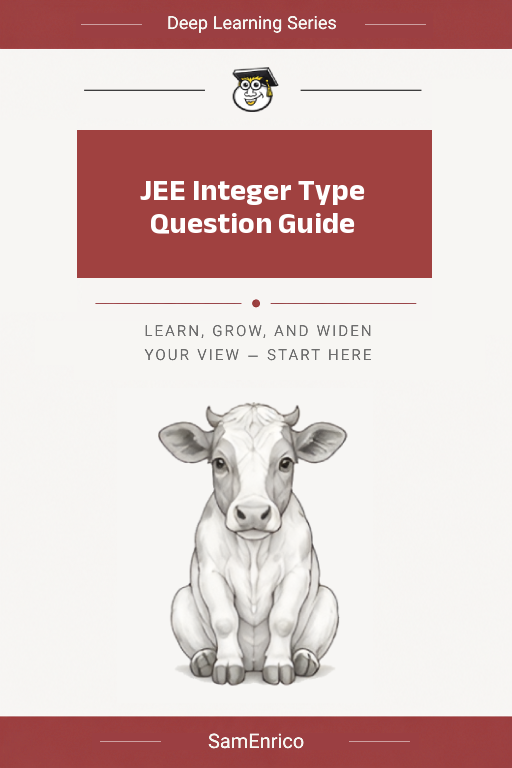
JEE Integer Type Question Guide eBook
Solve numerical answer questions with unit checkin
Solve numerical answer questions with unit checking and range approximation techniques.
Formats
Free sample
Chapter 1: The Ten Thousand Box--–- Rohan had just finished his JEE Main mock test. He had solved 18 out of 30 questions in the Integer Type section – a personal best. He was confident. He had checked his calculations twice. He had even re-read the questions to make sure he had not missed any constraints.
When the answer key was released, he eagerly compared his answers.He had gotten 12 wrong.Not because his physics was incorrect. Not because his chemistry equations were unbalanced. Not because his math derivations had flaws. He had gotten 12 wrong because of errors that had nothing to do with understanding the material. He had forgotten to convert centimeters to meters.
He had misplaced a decimal in a hurry. He had submitted 250 when the correct answer was 25. He had submitted 400 when the correct answer was 4000. He had even submitted a negative number – which is impossible for JEE Integer Type questions, since the answer must be between 0 and 9999.Rohan was not a bad student. He was not weak in physics, chemistry, or math.
He was missing something that no coaching institute had ever taught him: the strategic use of constraints.This chapter is about that missing piece. It is about the single most underutilized asset in JEE Integer Type questions: the answer cage. It is about why most students ignore this asset, and how you can turn it into your greatest weapon.The Cage That Sets You Free Here is a truth that sounds like a paradox but is actually the key to the entire JEE Integer Type section: the fact that your answer is trapped between 0 and 9999 is not a restriction. It is a liberation.Think about what happens in a subjective question. You derive an expression.
You plug in numbers. You get a result. That result could be anything – 0.0003, 1.47 × 10¹⁵, -8.2, or an irrational number like √2. You have no external check on whether your answer is reasonable. You are completely dependent on the correctness of your algebra and arithmetic.In a multiple-choice question, you have four options.
That is better than nothing, but four options is still a small cage. You can eliminate one or two obviously wrong answers, but you still have to choose between two or three plausible ones.In an Integer Type question, you have 10,000 possibilities. That sounds like a lot. But compared to infinity, 10,000 is a cage. And that cage is your strategic weapon.Why?
Because you can use the boundaries of the cage – 0 and 9999 – to check your work before you submit. If your answer is negative, you have made an error. If your answer has a decimal point, you have made an error. If your answer is greater than 9999, you have made an error. If your answer is wildly different from what physics or chemistry or math would predict, you have made an error.The cage does not restrict you.
It protects you. It is the guardrail on a mountain road. You do not drive into it. You use it to know where the edge is.Most students, like Rohan, ignore the cage. They calculate, they submit, they move on.
They never ask: "Does this answer make sense given the constraints?" They never use the boundaries as a sanity check. And they pay for that omission with wrong answers that should have been caught.The Range Envelope: Your First Line of Defense The most powerful technique in this entire book is also the simplest. Before you solve any problem – before you write a single equation, before you plug in any numbers – you will estimate a range envelope for the answer.What is a range envelope? It is two numbers: the smallest physically possible answer and the largest physically possible answer.Not the smallest mathematically possible answer. Not the largest number that could appear from some bizarre combination of constants.
The smallest and largest answers that make sense given the physical, chemical, or mathematical context of the problem.Let me give you an example. A stone is dropped from a height of 80 meters. Take g = 10 m/s². What is the time of fall?Before you calculate, ask yourself: what is the smallest possible time? Zero seconds?
That would mean the stone hits the ground instantly. That is impossible unless the height is zero. So the smallest possible time is something greater than zero. But can you be more specific? Yes.
The time cannot be less than the time it would take if gravity were infinite. But gravity is not infinite. So the lower bound is not helpful? Actually, it is. The time cannot be zero.
So the answer is at least 1? Not necessarily. But you can reason: if the height were 5 meters, the time would be 1 second (since h = ½gt² → 5 = ½×10×t² → t=1). Your height is 80 meters, which is much larger. So your time will be much larger than 1 second.
That is a lower bound: t > 1 second.Now, the largest possible time? If gravity were weaker, time would be longer. But g is fixed at 10. So the time cannot be arbitrarily large. In fact, from h = ½gt², t = √(2h/g) = √(160/10) = √16 = 4 seconds exactly.
So the range envelope is t > 1 second and t < 10 seconds? That is too wide. Let us be more precise. The actual answer is 4 seconds. Your range envelope should be narrow enough to catch errors but wide enough to include the correct answer.
A good rule: estimate upper and lower bounds that are off by no more than a factor of 2.For the stone problem: lower bound – if g were 20 (double), t = √(160/20) = √8 ≈ 2.8 seconds. Upper bound – if g were 5 (half), t = √(160/5) = √32 ≈ 5.7 seconds. So your range envelope is 2.8 < t < 5.7 seconds. If your calculation gives t = 4 seconds, you are inside. If it gives t = 10 seconds or t = 1 second, you are outside – and you have an error.This is the range envelope.
It takes 10 seconds to estimate. It will save you from hundreds of wrong answers.Bounding by Extremes: When You Cannot Solve Exactly Sometimes you cannot solve a problem exactly. The algebra is too complex. The time pressure is too high. You are stuck.
In those moments, most students panic, guess randomly, or leave the question blank.There is a better way. It is called bounding by extremes, and it is an advanced application of the range envelope.The idea is simple: even if you cannot find the exact answer, you can often find that the answer must be greater than X and less than Y. And if the gap between X and Y contains only one integer, you have found the answer without solving.How do you find X and Y? You replace the variable you cannot solve for with its minimum possible value (often zero) and its maximum possible value (given physical constraints).Consider a block sliding down an inclined plane. The time it takes to reach the bottom depends on the angle of the incline, the coefficient of friction, and the length of the incline.
Solving exactly requires solving equations of motion with friction – time-consuming.But you can bound the time. What is the smallest possible time? That would happen if there were no friction and the incline were vertical (90 degrees). In that case, the block is in free fall. The time for free…
This is the end of the free sample. Get the eBook to keep going. Buy now
About this book
Details
- Author
- Holliday Merri
- Publisher
- SamEnrico
- Language
- English
- Genre
- Non-Fiction, Student's Shortcut, Numerical
- Released
- 2026-06-01
- Pages (approx.)
- 138
- Available as
- eBook, Audiobook

Read better in the ZLOADR app
Your eBooks on your phone or tablet. Sign in with your SamEnrico account and start reading.
More by Holliday Merri
 Working Memory For SurgeonsHolliday Merri$11.99
 Emotion Recognition TrainingHolliday Merri$11.99
 Self Esteem After Baby LossHolliday Merri$11.99
 Detox Vomiting ManagementHolliday Merri$11.99
 Personal Branding Portfolio GuideHolliday Merri$11.99
 The Remote Flow State GuideHolliday Merri$11.99
 EMDR Trigger PreparationHolliday Merri$11.99
 Additional Insured EndorsementHolliday Merri$11.99
 Blood Moon: The Last Hunt of the Beast of GévaudanHolliday Merri$11.99
 A Collector's Handbook to the Aston Martin VantageHolliday Merri$11.99
 Airedale Terrier: King of TerriersHolliday Merri$11.99
 How to Produce a Safety LampHolliday Merri$11.99