
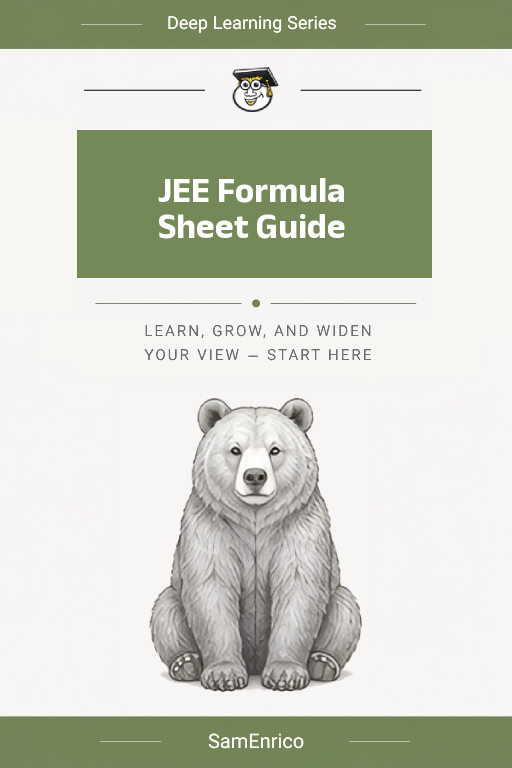
Non-FictionStudent's ShortcutFormula Mastery
JEE Formula Sheet Guide
Compile high-yield formulas from physics, chemistr
by Levin Reba
Compile high-yield formulas from physics, chemistry, and math into structured quick-reference sheets.
Formats
About this book
Free sample
Chapter 1: The Kinematics Code...--–- Most JEE aspirants drown in formulas because they treat them like a phonebook—memorized in order, forgotten under pressure. This chapter breaks that cycle. You are about to learn the 17 high-yield formulas that solve 70% of JEE Main’s kinematics and Newton’s law problems. But here is the secret: you will not just memorize them. You will learn the Trigger—the exact phrase in a question that tells you which formula to use.
By the end of this chapter, you will move from “I know this formula” to “I know exactly when to use it.”1.1 The Big Three: Your Kinematics Foundation Every kinematics problem in JEE rests on three equations. They assume one critical condition: constant acceleration. If acceleration changes, these equations break. JEE loves testing this assumption with trick problems.The Three Equations Equation When to Use Known Variables Unknown Variablev = u + at No displacement (s) givenu, a, tvs = ut + ½at²No final velocity (v) givenu, a, tsv² = u² + 2as No time (t) givenu, a, sv Trigger Table:“Starts from rest” → u = 0“Comes to rest” → v = 0“Moves with constant acceleration” → Use Big Three“Acceleration varies with time/position” → DO NOT use Big Three (use calculus)Common Pitfall #1: The Missing Sign JEE problems often give initial velocity upward, acceleration downward. Students plug numbers without signs and get wrong answers.Rule: Define a positive direction at the start of every problem.
Stick to it.Example: A ball thrown upward at 20 m/s from ground. Take upward positive.u = +20 m/sa = -g = -9.8 m/s²At top, v = 0Time to top: 0 = 20 - 9.8t → t = 2.04 s Without signs, you get nonsense.1.2 The S_n Formula: Distance in the nth Second This formula appears in JEE Main at least once every two years. Many students skip it because they think they can derive it. In exam pressure, derivation takes 45 seconds. Memorization takes 2 seconds.The Formula S_n = u + a/2 (2n - 1)Where S_n = distance traveled in the nth second (not first n seconds).Mnemonic: “Snake equals you plus half a snake…
This is the end of the free sample. Get the eBook to keep going. Buy now
Contents
- Chapter 1
- Chapter 2
- Chapter 3
- Chapter 4
- Chapter 5
- Chapter 6
- Chapter 7
- Chapter 8
- Chapter 9
- Chapter 10
- Chapter 11
- Chapter 12
Details
- Author
- Levin Reba
- Publisher
- SamEnrico
- Language
- English
- Genre
- Non-Fiction, Student's Shortcut, Formula Mastery
- Released
- 2026-05-29
- Pages (approx.)
- 133
- Available as
- eBook, Audiobook

Read better in the ZLOADR app
Your eBooks on your phone or tablet. Sign in with your SamEnrico account and start reading.
More by Levin Reba
 Deep Work for JournalistsLevin Reba$11.99
 Remote Retreats Neurodiversity InclusionLevin Reba$11.99
 The Wedding Planning DisputeLevin Reba$11.99
 Retirement Housing Partnership Deed GuideLevin Reba$11.99
 French Resistance Clandestine PressLevin Reba$11.99
 The Silk Road Kingpin: Inside the Rise and Fall of Ross UlbrichtLevin Reba$11.99
 Frozen Drift: The Miraculous Survival of the *Kuznetsov* CrewLevin Reba$11.99
 Understanding Chromosome 1 RingLevin Reba$17.99
 Budget Automation Tools GuideLevin Reba$12.99
 Raycast Power User AutomationLevin Reba$11.99
 How to Become a Dial BrusherLevin Reba$11.99
You may also like
 Hong Kong Handover 1997Dunn Johnnie$11.99
 Zumba For Postnatal Recovery CourseNeal Christian$11.99
 Zumba for BeginnersLadner Nikia$11.99
 YouTube Comment Mining GuideHumes Pandora$12.99
 Worry Box MeditationCarlin Rudy$11.99
 Workplace Stress MeditationNguyen Lynn$11.99
 Workplace Stress and Sleep RepairHawley Ivory$11.99
 Workplace Perfectionism CureDelaney Jeffry$11.99
 Workplace Injustice Anger GuideWallen Isabelle$11.99
 Work Addiction and Burnout LinkGreenwood Ester$11.99
 Women in Yoga and WellnessBeattie Galina$11.99
 Women in Stand Up ComedyChun Evangeline$11.99