
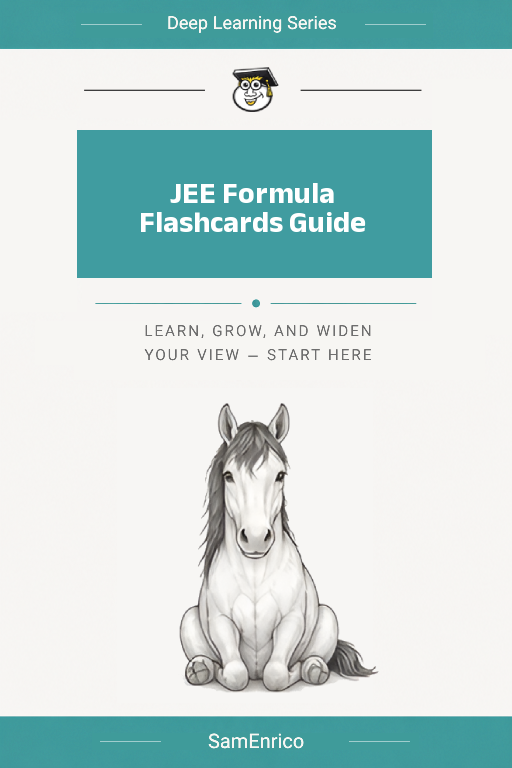
Non-FictionStudent's ShortcutFlashcards
JEE Formula Flashcards Guide Audiobook
Creates effective physical and digital flashcard s
by Rossi Anitra
Creates effective physical and digital flashcard systems for memorizing JEE formulas, reactions, and key constants.
Formats
Free sample
Chapter 1: The Forgetting Curve--–- Aryan stared at the formula sheet. He had spent three hours memorizing it yesterday. Forty formulas from the mechanics chapter. He knew them cold. He had written them five times each.
He had said them out loud until his roommate asked him to stop.Today, he could remember seven.Not seven formulas correctly. Seven formulas at all. The other thirty-three had vanished from his memory like water through a sieve. He flipped through his notebook, and each formula came back to him as he read it. "Oh, right," he muttered.
"I knew that." But he hadn't known it. Not really. He had recognized it when he saw it, but he couldn't retrieve it from his own mind.Aryan is not lazy. He is not unintelligent. He scored in the top fifteen percent of his class on the last exam.
But he is making the same mistake that millions of JEE aspirants make every year. He is confusing recognition with recall. He is mistaking the feeling of familiarity for the ability to produce.This chapter is about why Aryan forgot thirty-three formulas overnight, and what he—and you—can do about it.The Illusion of Fluency Every JEE aspirant knows the feeling. You spend hours reading formula sheets, highlighting key equations, nodding along as your teacher derives them on the board. The material feels familiar.
It feels like you know it. Then you sit for a mock test, and your mind goes blank.This is the illusion of fluency. When you re-read a formula sheet, your brain takes a shortcut. It recognizes the material without retrieving it. Recognition is easy.
It feels like learning. But it is not learning. It is the cognitive equivalent of looking at an answer key and believing you could have solved the problem yourself.The difference between recognition and recall is the difference between multiple-choice questions and fill-in-the-blank questions. On a multiple-choice test, the correct answer is in front of you. You just need to recognize it.
On the JEE, the correct formula is not in front of you. You need to produce it from memory, under time pressure, while simultaneously applying it to a novel problem.Recognition is a passive process. Recall is an active process. And active processes build memory. Passive processes do not.Here is the critical insight that separates top JEE scorers from the rest: every time you successfully…
This is the end of the free sample. Get the Audiobook to keep going. Buy now
About this book
Details
- Author
- Rossi Anitra
- Publisher
- SamEnrico
- Language
- English
- Genre
- Non-Fiction, Student's Shortcut, Flashcards
- Released
- 2026-05-28
- Pages (approx.)
- 114
- Available as
- eBook, Audiobook

Listen in the VoxFlicks app
Audiobooks and audio dramas wherever you go. Sign in with your SamEnrico account and press play.
More by Rossi Anitra
 The Constraint CalendarRossi Anitra$11.99
 Divorce Without ChildrenRossi Anitra$11.99
 Citrus Smell AnchorRossi Anitra$11.99
 Research Paper AI PromptsRossi Anitra$11.99
 The Sleep Apnea Memory Damage GuideRossi Anitra$11.99
 The Lion Kings of Kush: Guardians of the NileRossi Anitra$11.99
 Associate District ManagerRossi Anitra$11.99
 Wave Payroll Features GuideRossi Anitra$12.99
 Understanding Pitt–hopkins SyndromeRossi Anitra$17.99
 How to Start a Checking Instruments and Appliances (non-electronic) Business (Beginners Guide)Rossi Anitra$11.99
You may also like
 Hong Kong Handover 1997Dunn Johnnie$11.99
 Zumba For Postnatal Recovery CourseNeal Christian$11.99
 Zumba for BeginnersLadner Nikia$11.99
 YouTube Comment Mining GuideHumes Pandora$12.99
 Worry Box MeditationCarlin Rudy$11.99
 Workplace Stress MeditationNguyen Lynn$11.99
 Workplace Stress and Sleep RepairHawley Ivory$11.99
 Workplace Perfectionism CureDelaney Jeffry$11.99
 Workplace Injustice Anger GuideWallen Isabelle$11.99
 Work Addiction and Burnout LinkGreenwood Ester$11.99
 Women in Yoga and WellnessBeattie Galina$11.99
 Women in Stand Up ComedyChun Evangeline$11.99