
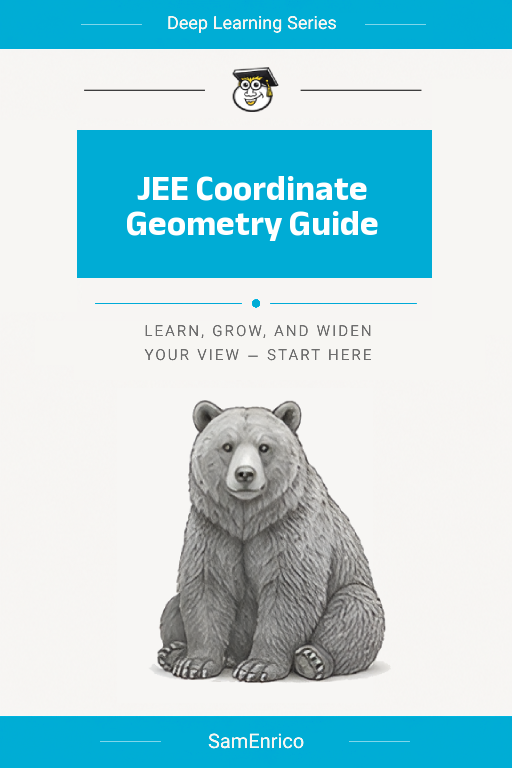
JEE Coordinate Geometry Guide eBook
Master circles, parabola, ellipse, and hyperbola e
Master circles, parabola, ellipse, and hyperbola equations with shortcut parametric forms and area calculations.
Formats
Free sample
Chapter 1: The Invisible Path--–- Close your eyes for a moment. Imagine a single point, floating freely in an endless plane. It has no size, no color, no weight. Now imagine a rule—a single condition that this point must obey. Perhaps it must stay exactly 5 units away from a fixed corner of the room.
Perhaps it must keep its distance to a certain line equal to its distance to a certain point. Perhaps the sum of its distances to two fixed pins must remain constant, like a string looped around them.As the point moves according to its rule, it traces a path. That path is invisible until you draw it. But once you see it, you recognize it. A circle.
A parabola. An ellipse. A hyperbola. Every conic section you will study in this book is nothing more than the invisible path of a point obeying a simple geometric command. This is the concept of a locus, and it is the single most important idea in coordinate geometry.Most JEE aspirants memorize formulas for circles, parabolas, ellipses, and hyperbolas without ever understanding where those formulas come from.
They learn that x2+y2=r2x^2 + y^2 = r^2x2+y2=r2 is a circle. They learn that y2=4axy^2 = 4axy2=4ax is a parabola. But when the exam presents a twisted condition like "the point moves such that its distance to (1,2) is twice its distance to the line x = 3," they freeze. They have memorized the destination but forgotten the journey.This chapter is that journey. You will learn to translate any geometric condition into an algebraic equation in four systematic steps.
You will master elimination techniques that strip away hidden parameters. You will wield graph transformations to sketch complex curves without plotting a single point. And you will discover the shifting origin trick—a method that turns messy, linear-term-laden equations into pristine standard forms in seconds.By the time you finish this chapter, you will not need to memorize the equation of a circle. You will derive it from first principles. You will not guess whether a parabola opens left or right.
You will know because you built its equation from its definition. Every formula in this book will become a natural consequence of the locus blueprint you construct right now.Let us begin.1.1 The Four-Step Method – Your Locus Blueprint Before we solve a single problem, we need a systematic method. The following four steps work for every locus problem in the JEE syllabus. Commit them to memory.Step 1: Let the moving point be P=(h,k)P = (h, k)P=(h,k). We use hhh and kkk temporarily to avoid confusion with the variables xxx and yyy that will appear in the final equation.Step 2: Translate the given geometric condition into an equation involving hhh and kkk.
This is the heart of the problem. Read carefully. "Distance from P to point A" becomes (h−x1)2+(k−y1)2\sqrt{(h - x_1)^2 + (k - y_1)^2}(h−x1)2+(k−y1)2. "Distance from P to line L" becomes a formula involving absolute values. "P lies on a circle with center C" becomes an equation.
Write exactly what the condition says.Step 3: Eliminate any parameters. If the condition introduces an extra variable (like ttt or θ\thetaθ), eliminate it using algebraic techniques. If there is no parameter, you are already done.Step 4: Replace (h,k)(h, k)(h,k) with (x,y)(x, y)(x,y). This returns the equation to standard coordinate notation. The result is the locus.That is it.
Four steps. They will never fail you. The only difference between an easy problem and a JEE Advanced problem is the complexity of Step 3.Let us test this method on a trivial example to see it in action.Example 1.1 (Basic Locus): Find the locus of a point PPP that moves such that its distance from the origin is always 5.Step 1: Let P=(h,k)P = (h, k)P=(h,k).Step 2: Distance from (h,k)(h, k)(h,k) to (0,0)(0, 0)(0,0) is h2+k2\sqrt{h^2 + k^2}h2+k2. The condition says h2+k2=5\sqrt{h^2 + k^2} = 5h2+k2=5. Square both sides: h2+k2=25h^2 + k^2 = 25h2+k2=25.Step 3: No parameters to eliminate.Step 4: Replace (h,k)(h, k)(h,k) with (x,y)(x, y)(x,y): x2+y2=25x^2 + y^2 = 25x2+y2=25.That is a circle centered at the origin with radius 5.
You already knew that. But notice: we did not start with the circle formula. The formula emerged from the definition. This is the power of locus thinking.Example 1.2 (Parameter Involved): A point PPP moves such that its coordinates are given by x=3t2x = 3t^2x=3t2, y=6ty = 6ty=6t, where ttt is a real parameter. Find the locus of PPP.Step 1: Let P=(h,k)P = (h, k)P=(h,k) with h=3t2h = 3t^2h=3t2 and k=6tk = 6tk=6t.Step 2: The condition is already given parametrically.
We need to eliminate ttt.Step 3: From k=6tk = 6tk=6t, we get t=k/6t = k/6t=k/6. Substitute into h=3t2h = 3t^2h=3t2: h=3(k/6)2=3(k2/36)=k2/12h = 3(k/6)^2 = 3(k^2/36) = k^2/12h=3(k/6)2=3(k2/36)=k2/12. Multiply both sides: 12h=k212h = k^212h=k2.Step 4: Replace (h,k)(h, k)(h,k) with (x,y)(x, y)(x,y): 12x=y212x = y^212x=y2, or y2=12xy^2 = 12xy2=12x.This is a parabola opening to the right. We found it without memorizing a single parabola formula. The parametric form gave us the equation directly after elimination.These two examples are simple.
But they reveal the essence of coordinate geometry. Every conic is a locus. Every locus can be found using these four steps. The rest of this chapter builds the algebraic skills to make Step 3 instantaneous.1.2 Algebraic Elimination – The Hidden Skill for 40% of JEE Problems Here is a truth that separates top JEE rankers from the rest: approximately 40% of coordinate geometry problems require parameter elimination. You will face parameters named ttt, θ\thetaθ, mmm, kkk, and λ\lambdaλ.
Your ability to eliminate them quickly determines whether you solve a problem in 60 seconds or 5 minutes.Elimination is the art of removing a parameter from two or more equations to find a direct relationship between xxx and yyy. There are four primary methods. Master all four, and you will never fear a parametric problem again.Method 1: Direct Substitution This is the simplest method. Solve one equation for the parameter and substitute into the other. Use this when one equation is linear in the parameter.Example 1.3: Eliminate ttt from x=2t+1x = 2t + 1x=2t+1, y=4t−3y = 4t - 3y=4t−3.From x=2t+1x = 2t + 1x=2t+1, we get t=(x−1)/2t = (x - 1)/2t=(x−1)/2.
Substitute into y=4t−3y = 4t - 3y=4t−3:y=4⋅x−12−3=2(x−1)−3=2x−2−3=2x−5y = 4 \cdot \frac{x - 1}{2} - 3 = 2(x - 1) - 3 = 2x - 2 - 3 = 2x - 5y=4⋅2x−1−3=2(x−1)−3=2x−2−3=2x−5.The locus is the straight line y=2x−5y = 2x - 5y=2x−5. Ten seconds. No complexity.Method 2: Equating Expressions (Trigonometric and Algebraic Identities)When the parameter appears in a symmetric way, solve each equation for the same function of the parameter and equate using an identity.Example 1.4: Eliminate θ\thetaθ from x=acosθx…
This is the end of the free sample. Get the eBook to keep going. Buy now
About this book
Details
- Author
- Hyatt Miguelina
- Publisher
- SamEnrico
- Language
- English
- Genre
- Non-Fiction, Student's Shortcut, Geometry Prep
- Released
- 2026-06-01
- Pages (approx.)
- 138
- Available as
- eBook, Audiobook

Read better in the ZLOADR app
Your eBooks on your phone or tablet. Sign in with your SamEnrico account and start reading.
More by Hyatt Miguelina
 Procrastination Study SolutionsHyatt Miguelina$11.99
 Merger Positioning Synergy GuideHyatt Miguelina$11.99
 Remote Retreats for Customer SupportHyatt Miguelina$11.99
 Norwegian Resistance School TeachersHyatt Miguelina$11.99
 Pomodoro Deep Work AdaptationHyatt Miguelina$11.99
 The Unlikely Rescue: How a Stranded Whale United a CommunityHyatt Miguelina$11.99
 The Silk Road's Shadow: The Untold Rise of the Opium Queen of YunnanHyatt Miguelina$11.99
 Polycrase MiningHyatt Miguelina$11.99
 Budget Vs Actual DashboardHyatt Miguelina$12.99
 Understanding ChoroideremiaHyatt Miguelina$17.99
 How to Become a Devulcanizer ChargerHyatt Miguelina$11.99