
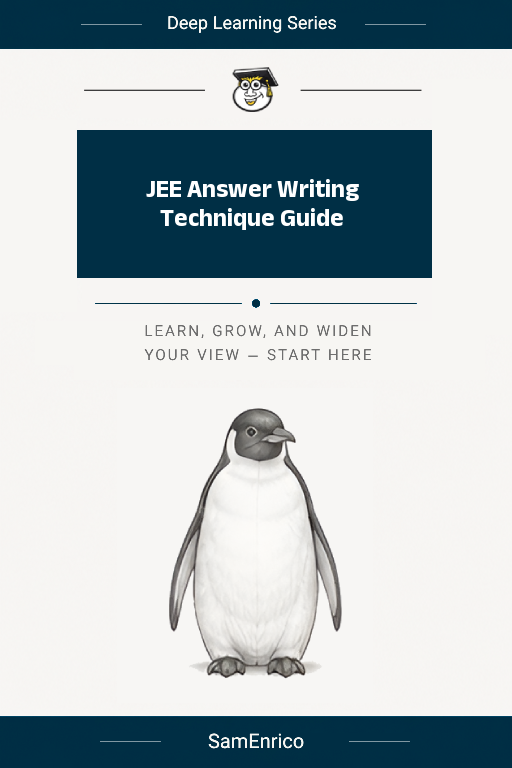
Non-FictionStudent's ShortcutAnswer Presentation
JEE Answer Writing Technique Guide
Teaches proper presentation, step marking, and par
Teaches proper presentation, step marking, and partial credit maximization for JEE Advanced numerical and subjective questions.
Formats
About this book
Free sample
Chapter 1: The Marking Matrix...--For three years, you have done everything right. You have solved thousands of problems. You have memorized every formula in the NCERT. You have worked through Irodov, through MS Chouhan, through the archives of past JEE papers. You walk into the examination hall with the quiet confidence of someone who has earned the right to succeed.Then the results come.
And something does not add up.You look at your score, then at the answer key, then back at your score. You solved the same number of questions as your friend who scored forty marks higher. You attempted the same NATs, the same MSQs, the same comprehension sets. But somehow, the examiner saw value in your friend’s answers that they did not see in yours.This chapter exists because that gap between being right and being scored as right is the single most misunderstood, under-taught, and underestimated factor in JEE Advanced preparation. Every year, thousands of students lose marks they have already earned – not because they lack conceptual understanding, but because they do not understand where the marks live on the page.The Fundamental Misunderstanding Most students believe that JEE Advanced marking is simple: get the final answer correct, receive full marks; get it wrong, receive zero.
This binary thinking is the first and most expensive mistake you will make.Let us examine the truth. The JEE Advanced examination is not a machine-graded multiple-choice test. It is a human-evaluated assessment of your problem-solving process. The final answer matters, yes. But the path you take to reach that answer – the steps you show, the logic you articulate, the clarity of your presentation – determines whether you receive credit when your final answer is wrong, partially correct, or even completely absent.Consider two students attempting the same 4-mark physics problem involving rotational motion.
Student A solves perfectly but writes illegibly, skips intermediate steps, and presents a final answer without units. Student B solves only 60 percent of the problem but writes clearly, shows every assumption, boxes intermediate values, and stops at the point where they realize they cannot…
This is the end of the free sample. Get the eBook to keep going. Buy now
Contents
- Chapter 1
- Chapter 2
- Chapter 3
- Chapter 4
- Chapter 5
- Chapter 6
- Chapter 7
- Chapter 8
- Chapter 9
- Chapter 10
- Chapter 11
- Chapter 12
Details
- Author
- Bland Jacelyn
- Publisher
- SamEnrico
- Language
- English
- Genre
- Non-Fiction, Student's Shortcut, Answer Presentation
- Released
- 2026-06-01
- Pages (approx.)
- 139
- Available as
- eBook, Audiobook

Read better in the ZLOADR app
Your eBooks on your phone or tablet. Sign in with your SamEnrico account and start reading.
More by Bland Jacelyn
 Creative Starvation SuccessBland Jacelyn$11.99
 Cause Effect Essay GPT GuideBland Jacelyn$11.99
 Rock Stacking PracticeBland Jacelyn$11.99
 The Nap Memory Boost HandbookBland Jacelyn$11.99
 Divorce and Pet CustodyBland Jacelyn$11.99
 The Healers of the Nile: Egypt's Forgotten Medical PioneersBland Jacelyn$11.99
 Asset Management AnalystBland Jacelyn$11.99
 Wave Accounting Free Setup GuideBland Jacelyn$12.99
 Understanding Pilo Dento Ungular Dysplasia MicrocephalyBland Jacelyn$17.99
 How to Start a Chemical Engineering Design Projects Business (Beginners Guide)Bland Jacelyn$11.99
You may also like
 Hong Kong Handover 1997Dunn Johnnie$11.99
 Zumba For Postnatal Recovery CourseNeal Christian$11.99
 Zumba for BeginnersLadner Nikia$11.99
 YouTube Comment Mining GuideHumes Pandora$12.99
 Worry Box MeditationCarlin Rudy$11.99
 Workplace Stress MeditationNguyen Lynn$11.99
 Workplace Stress and Sleep RepairHawley Ivory$11.99
 Workplace Perfectionism CureDelaney Jeffry$11.99
 Workplace Injustice Anger GuideWallen Isabelle$11.99
 Work Addiction and Burnout LinkGreenwood Ester$11.99
 Women in Yoga and WellnessBeattie Galina$11.99
 Women in Stand Up ComedyChun Evangeline$11.99