
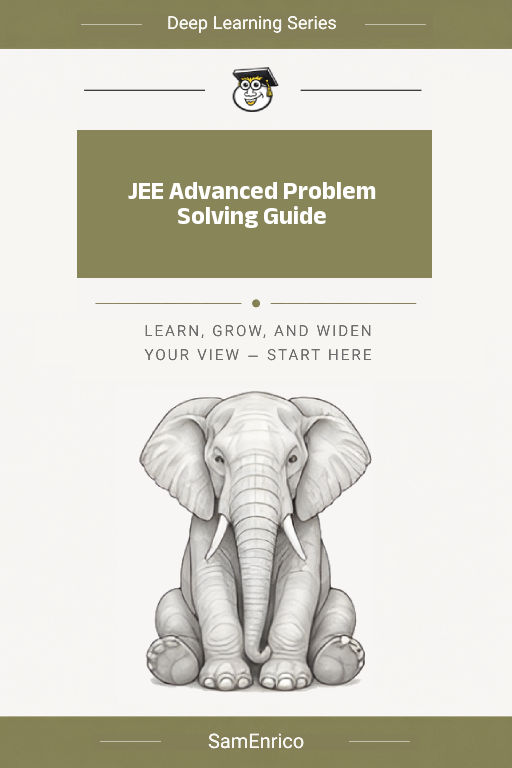
JEE Advanced Problem Solving Guide eBook
Tackle complex multi-concept problems using system
Tackle complex multi-concept problems using systematic approaches practiced by top rankers.
Formats
Free sample
Chapter 1: The Diagnosis Paradox--–- Knowing a formula is not the same as being able to solve a problem. If it were, every student who reads NCERT would secure an All India Rank under 100. Yet every year, thousands of students who have read every line of NCERT, memorized every derivation, and attended every lecture walk out of the JEE Advanced examination hall utterly bewildered. They say things like, "I knew the formula, but I couldn't apply it," or "The problem looked familiar, but I froze." This chapter is not about teaching you new formulas. It is about understanding why you cannot use the formulas you already know.
And more importantly, it is about building a personalized roadmap that will guide every decision you make for the rest of this book.The opening premise of this chapter is deliberately uncomfortable: you are probably making three times more mistakes than you realize, and most of them are not due to lack of intelligence or effort. They are due to a specific, diagnosable gap between recognition and recall. JEE Advanced does not test whether you have seen a formula before. It tests whether you can retrieve that formula spontaneously, under pressure, in a context that deliberately hides the cues you are used to. A student who can solve a simple physical pendulum problem in their notebook might completely freeze when the same pendulum is placed in a viscous medium, attached to a spring, or mounted on a moving platform.
The formula for time period is still T=2πI/mgd T = 2\pi\sqrt{I/mgd}T=2πI/mgd, but the problem no longer announces itself as a physical pendulum problem. That is the essence of the JEE Advanced challenge.This chapter serves as the diagnostic foundation for the entire book. Unlike every other chapter that follows, this one is designed to be completed untimed. There is no pressure to finish quickly. There is no clock counting down.
The only goal here is radical honesty about where you currently stand. The data you generate in this chapter will be referenced repeatedly in later chapters – when you choose your section order strategy in Chapter 7, when you build your error log in Chapter 8, and when you create your final 30-day revision plan in Chapter 12. If you skip this chapter or rush through it, every subsequent chapter will be less effective. This is not an introduction. It is a diagnostic laboratory.The Recognition Versus Recall Gap: Why Familiarity Fails Under Pressure The most dangerous illusion in JEE preparation is the feeling of familiarity.
You read a formula like F=ma F = ma F=ma or PV=n RTPV = n RTPV=n RT and you think, "I know this." But knowing is not the same as being able to use it. Cognitive psychologists distinguish between two entirely different mental processes: recognition and recall. Recognition is passive. It is the feeling of "I have seen this before." Recall is active. It is the ability to retrieve information from memory without any external cue.Here is a simple test to demonstrate the gap.
Complete the following sentences without looking back at the previous paragraph: "The formula for the time period of a physical pendulum is T=2π???T = 2\pi\sqrt{\text{???}}T=2π???." If you hesitated, you experienced the recognition-recall gap. You have seen the formula many times, but you could not retrieve it spontaneously. Now imagine that same hesitation happening under the 3-hour pressure of JEE Advanced Paper 1, with 60 questions competing for your attention, and your entire future seemingly hanging on each mark.To make this concrete, the reader is instructed to attempt the following exercise. Solve these five problems in order, without looking at any reference material, and time yourself loosely (not for speed, but to notice when you hesitate):Find the time period of a simple pendulum of length LLL on Earth.Find the time period of a physical pendulum consisting of a uniform rod of length LLL pivoted at one end.Find the time period of the same rod when it is oscillating in a viscous medium that exerts a damping torque proportional to angular velocity.Find the time period of the same rod when the pivot is attached to a spring that is itself oscillating horizontally.Find the time period of the same rod when the entire setup is inside an elevator accelerating upwards at g/2g/2g/2.Most students solve problem 1 easily. Problem 2 requires a moment of recall but is manageable.
Problem 3 introduces damping – suddenly the student is unsure whether the formula changes or just acquires an exponential factor. Problem 4 blends two domains (rotational mechanics and spring-mass systems) and many students freeze. Problem 5 is a non-inertial frame problem disguised as a pendulum problem, and by this point, the student who started confidently is now lost.The shock of this progression is intentional. It reveals that what you thought was "knowing" was actually just recognition. The rest of this book is designed to convert recognition into reliable recall under stress.
But first, you must accept that you have a gap. Denial is the enemy of improvement.The Three Types of Stupid Mistakes: A Diagnostic Framework Not all mistakes are created equal. When a student solves a problem incorrectly, they typically say "I made a silly mistake" and move on. This is a catastrophic error in itself. By lumping all mistakes into one category, you prevent yourself from identifying the actual root cause.
This book separates mistakes into three distinct types, each requiring a completely different solution.Type 1: Conceptual Mistakes – Using the Wrong Law A conceptual mistake occurs when you apply a law that does not apply to the situation. These are the most serious mistakes because they indicate a fundamental misunderstanding of physics, chemistry, or mathematics. They cannot be fixed by "being more careful" or "checking your work." They require re-learning the concept.Real JEE Example: A block of mass mmm is attached to a spring of spring constant kkk and placed on a rough horizontal surface with coefficient of friction μ\muμ. The block is pulled to stretch the spring by distance x0x_0x0 and released. Find the maximum compression of the spring.
The incorrect approach is to write 12kx02=12kxmax2\frac{1}{2}kx_0^2 = \frac{1}{2}kx_{\text{max}}^221kx02=21kxmax2 (conservation of mechanical energy). The mistake is conceptual because friction is non-conservative – mechanical energy is not conserved. The correct approach is the work-energy theorem: 12kx02−12kxmax2=μmg(x0+xmax)\frac{1}{2}kx_0^2 - \frac{1}{2}kx_{\text{max}}^2 = \mu mg(x_0 + x_{\text{max}})21kx02−21kxmax2=μmg(x0+xmax).How to identify a conceptual mistake: After checking the solution, ask yourself: "Did I know the correct law but forget to apply it, or did I not know that this law was required?" If the answer is the latter, it is a conceptual mistake. These mistakes are logged with a "C" in your diagnostic tracker.Type 2: Procedural Mistakes – Correct Law, Wrong Sequence A procedural mistake occurs when you know which law to use but you apply the steps in the wrong order. These mistakes are more subtle than conceptual mistakes because the final answer is often close to correct but not exactly right.
They indicate a weakness in problem-solving strategy, not in conceptual understanding.Real JEE Example: A system of two blocks connected by…
This is the end of the free sample. Get the eBook to keep going. Buy now
About this book
Details
- Author
- Gregory Everett
- Publisher
- SamEnrico
- Language
- English
- Genre
- Non-Fiction, Student's Shortcut
- Released
- 2026-06-01
- Pages (approx.)
- 154
- Available as
- eBook, Audiobook

Read better in the ZLOADR app
Your eBooks on your phone or tablet. Sign in with your SamEnrico account and start reading.
More by Gregory Everett
 Broken ToysGregory Everett$11.99
 Metta For Breakup HealingGregory Everett$11.99
 Eisenhower For Meetings GuideGregory Everett$11.99
 Tax Lien Wholesaling StrategyGregory Everett$11.99
 Immigrant AI Startup Founder JourneysGregory Everett$11.99
 Firangi and Desi DivideGregory Everett$11.99
 Borderline Parent Child WorthGregory Everett$11.99
 Shin Splints Prevention GuideGregory Everett$11.99
 Amputation Body Esteem GuideGregory Everett$11.99
 The Healers of Axum: Ancient Africa's Medical PioneersGregory Everett$11.99
 The Forgotten Codebreakers of World War IGregory Everett$11.99
 Breaking the Sound Barrier: The Untold Story of Chuck Yeager and the Bell X-1Gregory Everett$11.99
You may also like
 LSE Online Program LengthAgee Letisha$11.99
 Harvard Extension School for Working AdultsRoush Yer$11.99
 LSE Online Reading ListAshford Ludivina$11.99
 LSE Online Language RequirementsWhitten Daphine$11.99
 LSE Online Class SizeHughey Garret$11.99
 LSE Online Alumni MentorshipWild Lyla$11.99
 London School of Economics Alumni NetworkDutton Chantal$11.99
 Harvard Extension School Student SupportCantrell Christene$11.99
 Harvard Extension School Library AccessSantana Adah$11.99
 Harvard Extension School Degree CompletionBray Wyatt$11.99
 Harvard Extension School Course AuditingAbbott Craig$11.99
 Harvard Extension School Extension DiplomaNew Joane$11.99