
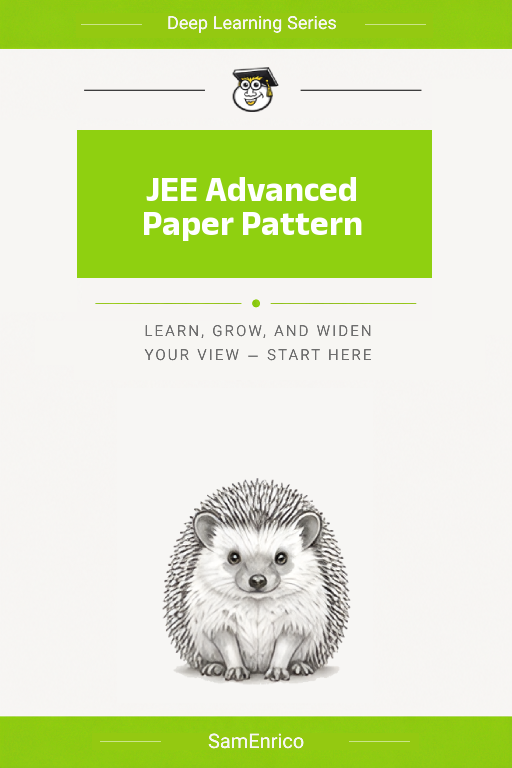
JEE Advanced Paper Pattern eBook
Solve integer-type and multiple-correct questions
by Neil Willian
Solve integer-type and multiple-correct questions using time allocation tactics across three two-hour papers.
Formats
Free sample
Chapter 1: The Two-Paper Fortress–- The alarm screams at 5:30 AM. You have slept four hours. Your heart pounds not from caffeine but from a singular, terrifying thought: In three hours, sixty Multiple Correct, Integer, Single Correct, and Matrix questions will decide the next five years of your life. You have memorized HC Verma, solved thousands of problems, and attended countless coaching classes. Yet, standing at the gate of the examination center, a cold sweat forms because you realize something crucial: You have never truly been taught how to fight this specific battle.
You know Physics, Chemistry, and Mathematics. But you do not know the JEE Advanced Paper Pattern. And that, more than any conceptual gap, is what separates the anxious from the inevitable.This chapter is not a dry listing of rules. It is a forensic dismantling of the examination fortress constructed by IIT Roorkee and IIT Rohtak for the 2024-2026 cycles. We will dissect the anatomy of Paper 1 and Paper 2, expose the hidden logic behind the distribution of the four question types, and reveal why pattern-recognition is a weapon equal in power to solving a complex differential equation.
By the end of this chapter, you will not merely know the pattern; you will see the exam the way a grandmaster sees a chessboard — not as a collection of random pieces, but as a system of predictable traps and opportunities.1. The Foundational Truth: Two Fortresses, Not One The single most destructive misconception among JEE Advanced aspirants is treating Paper 1 and Paper 2 as a single six-hour marathon with a lunch break. They are not. They are two independent three-hour examinations, designed with distinct personalities, difficulty gradients, and psychological objectives.Paper 1 (9:00 AM – 12:00 PM) is traditionally the "shock and awe" paper. It is designed to destabilize.
In recent years (2024-2025), Paper 1 has featured a higher proportion of Multiple Correct Questions (MCQs) and Matrix-Match problems that test cross-topic connections. The goal of the examiners is to force you to spend your first hour in a state of cognitive disorientation. If you enter Paper 1 expecting a gentle warm-up, you will crash.Paper 2 (2:30 PM – 5:30 PM) is the "precision strike." By afternoon, your brain has already endured three hours of intense focus. The examiners know this. Therefore, Paper 2 typically features a higher proportion of Integer/Numerical questions (where no negative marking offers a psychological safety net) and Single Correct Questions (SCQs) that reward deep, methodical verification over rapid guessing.
The shift from Paper 1 to Paper 2 is not just a change of time; it is a change of tempo.Consider the data from the 2025 JEE Advanced examination, analyzed by coaching institutes like FIITJEE and Allen:Paper 1: 42% MCQs, 25% Integers, 20% SCQs, 13% Matrix-Match.Paper 2: 30% MCQs, 35% Integers, 25% SCQs, 10% Matrix-Match.Notice the inversion. Paper 1 throws ambiguous, high-risk MCQs at you when your mind is freshest but most vulnerable to overthinking. Paper 2 offers you the "free hit" of Integer questions when fatigue has set in. Understanding this inversion is your first tactical victory.2. The Four Pillars of Battle: Dissecting Each Question Type Before you can allocate time or strategy, you must understand the inherent nature of each question type.
Think of these not as mere formats but as four different enemies, each with its own attack pattern.2.1 The Single Correct Question (SCQ): The Precision Duel Structure: Four options. Exactly one is correct. Marking: +4 for correct, -1 for incorrect.Psychology: The SCQ is the "honest" question. It rarely tries to trick you with subtle "all of the above" traps. Instead, it tests whether you know a specific formula, concept, or fact.
The danger of the SCQ is not ambiguity; it is time-sink. Because the answer is singular, students often fall into the trap of verifying all four options sequentially ("Is A correct? Yes. Is B correct? No.
Is C correct? No. Is D correct? No..."). This is a catastrophic waste of time.Where they hide: SCQs dominate the "definition-heavy" topics: Organic Chemistry reaction mechanisms, Physics laws (e.g., "Which of the following is not a consequence of Gauss's law?"), and Mathematics properties (e.g., "Which of the following functions is bijective?").Tactical Implication (from Chapter 2): You need 85%+ accuracy on SCQs for an AIR under 1000.
That means you should attempt approximately 10 out of 12 SCQs, but only those where you can identify the correct option within 90 seconds.2.2 The Multiple Correct Question (MCQ): The Hydra Structure: Four options. One or more (typically 2 or 3) are correct. Partial marking: +4 if all correct options selected, no incorrect; +2 if only half the correct options selected (e.g., 1 of 2) with no incorrect; -1 if any incorrect option selected along with correct ones.Psychology: This is the most dangerous question type. It is not a test of knowledge; it is a test of overconfidence. The partial marking system creates a perverse incentive: selecting one correct option is safer than selecting two correct options if you are unsure.
Many students lose 10-15 marks simply by selecting one wrong option on an MCQ they otherwise understood.Where they hide: MCQs dominate "comparative" topics: Inorganic Chemistry (comparing properties of p-block elements), Physics (comparing two physical situations), and Calculus (comparing function behaviors).Tactical Implication (from Chapter 5): Do NOT attempt MCQs in your first pass. Flag them. Return only after solving all SCQs and Integers. Apply the "One is True" Hypothesis: find the first provably correct option, then try to disprove the remaining three rather than verifying them.2.3 The Integer/Numerical Question: The Free Hit Structure: No options. You compute a numerical answer (typically an integer between 0 and 9, or a multi-digit integer).
Marking: +4 for correct, 0 for incorrect. No negative marking.Psychology: This is the only question type where the examiners have removed all downside risk. An incorrect Integer question does not penalize you; it simply does not reward you. This creates a profound psychological shift: every Integer question attempted, even with a wild guess, has a positive expected value. Yet, astonishingly, many students leave Integer questions blank because they are "unsure."Where they hide: Chapters that produce "clean" numbers: Physics (Units & Dimensions, Modern Physics - photoelectric effect, Optics - lens formula), Chemistry (Mole Concept, Coordination Compounds oxidation states, Thermodynamics ΔU/ΔH), Mathematics (Probability with factorials, Vectors dot/cross products, Complex Numbers roots of unity).Tactical Implication (from Chapter 4): Spend 3-4 minutes per Integer question — longer than any other type — because zero penalty makes the risk worthwhile.
Attempt 90% of all Integers in the paper. A logical guess using unit analysis or boundary estimation is infinitely better than a blank.2.4 The Matrix-Match Question: The Puzzle Box Structure: Two columns (Column A with 4 entries, Column B with 4-6 entries). You match each entry in Column A to one or more entries in Column B. Marking varies: typically +4 for fully correct, partial for partially correct.Psychology: The Matrix question is a logic puzzle dressed as a content question. It tests your ability to find unique mappings.
Most students waste 5-7 minutes on a single Matrix question because they try to solve it sequentially (match A1 to B1, then A2, etc.). The secret is one-to-one mapping: find the entry in Column B that uniquely matches only one entry in Column A, then eliminate.Where they hide: Inorganic Chemistry (reagents to colors/compounds), Physics (units to dimensions, phenomena to laws), Mathematics (functions to ranges, matrices to properties).Tactical…
This is the end of the free sample. Get the eBook to keep going. Buy now
About this book
Details
- Author
- Neil Willian
- Publisher
- SamEnrico
- Language
- English
- Genre
- Non-Fiction, Student's Shortcut, Advanced Pattern, Time Management
- Released
- 2026-06-01
- Pages (approx.)
- 156
- Available as
- eBook, Audiobook

Read better in the ZLOADR app
Your eBooks on your phone or tablet. Sign in with your SamEnrico account and start reading.
More by Neil Willian
 Stress and Digital Distraction CouplesNeil Willian$11.99
 Drowning Rescue CPRNeil Willian$11.99
 The Expectation ReleaseNeil Willian$11.99
 Menopause Hot Flash BreathNeil Willian$11.99
 Gratitude for Difficult ChildhoodNeil Willian$11.99
 YouTube Creator MemoirNeil Willian$11.99
 Missing My Family at SeaNeil Willian$11.99
 Travel Nap Jet Lag PreventionNeil Willian$11.99
 Blue Zone Plant Based DietNeil Willian$11.99
 Gates of Immortality: The Untold Siege of BabylonNeil Willian$11.99
 The Codebreakers' War: How Women Cracked the Enigma Before the MachinesNeil Willian$11.99
 The Lost Peaks of Kilimanjaro: The Renaissance Climbers Who Defied the ImpossibleNeil Willian$11.99