
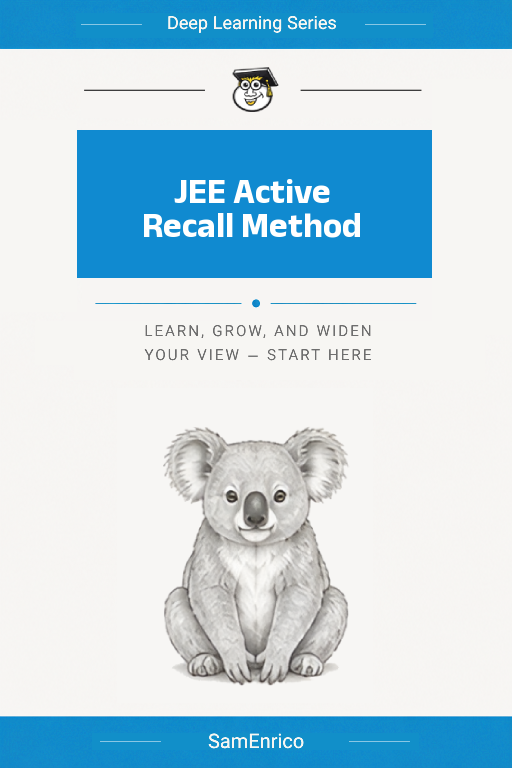
JEE Active Recall Method Audiobook
Use self-testing and spaced repetition to retain f
Use self-testing and spaced repetition to retain formulas and reactions.
Formats
Free sample
Chapter 1: The 6,400 Formula Trap--It begins not with a bang, but with a slow, creeping dread. You have just finished studying a chapter—let us say it is Electrostatics. You understood Coulomb's law. You worked through the derivation of electric field due to a dipole. You even solved ten practice problems, getting eight of them correct.
You close the book, satisfied. You feel competent. You feel prepared.Three days later, you open a mock test. Question one: "Two point charges are placed at the vertices of an equilateral triangle. Find the net electric field at the third vertex." You stare at the page.
Your mind is not empty—it is worse than empty. It is full of fog. You know you studied this. You remember that there was a formula involving 14πϵ0\frac{1}{4\pi\epsilon_0}4πϵ01. But is it qr2\frac{q}{r^2}r2q or qr\frac{q}{r}rq?
Do you add vectors or scalars? What about the angle? You spend ninety seconds fumbling, then guess, then move on. By the end of the test, you have lost twenty marks on questions you know you studied.This is not a story about laziness. This is not a story about low IQ or poor coaching.
This is a story about a fundamental mismatch between how you are studying and how your brain actually works. And until you understand that mismatch, you will continue to pour hundreds of hours into methods that actively work against you.The Number That Should Scare You Let us begin with a calculation. Over the two years of JEE preparation, you are expected to learn:Physics: Approximately 1,200 formulas, including derivations, special cases, and dimensional constants. This covers Mechanics, Electrodynamics, Thermodynamics, Optics, and Modern Physics.Chemistry: Approximately 2,800 distinct pieces of information. Organic reactions (naming reactions, mechanisms, reagents) account for about 1,200.
Inorganic facts (colors, oxidation states, qualitative analysis, periodic trends) account for another 1,000. Physical Chemistry formulas (thermodynamics, kinetics, equilibrium) account for the remaining 600.Mathematics: Approximately 2,400 formulas, theorems, and identities across Algebra, Calculus, Trigonometry, Coordinate Geometry, and Vectors.The total is roughly 6,400 distinct items. That is the minimum. Some estimates go higher when you include exceptions, named reactions, and obscure formulas that appear once every five years.Now, let us do the math on what it would take to memorize 6,400 items using brute force. Assume you spend 10 minutes on each item—reading it, writing it, repeating it.
That is 64,000 minutes. Divide by 60: 1,067 hours. Divide by 365 days: nearly 3 hours of pure memorization every…
This is the end of the free sample. Get the Audiobook to keep going. Buy now
About this book
Details
- Author
- Schneider Katrina
- Publisher
- SamEnrico
- Language
- English
- Genre
- Non-Fiction, Student's Shortcut
- Released
- 2026-06-01
- Pages (approx.)
- 147
- Available as
- eBook, Audiobook

Listen in the VoxFlicks app
Audiobooks and audio dramas wherever you go. Sign in with your SamEnrico account and press play.
More by Schneider Katrina
 Female Athlete Triad PreventionSchneider Katrina$11.99
 Listen To Understand Not ReplySchneider Katrina$11.99
 Immigrant Automotive Repair Chain GuideSchneider Katrina$11.99
 Wholesaling Cold Calling ScriptsSchneider Katrina$11.99
 Writer's Block SolutionSchneider Katrina$11.99
 The Bicycle BlameSchneider Katrina$11.99
 Explosive Residue TraceSchneider Katrina$11.99
 Coppola Dynasty - Francis Ford CoppolaSchneider Katrina$11.99
 ADHD Childhood Self EsteemSchneider Katrina$11.99
 The Silk Road's Shadow: Ross Ulbricht and the Birth of Bitcoin's Wild WestSchneider Katrina$11.99
 The Siege of Handan: Qin's Ruthless GambitSchneider Katrina$11.99
 The Asura's Curse: How a Fallen Titan Shaped the CosmosSchneider Katrina$11.99
You may also like
 Hong Kong Handover 1997Dunn Johnnie$11.99
 Zumba For Postnatal Recovery CourseNeal Christian$11.99
 Zumba for BeginnersLadner Nikia$11.99
 YouTube Comment Mining GuideHumes Pandora$12.99
 Worry Box MeditationCarlin Rudy$11.99
 Workplace Stress MeditationNguyen Lynn$11.99
 Workplace Stress and Sleep RepairHawley Ivory$11.99
 Workplace Perfectionism CureDelaney Jeffry$11.99
 Workplace Injustice Anger GuideWallen Isabelle$11.99
 Work Addiction and Burnout LinkGreenwood Ester$11.99
 Women in Yoga and WellnessBeattie Galina$11.99
 Women in Stand Up ComedyChun Evangeline$11.99