
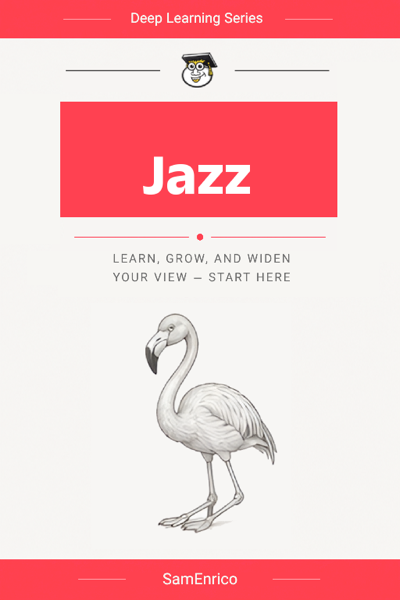
Free sample
Chapter 1: The Swing Question...--–- On a humid evening in 1938, a young man walked into the Savoy Ballroom in Harlem for the first time. He had studied classical piano for twelve years. He could read orchestral scores, name any chord inversion, and recite the entire circle of fifths from memory. But as the Count Basie orchestra launched into "One O'Clock Jump," he froze. The rhythm section was not playing what was written.
The bass player was sliding between notes that did not exist in any scale he knew. The drummer was hitting the snare drum on the backbeat – beats two and four – with an urgency that made his own foot tap involuntarily. And then the tenor saxophonist stood up to solo. The young man later wrote in his journal: "He played twenty choruses. I could not predict a single note.
And yet every note felt inevitable. I realized I understood nothing."That young man was not a novice. He was a Juilliard-trained musician who would later become one of the most respected musicologists of his generation. But on that night, he encountered a truth that no textbook had prepared him for: jazz is not primarily a written art. It is not about notes on a page.
It is about a question – a question that every jazz musician asks, consciously or not, every time they play. That question is: How do I respond to what just happened?This chapter is called "The Swing Question" because swing is not merely a rhythm. Swing is an attitude, a conversation, and above all, a way of listening. Before we can study jazz history, learn chord progressions, or transcribe Charlie Parker solos, we must first understand what makes jazz jazz. And that understanding begins not with theory, but with three foundational pillars that have survived every stylistic change from New Orleans to hip-hop fusion.The Three Pillars: What Makes Music "Jazz"?If you ask ten jazz musicians to define jazz, you will get eleven answers.
Some will say it is a feeling. Others will insist it is a specific harmonic vocabulary. A few will argue that jazz died in 1965 and everything since is something else. But despite these disagreements, nearly all jazz traditions share three core characteristics: swing rhythm, improvisation, and the blues feeling. These are not checkboxes; they are overlapping, interdependent forces.
You can have swing without the blues (some European jazz). You can have improvisation without swing (some avant-garde classical). But…
This is the end of the free sample. Get the Audiobook to keep going. Buy now
About this book
Details
- Author
- Gossett Mariann
- Publisher
- SamEnrico
- Language
- English
- Genre
- Non-Fiction, Informative, Educational
- Released
- 2026-06-02
- Pages (approx.)
- 158
- Available as
- eBook, Audiobook

Listen in the VoxFlicks app
Audiobooks and audio dramas wherever you go. Sign in with your SamEnrico account and press play.
More by Gossett Mariann
 Paleo Smoothies Without FruitGossett Mariann$11.99
 Body Recomp For BeginnersGossett Mariann$11.99
 Leading Overland Myanmar To LaosGossett Mariann$11.99
 Fentanyl Danger GuideGossett Mariann$11.99
 The Swiss Vanguard: Blood and Gold in the Italian WarsGossett Mariann$11.99
 Escalation Clause Contract Pricing WorkbookGossett Mariann$12.99
 How to Produce Candle SnuffersGossett Mariann$11.99
 How to Start a Agricultural College Business (Beginners Guide)Gossett Mariann$11.99
You may also like
 Hong Kong Handover 1997Dunn Johnnie$11.99
 Zumba For Postnatal Recovery CourseNeal Christian$11.99
 Zumba for BeginnersLadner Nikia$11.99
 YouTube Comment Mining GuideHumes Pandora$12.99
 Worry Box MeditationCarlin Rudy$11.99
 Workplace Stress MeditationNguyen Lynn$11.99
 Workplace Stress and Sleep RepairHawley Ivory$11.99
 Workplace Perfectionism CureDelaney Jeffry$11.99
 Workplace Injustice Anger GuideWallen Isabelle$11.99
 Work Addiction and Burnout LinkGreenwood Ester$11.99
 Women in Yoga and WellnessBeattie Galina$11.99
 Women in Stand Up ComedyChun Evangeline$11.99