
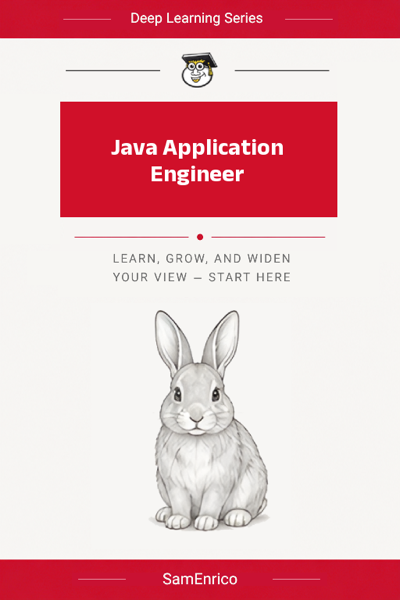
Java Application Engineer eBook
A Coursebook on Java Application Engineer
by Steen Asa
A Coursebook on Java Application Engineer
Formats
Free sample
Chapter 1: The 3 AM Pager--– It was 3:14 AM on a Saturday when Sarah’s pager went off. Not a simulated alert from a training exercise. Not a false alarm from overeager monitoring. A real, hair-on-fire, “customers-cannot-check-out” production outage at a mid-sized e-commerce company where she’d been a Java developer for eighteen months.She sat up in bed, heart racing, and opened her laptop. The alert read: Null Pointer Exception in Order Processor.calculate Total - 98% error rate. Twenty minutes later, after scrolling through logs and restarting the service twice, she found the culprit. A new developer had added a get User().get Address().get Postal Code() chain without checking if get User() or get Address() could return null. The null came from a rare edge case—a guest checkout that never completed address verification. In two weeks of testing, no one hit that path. In production, it triggered exactly once per hour, corrupting the order total and failing silently until the error rate tripped the alert.The fix took two lines of code. The cost of the outage? Approximately $47,000 in lost sales and overtime. The cost to Sarah’s reputation? Higher. The question that haunted her afterward was not “How do I avoid null pointers?” but something much deeper: Why did no one, including me, ask what could break before we shipped?This chapter is not about syntax. It is not about design patterns or frameworks or which IDE to use. It is about the single most important distinction in your career: the difference between a Java Developer who writes code that works on their machine, and a Java Application Engineer who writes code that survives in production, under load, through failures, and across years of maintenance by strangers.The 80/20 Rule of Engineering Impact Let us begin with an uncomfortable truth. Writing functional code is approximately 20% of what makes a valuable software engineer. The remaining 80% consists of activities that are rarely taught in bootcamps, poorly covered in most tutorials, and almost never discussed in job interviews—yet they determine whether you are trusted with critical systems.The 20% that everyone focuses on:Syntax and language features Algorithmic efficiency Getting the feature to compile and pass basic tests Making it “work on my machine”The 80% that actually matters in production:Defensive design: Anticipating what could go wrong and coding defensively against it Observability: Ensuring you can understand system behavior without guessing Resilience: Handling failures of dependencies without cascading collapses Maintainability: Writing code that can be safely modified by someone who has never met you Operability: Deploying, scaling, rolling back, and debugging in production environments Security: Preventing the injection, access, and cryptographic flaws that cause real breaches Performance under load: Understanding JVM behavior, GC tuning, and concurrency Testing strategy: Knowing what to test, how much to test, and where tests provide leverage This chapter begins the process of shifting your center of gravity from the 20% to the 80%. By the end of this book, you will not simply know more Java. You will be a different kind of engineer.The Three Questions Every Senior Engineer Asks Before Writing a Single Line Before Sarah’s team shipped the Null Pointer Exception that woke her at 3 AM, no one asked three simple questions. Senior engineers, regardless of title, have internalized these questions to the point of reflex. Juniors think they are too busy coding to ask. Let us correct that right now.Question 1: How does this fail?This is not a cynical question. It is an engineering question. Every piece of software, every feature, every line of code has multiple failure modes. The question forces you to enumerate them before they manifest in production.For the postal code example, the failure modes include:get User() returns null (user deleted or never persisted)get User() returns a user with get Address() returning null (address incomplete)get Address() returns an address with get Postal Code() returning null (data migration gap)get User() returns a user whose address object is populated but postal Code is an empty string (validation failure)The database connection to retrieve the user fails (network partition)The user object exists but the session is expired (concurrent modification)A junior developer sees “get the postal code.” A senior engineer sees six distinct failure modes. The difference is not intelligence. It is discipline.Question 2: How do I know it is working?If you cannot answer this question with something other than “it hasn’t crashed yet,” you are flying blind. Production systems need explicit, verifiable indicators of health.The answer takes forms:Metrics: A counter for successful order completions, a histogram of latency per endpoint, a gauge of queue depth Logs: Structured, searchable records of significant events, including correlation IDs to trace requests across services Health checks: An endpoint that verifies all critical dependencies (database, message broker, cache) are reachable Tests: Automated assertions that would catch the failure mode before it reaches production For the postal code example, “how do I know it’s working” includes: a metric for null returns, a log entry every time a user lacks a postal code, and a health check that verifies address completion rates stay above 99%.Question 3: How do I roll it back?Every deployment is a hypothesis. The hypothesis might be wrong. When it is wrong, speed of recovery matters more than speed of deployment.Rollback planning means:Can you revert to the previous version in under five minutes?Are database migrations reversible? (Adding a column: reversible. Dropping a column: not without data loss. This matters.)Can you feature-flag the new behavior to disable it without redeploying?Does your CI/CD pipeline support one-click rollback?If you cannot answer “how do I roll this back,” you are not ready to deploy it. The only exception is when the cost of rollback is lower than the cost of fixing forward—but that is a calculated decision, not an accident.Defensive Programming: The Core Discipline Defensive programming is not pessimism. It is realism applied to code. The principle is simple: trust no input, trust no state, trust no assumption that cannot be verified. Every external call, every user input, every object reference, every database query result is a potential failure point. Defensive code validates, checks, and fails fast with meaningful errors.Validate All Inputs at the Boundary The most common source of production bugs is not complex algorithms. It is unexpected inputs that violate implicit assumptions.java Copy Download// Non-defensive: assumes user and address are never null
public Big Decimal calculate Total(Order order) { String postal Code = order.get User().get Address().get Postal Code(); return apply Shipping By Region(postal Code, order.get Items()); }
// Defensive: validates at the boundary public Big Decimal calculate Total(Order order) { if (order == null) { throw new Illegal Argument Exception("Order cannot be null"); }
User user = order.get User(); if (user == null) { throw new Illegal State Exception("Order " + order.get Id() + " has no associated user"); }
Address address = user.get Address(); if (address == null || address.get Postal Code() == null || address.get Postal Code().is Blank()) { // Log with correlation ID for debugging log.warn("Order {} missing valid postal code, using default shipping", order.get Id()); return calculate Default Shipping(order.get Items()); }
return apply Shipping By Region(address.get Postal Code(), order.get Items()); }The defensive version is longer. It is also production-ready. The non-defensive…
This is the end of the free sample. Get the eBook to keep going. Buy now
About this book
Details
- Author
- Steen Asa
- Publisher
- SamEnrico
- Language
- English
- Genre
- Non-Fiction, Informative, Educational
- Released
- 2026-05-04
- Pages (approx.)
- 154
- Available as
- eBook, Audiobook

Read better in the ZLOADR app
Your eBooks on your phone or tablet. Sign in with your SamEnrico account and start reading.
More by Steen Asa
 Red Light Breath PracticeSteen Asa$11.99
 Recovery From Pandemic BurnoutSteen Asa$11.99
 Pre Talk Movement SnackSteen Asa$11.99
 Anger in Neurodiverse CouplesSteen Asa$11.99
 The Self Worth Affirmation Rewiring GuideSteen Asa$11.99
 The Lion and the Rose: The Golden Court of Eleanor of AquitaineSteen Asa$11.99
 Rwanda Tech Hub Innovation GuideSteen Asa$12.99
 Excel To Presentation ShortcutsSteen Asa$12.99Excel To Presentation ShortcutsSteen Asa$12.99
 Understanding Lyp (Lymphomatoid Papulosis)Steen Asa$17.99
 How to Become a Laminator ISteen Asa$11.99