
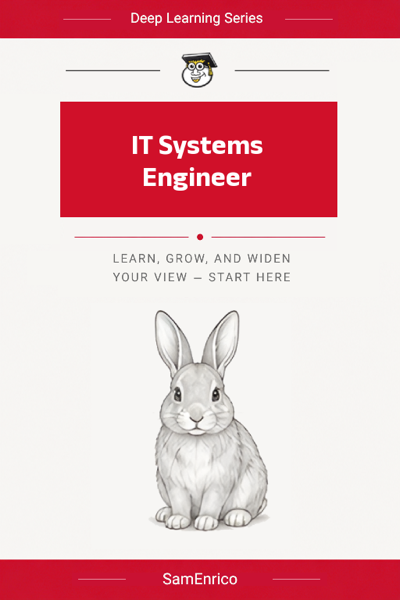
IT Systems Engineer eBook
A Coursebook on IT Systems Engineer
by Laws Lucina
A Coursebook on IT Systems Engineer
Formats
Free sample
Chapter 1: The Glue Paradox...–- It was 2:47 AM on Black Friday when the pager woke Sarah for the third time in an hour. The e-commerce platform she helped build was supposed to handle ten times its usual traffic. Instead, every third request was timing out. The software engineers pointed at the infrastructure. The systems administrators pointed at the code.
No one was wrong. No one was right. And absolutely no one was sleeping.The outage lasted four hours and cost the company $2.4 million in lost sales. The post-mortem would later reveal the root cause: a single misconfigured TCP keepalive setting that no single team owned. The developers assumed the network team handled connection lifetimes.
The network team assumed the application managed its own connections. The systems engineers? The company didn't have any. They had brilliant coders and skilled operators, but they had no one whose job was to stare directly into the gap between them.That company now has a dedicated Systems Engineering team. Sarah leads it.This book is for everyone who has ever been Sarah – or who wants to be.The Definition Problem: Why Nobody Can Agree What a Systems Engineer Does Open any job search website and search for "Systems Engineer." You will find job descriptions that range from "write Python automation scripts" to "manage VMware clusters" to "design cloud architecture" to "troubleshoot networking issues." Some require a computer science degree.
Others require a Cisco certification. A few ask for Kubernetes experience. Many ask for all of the above and a willingness to carry a pager.This confusion is not accidental. It reflects a deeper truth: systems engineering has always been the discipline that lives in the cracks between other, more established disciplines. Software engineering has code.
Database administration has schemas. Network engineering has packets. Systems engineering has the entire mess in between.Here is the definition we will use throughout this book, and it is intentionally narrow:A Systems Engineer is someone who ensures that software runs correctly, safely, and scalably in production, by bridging the gap between application code and the infrastructure it runs on.Notice what this definition does not say. It does not say you must be an expert programmer, though you will write code. It does not say you must be a certified network architect, though you will debug packets.
It does not say you must be a Linux kernel contributor, though you will stare at /proc files. It says you must bridge – meaning you sit at the intersection, understanding enough of each domain to translate between them and to catch the failures that fall into the gaps.This is what makes systems engineering uniquely challenging and uniquely valuable. When everything works, no one notices you. When something breaks, everyone looks at you – not because you caused it, but because you are the only person who can see both the application logs and the system metrics at the same time.The Fallacies That Will Eventually Break You In the 1990s, two engineers at Sun Microsystems – Bill Joy and James Gosling – articulated a set of assumptions that programmers made about distributed systems. They called these assumptions the "Fallacies of Distributed Computing," and they remain astonishingly relevant three decades later.
These fallacies are not academic curiosities. They are the direct cause of the majority of production outages you will ever experience.Let us examine each fallacy, because understanding them is the first step toward becoming a systems engineer worth hiring.Fallacy #1: The network is reliable.Every engineer who has ever worked on a distributed system has learned this lesson the hard way. Packets get dropped. Cables get cut. DNS servers stop responding.
Load balancers exhaust their connection tables. Cloud providers have regional outages. A squirrel chews through a fiber optic line. (This actually happened to a major trading firm in 2014, causing a 45-minute outage.)The network is not reliable. It has never been reliable.
It will never be reliable. The only question is how you design your systems to survive its unreliability. Do you retry failed requests? Yes. Do you retry them indefinitely?
No – that is how you create a retry storm. Do you implement circuit breakers? Yes. Do you configure them correctly? Most teams do not.Fallacy #2: Latency is zero.When you call a function in the same process, the return is effectively instantaneous – measured in nanoseconds.
When you make an HTTP request to a service on a different continent, the round trip is measured in milliseconds. Six orders of magnitude difference. Yet developers consistently write code as if the network were a local function call.Consider what happens when a microservice calls three other services in sequence. If each call takes 100 milliseconds (a reasonable number for a well-optimized service), the total latency is 300 milliseconds – already noticeable to a human user. If one of those services has a temporary slowdown to 500 milliseconds, the total latency becomes over one second.
Users click again. Retries multiply. The system collapses under its own weight.The systems engineer asks: What is the p99 latency of each dependency? What happens when that latency doubles? Triples?
What circuit breakers and timeouts protect the system? These are not implementation details. They are design questions.Fallacy #3: Bandwidth is infinite.The cloud makes bandwidth feel infinite. It is not. Every network interface has a maximum throughput.
Every cloud provider charges for data transfer. Every database replication stream has a limit. Every log aggregation system can be overwhelmed.A single misconfigured log statement can generate gigabytes per second. A background job that pulls the entire database every hour can saturate a network link. A distributed tracing system sampling 100% of requests can produce more telemetry data than your monitoring stack can ingest.
The systems engineer monitors bandwidth utilization and knows what "normal" looks like.Fallacy #4: The network is secure.This fallacy is the most dangerous because it is the least obviously false. Your internal network is not secure. VPNs have vulnerabilities. TLS certificates expire. Service meshes can be misconfigured.
Developers accidentally commit credentials to public repositories. A single compromised container can become a foothold for lateral movement across your entire cluster.The systems engineer assumes the network is hostile – even the internal network. Service-to-service authentication is mandatory, not optional. Secrets are rotated automatically. Zero-trust networking is the baseline, not an aspiration.Fallacy #5: Topology doesn't change.Your beautifully architected three-tier application with web servers, application servers, and database servers assumes the servers stay where you put them.
In the cloud, they do not. Instances are terminated and replaced. Autoscaling groups add and remove capacity. Kubernetes reschedules pods across nodes. Region failover sends traffic to entirely different data centers.The systems engineer builds systems that assume topology changes constantly.
Service discovery is automatic, not hardcoded. Configuration is dynamic, not static. Health checks determine routing, not fixed IP addresses.Fallacy #6: There is one administrator.This fallacy is subtle and devastating. It assumes that one person – or one team – controls the entire system. In modern organizations, no one does.
The frontend team controls the CDN configuration. The backend team controls the API gateways. The data team controls the databases. The platform team controls the Kubernetes clusters. The security team controls the firewall rules.
And the SRE team is paged when any of them breaks.The systems engineer is not the administrator of all things.…
This is the end of the free sample. Get the eBook to keep going. Buy now
About this book
Details
- Author
- Laws Lucina
- Publisher
- SamEnrico
- Language
- English
- Genre
- Non-Fiction, Informative, Educational
- Released
- 2026-05-11
- Pages (approx.)
- 157
- Available as
- eBook, Audiobook

Read better in the ZLOADR app
Your eBooks on your phone or tablet. Sign in with your SamEnrico account and start reading.
More by Laws Lucina
 Assertiveness for Divorce ProceedingsLaws Lucina$11.99
 Meditation for Ovarian Cyst PainLaws Lucina$11.99
 Teresa of Ávila Mystical Marriage RingLaws Lucina$11.99
 Self Hypnosis For Memory Enhancement WorkbookLaws Lucina$11.99
 Leading Hybrid Customer SupportLaws Lucina$11.99
 The Silent Depths: The Quest to Map the Indian Ocean’s Hidden WondersLaws Lucina$11.99
 Shadows of the Senate: The Untold Rise of Hiram Rhodes RevelsLaws Lucina$11.99
 How to Start a Parts of Suits for Men and Boys Business (Beginners Guide)Laws Lucina$11.99
 Harvard Extension vs LSE Admission RateLaws Lucina$12.99
 House Sitting Calendar GuideLaws Lucina$12.99
 Understanding Epilepsy Microcephaly Skeletal DysplasiaLaws Lucina$17.99