
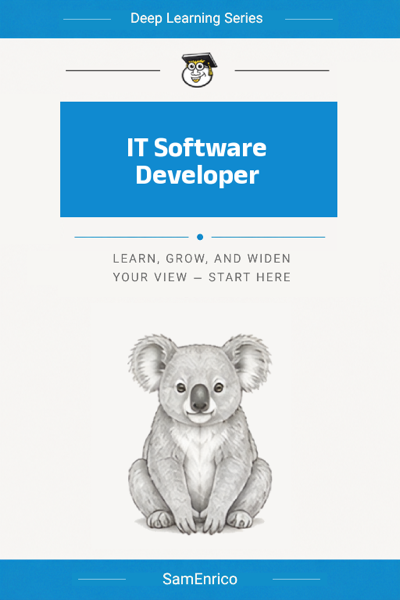
IT Software Developer eBook
A Coursebook on IT Software Developer
by Hugh Kim
A Coursebook on IT Software Developer
Formats
Free sample
Chapter 1: The Broken Window...--–- Every software project begins with a single line of code. That line seems harmless—a variable assignment here, a conditional check there. But within that first line lies a seed. If planted carefully, it grows into a maintainable, joyful system that serves users for a decade. If planted carelessly, it cracks the foundation.
And once the first crack appears, more follow. This is the story of how professional programmers learn to stop the cracks before they become canyons.You have likely written code that works. It compiles, passes a few tests, and delivers the required output. Congratulations—you have achieved what millions of tutorial videos and coding bootcamps promise. But there is a vast, uncomfortable gap between working code and professional code.
Working code is the minimum viable product of a beginner. Professional code anticipates that six different people will modify it over three years, that requirements will change twice before the next release, and that the original author will be on vacation when the production outage occurs.This book exists to bridge that gap. It is not a reference manual for a specific programming language. It will not teach you syntax or how to install a compiler. Instead, it synthesizes the collective wisdom of the ten most influential software development books of the past three decades—from The Pragmatic Programmer to Clean Code to Designing Data-Intensive Applications—into a single, structured learning pathway.
You will emerge not as someone who merely writes code, but as a software developer who thinks like an engineer, communicates like a teammate, and designs like an architect.The Journey from Journeyman to Master In traditional trades, a journeyman is someone who has learned the basics and can work independently but lacks the wisdom to handle unusual situations or lead others. A master, by contrast, has internalized principles to the point that they become instinct. Masters do not just solve the problem in front of them; they anticipate the problems that will emerge six months later. They leave code cleaner than they found it. They know when to write a comment and when to rename a variable instead.Most working developers stall at the journeyman level.
They can complete tickets, fix bugs, and add features. But they also produce code that confuses their teammates, breaks in unpredictable ways, and accumulates "technical debt"—a term we will explore throughout this book. The difference between a journeyman and a master is not years of experience. It is the deliberate cultivation of specific habits: taking responsibility, eliminating duplication, designing for change, and continuously expanding one's knowledge.This chapter introduces the foundational mindset of pragmatic programming. It is called "The Broken Window" because of a famous criminological theory that applies directly to software.
Before we dive into code, we must understand how small, tolerated failures cascade into catastrophic system decay—and how a single disciplined developer can reverse that decay.The Broken Window Theory of Software In the 1980s, criminologists James Wilson and George Kelling proposed the "broken windows theory." They observed that a building with a few broken windows, if left unrepaired, would soon have all its windows broken. Why? Because the unrepaired window sends a signal: no one cares, disorder is acceptable, and further vandalism carries no consequences. The theory was later applied to policing and urban decay.Software projects suffer from the exact same dynamic. A single bad commit—a poorly named variable, a copy-pasted block of code, a missing error handler—is a broken window.
If the team tolerates that first break, another developer will add a second. Within months, the codebase becomes a "broken windows" wasteland where every developer adopts a survival mentality: "It's already a mess, so my small mess won't matter."Consider a real-world example that the author has witnessed across a dozen engineering teams. A junior developer writes a quick function to format dates. The function works but has a misleading name: format(data) instead of format Date(date). A senior developer notices during code review but thinks, "It's just a naming issue, we'll fix it later." Later never comes.
Three months afterward, a different developer needs to format currency. They see format(data), assume it works for all types, and pass a currency object. The function crashes in production because it was only tested with dates. The on-call engineer, under pressure, adds a conditional if (typeof data === 'currency')—another broken window. Eventually, the formatting module becomes an unmaintainable tangle of special cases, and the team is afraid to touch it.The broken window theory teaches us two uncomfortable truths.
First, quality is not achieved by grand architectural plans alone. It is achieved by thousands of small, correct decisions made daily. Second, each developer has a responsibility to fix broken windows immediately, even if they did not cause them. The alternative is a death by a thousand cuts.Actionable Takeaway: When you see a broken window—bad naming, duplication, inconsistent formatting, a missing test—fix it right then. Not next sprint.
Not after the release. Now. If you lack permission or time, at least file a ticket with clear reproduction steps. The act of acknowledging the break is the first step toward repair.DRY: The Single Most Powerful Weapon Against Complexity If you remember only one acronym from this book, make it this one: DRY (Don't Repeat Yourself). The term was coined by Andy Hunt and Dave Thomas in The Pragmatic Programmer, and it is the closest thing software engineering has to a law of physics.DRY states that every piece of knowledge in a system must have a single, unambiguous, authoritative representation.
In practical terms: do not duplicate logic, do not duplicate data definitions, do not duplicate configuration, and do not duplicate comments that describe the same thing in different places.Why is duplication so destructive? Because when knowledge is duplicated, you must update it in multiple places when a requirement changes. Invariably, you will forget one of those places, and inconsistency will creep in. The system will then behave unpredictably—not because the logic is wrong, but because different parts of the system disagree on what "right" means.Consider a simple example. You write a function that calculates tax:python Copy Downloaddef calculate_tax(amount): return amount * 0.08 # 8% sales tax Elsewhere in the codebase, you hardcode the same 8% rate:python Copy Downloaddef apply_discount(amount): return amount - (amount * 0.08) # Wait, is this tax or discount?If the tax rate changes to 8.5%, you now have two places to update.
A junior developer might update only calculate_tax and miss apply_discount. The system will now show inconsistent totals to the user, eroding trust.The DRY principle applies far beyond simple constants. It applies to:Business rules: A rule like "orders over $100 ship free" should appear exactly once.Database schemas: The definition of a User should not be duplicated across migration files, ORM models, and API documentation.Workflow logic: The steps for "checkout" should not be re-implemented in a web controller, a mobile API, and a background job.Configuration: Connection strings, feature flags, and deployment settings should live in one place (usually environment variables or a config service).But beware of false DRY. Some developers, in their zeal to eliminate duplication, create abstractions…
This is the end of the free sample. Get the eBook to keep going. Buy now
About this book
Details
- Author
- Hugh Kim
- Publisher
- SamEnrico
- Language
- English
- Genre
- Non-Fiction, Informative, Educational
- Released
- 2026-05-06
- Pages (approx.)
- 139
- Available as
- eBook, Audiobook

Read better in the ZLOADR app
Your eBooks on your phone or tablet. Sign in with your SamEnrico account and start reading.
More by Hugh Kim
 Lavender Farm VisualizationHugh Kim$11.99
 Nuts and Seeds LongevityHugh Kim$11.99
 The Floating Cloud InductionHugh Kim$11.99
 Cross Border FBA ProfitsHugh Kim$11.99
 The Parent Exercise Motivation GuideHugh Kim$11.99
 The Fall of the Duvaliers: Haiti's Bloody Impeachment TrialHugh Kim$11.99
 PhD and Research Graduate PRHugh Kim$12.99
 Understanding Renal GlycosuriaHugh Kim$17.99
 Ultimate Handbook Guide to Ankara : (Turkey) Travel GuideHugh Kim$11.99