
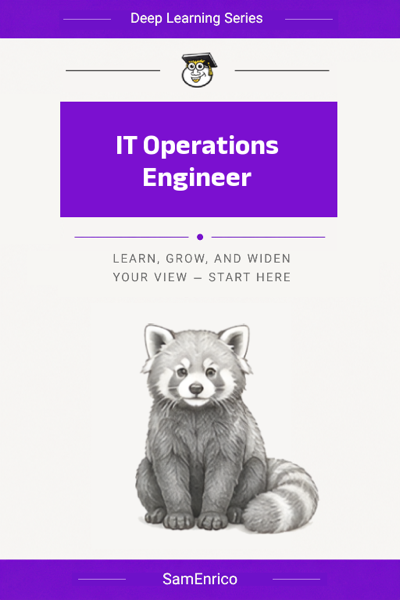
Non-FictionInformativeEducational
IT Operations Engineer eBook
A Coursebook on IT Operations Engineer
by Tibbs Lavern
A Coursebook on IT Operations Engineer
Formats
Free sample
Chapter 1: The 2:14 AM Awakening...--It is 2:14 AM on a Tuesday, and your phone is buzzing on the nightstand.The vibration sounds like a trapped insect against the wooden surface. You reach for it without opening your eyes, a reflex honed over months of on-call rotations. The screen glows harshly in the dark room. The alert reads: "API latency – 99th percentile – 5.2 seconds – us-east-1 – CRITICAL."Your heart rate climbs before your mind fully wakes. You swing your legs out of bed, stumble to the home office you built in the corner of your bedroom, and open your laptop.
The screen is too bright. You squint. You SSH into the first server. ssh api-prod-01 – enter. The prompt appears.
You type journalctl -u api -n 50 because that is what you always do, even when you are half-asleep.You see errors. You do not understand them. You restart the service. systemctl restart api – enter. The service comes back.
The alerts stop. You close your laptop, crawl back into bed, and stare at the ceiling. Your partner rolls over and mumbles, "Everything okay?" You say, "Yeah, just a glitch." You do not know if that is true. You do not know what caused the alert. You do not know if it will happen again.The next morning, your manager asks, "What happened at 2 AM?" You say, "The API had high latency.
I restarted the service." She asks, "Why?" You pause. "I don't know. It worked." She nods, but her eyes say something else. She is not angry. She is worried.
Not about the outage – the outage lasted six minutes. She is worried about you. About the team. About the pattern.This is the pattern: something breaks at 2 AM, someone wakes up, someone guesses, someone restarts a service, someone goes back to bed, and no one ever learns why. The same alert returns two weeks later.
The same engineer wakes up. The same guess happens. The same restart fixes it – temporarily.This book is the end of that pattern.The Myth of "Keeping the Lights On"There is a story that IT Operations tells about itself. It goes like this: operations is the plumbing of the digital world. It is not glamorous.
It is not exciting. It is necessary. The developers build the features. The operations engineers keep the servers running. The developers get the credit.
The operations engineers get the 2 AM pages.This story is wrong.Not partially wrong. Not outdated. Fundamentally, dangerously wrong. It is wrong because it confuses two different things: reacting to failure and engineering reliability. The operations engineer who only restarts services is not an engineer.
She is a firefighter. Firefighters are brave and necessary, but they do not design fireproof buildings. They show up after the fire starts. An engineer designs the building so the fire never starts – or if it does, the sprinklers activate, the alarms trigger, and the damage is contained before anyone even knows there was a problem.The modern IT Operations Engineer is not a firefighter. She is an architect of antifragile systems.Antifragile is a term coined by Nassim Nicholas Taleb.
Something that is fragile breaks under stress. Something that is robust survives stress. Something that is antifragile gets stronger under stress. A good operations engineer does not just keep the lights on. She builds systems that learn from failure, adapt to stress, and become more reliable the more they are tested.The 2:14 AM page is not your fault.
It is the system's fault. But it is your responsibility to fix it – not by becoming a better firefighter, but by eliminating the fire altogether.Meet Maria: Your Guide Through This Book Before we go further, let me introduce you to someone. Her name is Maria. She is twenty-four years old. She graduated with a computer science degree eighteen months ago.
She took a job as a junior operations engineer at a fintech company called Fin Scale. Fin Scale processes payments for small businesses. When Fin Scale is down, people lose money. The pressure is enormous.Maria is smart. She knows Python.
She knows Linux – sort of. She passed the certification exams. But her first month on the job was chaos. Her first on-call shift was the 2:14 AM page I just described. She spent the next morning feeling like a fraud.
She spent the next week terrified of her phone.You are going to follow Maria through this book. Every chapter will show you a problem she faced, a mistake she made, and a lesson she learned. By the end, she will be the engineer who sleeps through the night. So will you.But Maria is not a real person. She is a composite – a character built from the stories of dozens of engineers I have mentored, trained, and worked alongside.
Her struggles are real. Her victories are real. And her transformation is possible for anyone willing to do the work.The Historical Arc: From Screwdrivers to APIs To understand what an IT Operations Engineer does today, you have to understand where the role came from. This is not academic history. This is practical knowledge because the systems you will inherit were built in these eras, and the people you work with learned their habits in these eras.The Physical Era (1990s – Early 2000s)In the beginning, there were servers.
Physical servers. Big metal boxes in data centers with raised floors and humming air conditioners. If a hard drive failed, someone drove to the data center, opened the server, and replaced the drive with a screwdriver. If a server crashed, someone walked to the rack, pressed the power button, and waited. If you needed a new server, someone ordered hardware, waited for delivery, racked it, cabled it, and installed the operating system from a CD-ROM.This was the era of the sysadmin (system administrator).
The sysadmin was a wizard. She knew arcane commands. She had keys to the data center. She kept the business running through sheer force of will and institutional knowledge. The sysadmin was indispensable.The problem was scale.
A good sysadmin could manage fifty servers. A great sysadmin could manage a hundred. But a hundred servers was a lot. Each server required patching, monitoring, backup verification, and configuration management – all done by hand or with fragile shell scripts that worked on one server and broke on another.The Virtualization Era (Mid-2000s – Early 2010s)VMware changed everything. Virtualization meant one physical server could run ten virtual machines.
Hardware utilization went from 10% to 80%. Provisioning a new server went from two weeks (order, rack, cable, install) to twenty minutes (clone a template). The role of the sysadmin shifted from hardware wrangler to VM wrangler.But the fundamental problem remained. Each VM was still a snowflake – uniquely configured, manually maintained, and irreplaceable. If a VM died, you could restore it from backup, but you could not rebuild it from nothing because no one had documented exactly what was installed, how it was configured, or why it worked.The term snowflake server describes this perfectly: every server is unique, delicate, and impossible to reproduce exactly.
Snowflake servers are beautiful in isolation and disastrous at scale.The Cloud-Native Era (2010s – Present)Amazon Web Services (AWS) launched in 2006, but it…
This is the end of the free sample. Get the eBook to keep going. Buy now
About this book
Details
- Author
- Tibbs Lavern
- Publisher
- SamEnrico
- Language
- English
- Genre
- Non-Fiction, Informative, Educational
- Released
- 2026-05-11
- Pages (approx.)
- 145
- Available as
- eBook, Audiobook

Read better in the ZLOADR app
Your eBooks on your phone or tablet. Sign in with your SamEnrico account and start reading.
More by Tibbs Lavern
 Boundary Setting for Vacation RentalsTibbs Lavern$11.99
 Franciscan Mendicant Preaching ManualTibbs Lavern$11.99
 Self Hypnosis For Athletic Performance GuideTibbs Lavern$11.99
 Meditation for Diabetic NeuropathyTibbs Lavern$11.99
 Remote Employee Wellness GuideTibbs Lavern$11.99
 Whispers of the Silk Road: The Forgotten Love Letters of Marco Polo and the Persian PrincessTibbs Lavern$11.99
 The Silent Conquest: First Steps into the Alps' Forbidden PeaksTibbs Lavern$11.99
 Understanding Epilepsy Benign Neonatal Familial 3Tibbs Lavern$17.99
 Harvard Extension vs LSE FlexibilityTibbs Lavern$12.99
 House Sitting Success StoriesTibbs Lavern$12.99
 How to Start a Passenger Agent (not Transport Authority) Business (Beginners Guide)Tibbs Lavern$11.99
You may also like
 Hong Kong Handover 1997Dunn Johnnie$11.99
 Zumba For Postnatal Recovery CourseNeal Christian$11.99
 Zumba for BeginnersLadner Nikia$11.99
 YouTube Comment Mining GuideHumes Pandora$12.99
 Worry Box MeditationCarlin Rudy$11.99
 Workplace Stress MeditationNguyen Lynn$11.99
 Workplace Stress and Sleep RepairHawley Ivory$11.99
 Workplace Perfectionism CureDelaney Jeffry$11.99
 Workplace Injustice Anger GuideWallen Isabelle$11.99
 Work Addiction and Burnout LinkGreenwood Ester$11.99
 Women in Yoga and WellnessBeattie Galina$11.99
 Women in Stand Up ComedyChun Evangeline$11.99