
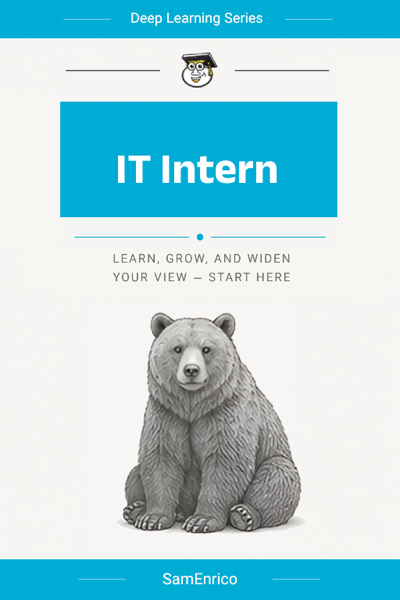
IT Intern eBook
A Coursebook on IT Intern
A Coursebook on IT Intern
Formats
Free sample
Chapter 1: The Zero-Sum Trap...--The morning of your first internship, you will wake up approximately forty-five minutes before your alarm. Your heart will pound. Your laptop bag will sit by the door, already packed the night before with items you will not need—a notebook, three pens, a printed copy of your offer letter, and a lingering sense of fraudulence. You will check your email seven times before brushing your teeth. And somewhere between the second and third check, a thought will surface, cold and insistent:Everyone here knows more than I do.This is not actually true.
But it feels true. And that feeling—that specific, prickling certainty that you are about to be exposed as someone who accidentally passed the technical interview—has a name. It is called the Zero-Sum Trap, and it is the single greatest threat to your internship success. Not your coding ability. Not your lack of experience.
Not the legacy codebase written by someone named Kevin in 2014 who no longer works at the company.The trap.The Geometry of Imposter Syndrome Here is what the Zero-Sum Trap looks like from the inside. You believe, perhaps without ever saying it out loud, that knowledge is a fixed quantity. There is a finite amount of "knowing how to do things" distributed across your team. The senior engineers have most of it. The mid-level engineers have some.
The interns—you, specifically—have the smallest slice. And because knowledge is fixed, any admission of ignorance feels like a permanent subtraction. If you ask a question, you are not gaining knowledge. You are revealing a deficit. You are proving that your slice was even smaller than everyone suspected.This is a lie.
But it is a seductive lie, because it mirrors the environment you just left.University operates on a zero-sum grading curve more often than professors admit. There are a fixed number of A's. Your success mathematically reduces the available success for others. The exam has a known answer key. The problem set has a correct solution.
Your grade depends on how closely your output matches an answer that already exists. In that world, asking for help feels like cheating. It feels like admitting you did not earn your place.Industry does not work this way. At all.In a software engineering organization, knowledge is not fixed. It is generative.
When you ask a question, two things happen simultaneously: you gain understanding, and your teammate deepens their own understanding by explaining it. The total knowledge in the system increases. No one loses. The senior engineer who answers your question does not have less knowledge afterward. They have more—because teaching is the fastest path to mastery.
Ask any engineering manager to name their strongest technical lead, and they will point to the person who answers the most questions on Slack, not the person who writes the most code in the dark.The Zero-Sum Trap convinces you that asking for help costs you something. In reality, silence costs you everything.Jamal's First Hour Let me introduce you to someone you will be following throughout this book. His name is Jamal, and he is about to make every mistake in this chapter so you do not have to.Jamal arrived at his internship at a mid-sized fintech company called Veridian Pay at 9:47 AM, thirteen minutes early, wearing a button-down shirt that was slightly too starched. He had prepared. He had read the onboarding guide twice.
He had cloned the repository the night before. He had even run the test suite, watched it fail because of missing environment variables, and decided that was probably fine.His assigned mentor was a senior engineer named Priya who had been at Veridian for six years. Priya had the kind of calm efficiency that Jamal found deeply intimidating—the way she typed without looking at her keyboard, the way she had three monitors arranged at precise angles, the way she said "let me show you something" and then produced exactly the correct log file on the first try."Your first ticket is in Jira," Priya said. "It's a bug in the payment confirmation flow. Users report that sometimes the confirmation email sends twice.
Should be a good warm-up."Jamal nodded. He opened Jira. He found the ticket. He read the description three times. He understood approximately forty percent of the words.The bug was in a file called payment_processor.py.
The file was 847 lines long. It had no docstring. It had functions with names like _handle_webhook_response_v3 and fix_legacy_transaction_state and—Jamal was not making this up—hack_for_client_1239. The commit history showed that the last meaningful comment was added in 2019 and said "TODO: refactor this entire module."Jamal stared at the screen. Forty-five minutes passed.
He had written zero lines of code. He had opened twelve browser tabs and closed nine of them. He had learned that the payment system used something called idempotency keys, which he vaguely remembered from a system design video he watched at 1.5x speed during finals week. He did not know what to do next.He had two choices.Choice one: ask Priya for help. Walk over to her desk, or send a Slack message, and say something like, "I don't really understand where to start." This felt humiliating.
Priya had given him a "warm-up." This was supposed to be easy. Asking for help on the easy ticket would prove he should not have been hired.Choice two: keep struggling alone. Spend another two hours reading code. Maybe figure it out eventually. At least then he could say he did it himself.Jamal chose option two.By 12:30 PM, he had written three lines of code.
They were wrong. He had introduced a syntax error that broke the test runner for the entire module. He did not know how to fix it because he did not understand how the test runner worked. He was now four hours into his internship and actively making things worse.At 12:31, Priya appeared at his desk. "You've been quiet," she said.
"How's it going?"Jamal considered lying. He considered saying "almost done." He considered closing his laptop and pretending the Wi-Fi had failed.Instead, he said, "I'm stuck. I don't understand the payment processor at all. And I broke the tests."Priya pulled up a chair. "Show me."For the next twenty minutes, Priya walked Jamal through the payment_processor file.
She explained the idempotency key pattern. She showed him where the duplicate email bug had been reported before—buried in a ticket from 2022 that Jamal had not found because he did not know to search for "idempotency collision." She helped him revert his syntax error. And then she said something Jamal would remember for years:"I've been here six years. I still don't understand half of this file. The person who wrote it quit in 2020.
We're all just doing our best."Jamal's shoulders dropped six inches. He was not supposed to understand everything. No one did. The expectation was not mastery. The expectation was curiosity.He fixed the bug by 3:00 PM.
The fix was five lines of code. The real work had been unblocking himself—learning that asking for help was not…
This is the end of the free sample. Get the eBook to keep going. Buy now
About this book
Details
- Author
- Angulo Wilber
- Publisher
- SamEnrico
- Language
- English
- Genre
- Non-Fiction, Informative, Educational
- Released
- 2026-06-02
- Pages (approx.)
- 134
- Available as
- eBook, Audiobook

Read better in the ZLOADR app
Your eBooks on your phone or tablet. Sign in with your SamEnrico account and start reading.
More by Angulo Wilber
 The Villain's VoiceAngulo Wilber$11.99
 Architecture Studio Stress WorkbookAngulo Wilber$11.99
 Metta for Attachment WoundsAngulo Wilber$11.99
 FIRE Movement Retirement StrategyAngulo Wilber$11.99
 The Cut Off Recovery GuideAngulo Wilber$11.99
 The Maestro and the Maori: How a Conductor United a Nation Through MusicAngulo Wilber$11.99
 Understanding Neuraminidase Beta-galactosidase DeficiencyAngulo Wilber$17.99
 Scholarships for African Students ExplainedAngulo Wilber$12.99
 MercadoLibre SWOTAngulo Wilber$12.99
 How to Become a Lay-out Worker IAngulo Wilber$11.99