
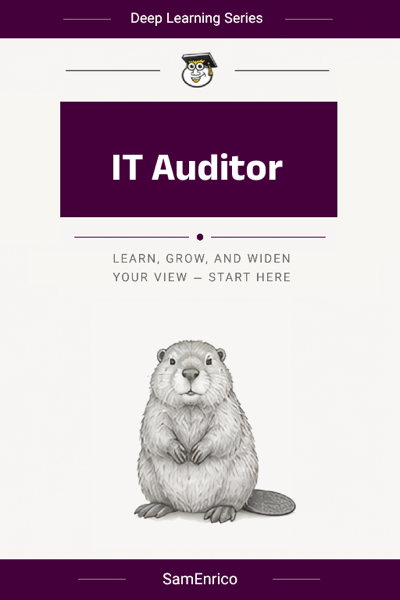
Non-FictionInformativeEducational
IT Auditor eBook
A Coursebook on IT Auditor
A Coursebook on IT Auditor
Formats
Free sample
Chapter 1: The Auditor’s Pivot...--–- The fluorescent lights of the conference room hummed a monotonous apology for the 3:00 PM hour. Sarah, a senior financial auditor with ten years of experience, was reviewing the monthly close process for a mid-sized manufacturing client. Everything looked clean—journal entries were approved, reconciliations were signed off, and the variance analysis was meticulous. But something nagged at her. A single line item under "IT Miscellaneous" had grown from 12,000to12,000 to 12,000to147,000 over six months with no corresponding business explanation.
The CFO waved it away as "software licensing fluctuations."Sarah almost let it go. After all, she was a financial auditor, not an IT person. Her job was material misstatements, not network traffic. But a recent internal memo from her firm's national office had mentioned something called "IT General Controls" and warned that financial auditors could no longer ignore the systems that generated the numbers.She asked to see the IT department's user access review for the general ledger system.The IT manager looked confused. "We don't really do that," he said.
"Our ERP vendor handles security.""Do they?" Sarah asked.Four hours later, she discovered that seventeen former employees—including three who had been terminated for cause—still had active, privileged access to the general ledger. One of those former employees had logged in the previous night at 2:17 AM and exported a complete list of customer payment details.The $147,000 line item turned out to be fraudulent payments routed to a shell vendor. The terminated employee with the active account was the perpetrator.Sarah wasn't an IT auditor. But she became one that day.This is a true story. It happens every week in companies of every size, in every industry.
And it is the single best explanation for why you are holding this book. The line between financial auditing and IT auditing has not just blurred—it has evaporated. In its place is a new discipline that demands fluency in both spreadsheets and server logs, both journal entries and JSON web tokens.The Myth of the Back-Office Bean Counter For most of the twentieth century, the auditor was a figure of quiet, reassuring precision. You showed up after the fiscal year ended, pulled a statistical sample of invoices, tested a few controls, and issued an opinion. The data lived in filing cabinets.
The threats were arithmetic errors and the occasional intentional misclassification. Your greatest technical challenge was knowing when to use lower-of-cost-or-market.That world is dead. It was killed not by a single event but by a slow, accelerating cascade of technological transformations that each seemed manageable until they became overwhelming. The personal computer brought spreadsheets, which brought complexity. The internet brought connectivity, which brought exposure.
The cloud brought agility, which brought shared responsibility. And AI brought automation, which brought the terrifying possibility that the systems you audit might be making decisions no human fully understands.The modern IT auditor does not count beans. The modern IT auditor ensures that the bean-counting system cannot be manipulated by a terminated employee with a grudge, a compromised vendor with privileged access, or a nation-state actor who exploited an unpatched vulnerability in a firewall rule written six years ago.This book is about that transition. It is not a theoretical treatise. It is a field manual for the auditor who has realized that checking the box labeled "IT controls reviewed" is no longer enough—because the boxes themselves are moving, multiplying, and sometimes lying.The Great Misunderstanding: IT Audit vs.
Cybersecurity Before we go any further, we must confront a confusion that derails careers and compromises audits. Ask ten executives what an IT auditor does, and you will hear ten different answers. The most common mistake is conflating IT auditing with cybersecurity posture assessment. They are related. They are not the same.Information Systems (IS) Audit focuses on the confidentiality, integrity, and availability of information systems.
It asks: Does the system do what it is supposed to do? Is the data accurate? Can the system be accessed by unauthorized people? Would the business survive if the system went offline for a week? These are questions of control design and operating effectiveness.Cybersecurity Posture Assessment focuses on threat detection, response maturity, and adversary simulation.
It asks: Who is trying to break in? How would we know? How fast can we respond? Could a skilled attacker evade our defenses? These are questions of resilience and active defense.Here is the critical insight: They are not alternatives.
They are two lenses on the same problem. A system can have perfect controls on paper—segregation of duties, approval workflows, audit trails—and still be vulnerable to a phishing attack that steals an administrator's credentials. Conversely, a system can have world-class threat detection and still produce materially misstated financial reports because a data transformation rule was misconfigured.The IT auditor must look through both lenses. This book will teach you how.Why "General IT Controls" Is No Longer Enough Traditional audit methodology divides IT controls into two buckets: General IT Controls (GITCs) and application controls. GITCs are the foundational controls that apply across the entire IT environment—access management, change management, backup and recovery, and IT operations.
Application controls are specific to individual systems—input validation, processing logic, output verification.For decades, the conventional wisdom held that if GITCs were strong, application controls could be tested lightly. The logic was seductive: if the environment was secure and changes were properly approved, then the applications running in that environment must be reliable.That logic has collapsed under the weight of modern system architecture.Consider cloud computing. When your application runs on infrastructure you do not own, the traditional distinction between GITCs and application controls becomes meaningless. The cloud provider manages physical access, hypervisor security, and network infrastructure. You manage identity, encryption, and configuration.
Who is responsible for change management when the provider pushes an automatic update that breaks your data validation rule? Who audits that?Consider Dev Ops. When developers deploy code dozens of times per day through automated pipelines, the traditional change management control—"all changes must be approved by the change advisory board"—becomes impossible. The control must become something else: automated testing, peer review requirements, deployment gates. The form changes, but the objective does not.
The auditor must understand both.Consider AI. When an algorithm adjusts credit limits, flags fraudulent transactions, or approves loan applications, what control do you audit? The code? The training data? The model's drift over time?
The answer is all of the above, and none of them fit neatly into the GITC framework.This book does not abandon GITCs. It expands them. It teaches you how to audit traditional controls in traditional environments while also teaching you how to adapt those same principles to cloud, Dev Ops, and AI.The Case for Continuous Monitoring (And Why It Is Not a Silver Bullet)One of the most seductive phrases in modern audit is "continuous auditing." The promise is irresistible: instead of testing controls once a year with a sample of transactions, you monitor every transaction in real time. Anomalies trigger alerts. Exceptions are investigated immediately.
The audit becomes a live feed rather than a photograph.In theory, this is the future. In practice, it is more…
This is the end of the free sample. Get the eBook to keep going. Buy now
About this book
Details
- Author
- Marcus Ardith
- Publisher
- SamEnrico
- Language
- English
- Genre
- Non-Fiction, Informative, Educational
- Released
- 2026-06-02
- Pages (approx.)
- 157
- Available as
- eBook, Audiobook

Read better in the ZLOADR app
Your eBooks on your phone or tablet. Sign in with your SamEnrico account and start reading.
More by Marcus Ardith
 Innocence Project Delaware CasesMarcus Ardith$11.99
 Design Thinking Collaboration WorkbookMarcus Ardith$11.99
 Intermittent Fasting GuideMarcus Ardith$11.99
 Israel Green Tax Reform GuideMarcus Ardith$11.99
 The Holiday Sleep Survival GuideMarcus Ardith$11.99
 Freedom’s Echo: The Forgotten Voices of the 1963 March on DetroitMarcus Ardith$11.99
 The Alchemy of Colors: The Lost Palette of the MayaMarcus Ardith$11.99
 Understanding Chromosome 3 Duplication SyndromeMarcus Ardith$17.99
 Manually Delivered MVP GuideMarcus Ardith$12.99
 Social Media Business SetupMarcus Ardith$12.99
 How to Become a Cable Installer-repairerMarcus Ardith$11.99
You may also like
 Hong Kong Handover 1997Dunn Johnnie$11.99
 Zumba For Postnatal Recovery CourseNeal Christian$11.99
 Zumba for BeginnersLadner Nikia$11.99
 YouTube Comment Mining GuideHumes Pandora$12.99
 Worry Box MeditationCarlin Rudy$11.99
 Workplace Stress MeditationNguyen Lynn$11.99
 Workplace Stress and Sleep RepairHawley Ivory$11.99
 Workplace Perfectionism CureDelaney Jeffry$11.99
 Workplace Injustice Anger GuideWallen Isabelle$11.99
 Work Addiction and Burnout LinkGreenwood Ester$11.99
 Women in Yoga and WellnessBeattie Galina$11.99
 Women in Stand Up ComedyChun Evangeline$11.99