
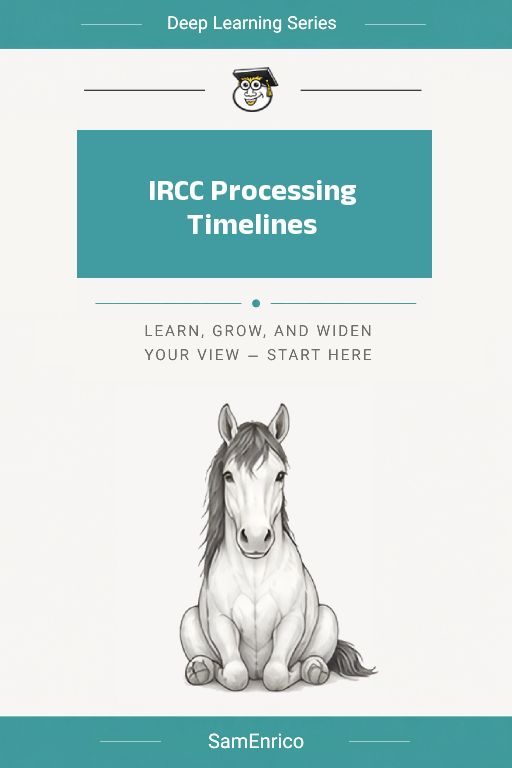
IRCC Processing Timelines eBook
Track Express Entry application processing for Can
Track Express Entry application processing for Canadian graduates with GCKey updates, webforms, and estimated completion.
Formats
Free sample
Chapter 1: The Invisible Clock--–- Every morning, thousands of Canadian graduates log into their GCKey accounts, stare at a progress bar that never seems to move, and wonder if anyone at Immigration, Refugees and Citizenship Canada (IRCC) has even opened their file. They refresh the page, refresh again, and convince themselves that a change in wording from "We are processing your application" to "Your application is in progress" means something significant. It rarely does.The hard truth is that the progress bar you see is not designed to inform you. It is designed to comfort you. And comfort, as any immigration lawyer will tell you, is not the same as clarity.This chapter dismantles the illusion of the public-facing estimated completion date.
You will learn that IRCC operates on a completely separate timeline—one built around internal "bring forward" dates (BF dates) that are invisible to applicants, managed by officers who may spend as little as fifteen minutes on your entire file spread across six months. More importantly, you will learn when to actually trust the estimated completion date (almost never) and when to ignore it entirely (most of the time). By the end of this chapter, you will stop watching the progress bar and start understanding the invisible clock that actually matters.The Great Deception: Understanding the Public-Facing Progress Bar In 2018, IRCC introduced the online application status tracker with great fanfare. The promise was simple: applicants would no longer be left in the dark. They would see a visual representation of their application's journey from submission to decision.
A progress bar would move from 0% to 100%, and at the end, a decision would appear.What IRCC did not advertise was that the progress bar is not tied to any actual work being done on your file. It is a countdown timer based on historical processing times for a broad category of applications—not your specific circumstances, not your specific visa office, not your specific officer's workload.Consider this real example. Two Canadian graduates with identical profiles—both applied under the Canadian Experience Class (CEC) on the same day, both with perfect documentation, both with clean criminal records. One receives permanent residence in four months. The other waits fourteen months.
Both had the exact same progress bar showing "Estimated remaining time: 4 months" for most of that period.How is this possible? Because the progress bar is not a predictor. It is a historical average dressed up as a forecast.The estimated completion date shown in your GCKey account is calculated using a simple formula: IRCC takes the average processing time for 80% of completed applications in your category over the past six to twelve months and subtracts the time since your application was submitted. If the average for CEC applications is six months, and you submitted three months ago, the system will show three months remaining. This happens whether an officer has looked at your file or not.The Canadian Experience Class Advantage (Such as It Is)Before we go further, let's establish why this book focuses on Canadian graduates and the CEC category.
If you are reading this, you likely studied at a Canadian Designated Learning Institution (DLI), earned a degree or diploma, obtained a Post-Graduation Work Permit (PGWP), and are now applying for permanent residence through Express Entry under CEC.Compared to outland applicants (those applying from outside Canada), you have several apparent advantages. You are already in Canada. You have Canadian work experience. You have Canadian educational credentials. IRCC has already vetted you at least twice (for your study permit and your PGWP).
Your biometrics and medical exams are likely already in the system.These advantages translate into faster eligibility screening. While an outland applicant might wait six months just to have their eligibility reviewed, a CEC graduate often sees eligibility marked "Passed" within two to three months. The reason is simple: IRCC trusts Canadian documents more than foreign ones. Your degree from the University of Toronto is verifiable with a phone call. Your employer in downtown Vancouver is reachable during Canadian business hours.However—and this is crucial—the eligibility advantage does not extend to security screening.
Once eligibility passes, CEC graduates enter the same black hole as every other applicant. Security screening is handled by partner agencies (CSIS, CBSA, and international intelligence sharing networks) that operate on their own timelines, measured in months or sometimes years. A Canadian graduate who has traveled extensively or who holds citizenship from certain countries can find themselves in Comprehensive Security Screening (CSS)—a process detailed fully in Chapter 9—with no faster path than any other applicant.The Public-Facing Clock: A Decision Rule Given how misleading the estimated completion date can be, you need a clear rule for when to pay attention to it and when to ignore it. Drawing from analysis of thousands of GCMS notes (see Chapter 4 for how to order your own), immigration consultants have established a reliable decision rule:Ignore the estimated completion date completely until your Eligibility assessment shows "Passed" in your GCMS notes. Before that point, the estimated completion date is a generic placeholder with no relationship to your actual file progress.After Eligibility passes, the estimated completion date becomes moderately reliable for planning purposes—meaning it will be accurate within a range of plus or minus two to three months.
Even then, it can be thrown off by comprehensive security screening, unresponsive employers (see Chapter 7), or backlogs at your specific visa office.Let me repeat this because it is the single most important takeaway of this chapter: The estimated completion date is meaningless until Eligibility is passed. Do not make life decisions—quitting your job, booking international travel, canceling your lease—based on that date before Eligibility passes. I have seen applicants book non-refundable flights based on a progress bar that showed "1 month remaining," only to discover that no officer had touched their file for five months.How do you know when Eligibility has passed? You cannot see it in GCKey. You can only see it in your GCMS notes.
Yes, this is frustrating. Yes, it feels like IRCC is hiding information from you. Chapter 4 will walk you through ordering and reading GCMS notes step by step. For now, just know that the public-facing system is deliberately limited. IRCC does not want you seeing internal assessments because those assessments can change, and officers do not want to be held to preliminary conclusions.The Internal Engine: Bring Forward (BF) Dates If the public-facing progress bar is a theatrical prop, the internal bring forward (BF) date system is the actual engine driving your file forward.Every time an IRCC officer touches your file—whether to review eligibility, request a document, or simply note that something is missing—they assign a BF date.
This is a date in the future when the file will automatically reappear in the officer's queue for another review. The officer is not required to do anything on that date except look at the file again. They might take action. They might assign a new BF date. They might do nothing at all if they are backlogged.Here is how a typical BF date sequence works for a Canadian graduate's Express Entry application:Day 0: You…
This is the end of the free sample. Get the eBook to keep going. Buy now
About this book
Details
- Author
- Meacham Milagros
- Publisher
- SamEnrico
- Language
- English
- Genre
- Non-Fiction, Student's Shortcut
- Released
- 2026-05-29
- Pages (approx.)
- 153
- Available as
- eBook, Audiobook

Read better in the ZLOADR app
Your eBooks on your phone or tablet. Sign in with your SamEnrico account and start reading.
More by Meacham Milagros
 Sleep Meditation for TeensMeacham Milagros$11.99
 The B Vitamin Dementia PreventionMeacham Milagros$11.99
 Mongolia Horse Trek LeaderMeacham Milagros$11.99
 Lonely Caregiver ConnectionMeacham Milagros$11.99
 The Pomodoro Single Task GuideMeacham Milagros$11.99
 The Great Escape of Abu Salim: Libya's Infamous Prison Tunnel Breakout (1964)Meacham Milagros$11.99
 How to Start a Carbon and Aramid Thread Weaving Business (Beginners Guide)Meacham Milagros$11.99
 Automation ManagerMeacham Milagros$11.99
 Web Summit Pitch GuideMeacham Milagros$12.99
 Learn to Play the BombardeMeacham Milagros$11.99
You may also like
 Hong Kong Handover 1997Dunn Johnnie$11.99
 Zumba For Postnatal Recovery CourseNeal Christian$11.99
 Zumba for BeginnersLadner Nikia$11.99
 YouTube Comment Mining GuideHumes Pandora$12.99
 Worry Box MeditationCarlin Rudy$11.99
 Workplace Stress MeditationNguyen Lynn$11.99
 Workplace Stress and Sleep RepairHawley Ivory$11.99
 Workplace Perfectionism CureDelaney Jeffry$11.99
 Workplace Injustice Anger GuideWallen Isabelle$11.99
 Work Addiction and Burnout LinkGreenwood Ester$11.99
 Women in Yoga and WellnessBeattie Galina$11.99
 Women in Stand Up ComedyChun Evangeline$11.99