
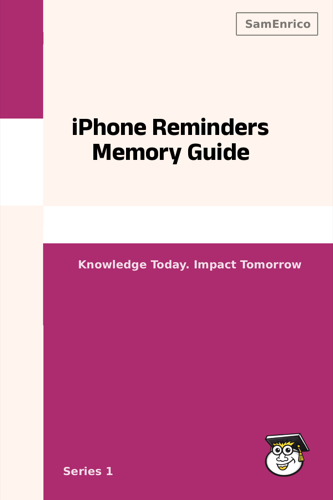
iPhone Reminders Memory Guide eBook
Master Apple's native reminders app for daily task
by Card Newton
Master Apple's native reminders app for daily task recall with this practical digital organization handbook.
Formats
Free sample
Chapter 1: The Open Loop...--I want you to try something. Right now, while you are reading this sentence, pause for exactly three seconds and ask yourself a single question: What is the one thing I am currently supposed to be doing that I have not done yet?Do not keep reading. Pause....You felt it, did you not? That tiny, almost imperceptible tug of anxiety somewhere behind your sternum. For some of you, it was a work deadline.
For others, it was a text message you forgot to reply to, a bill you need to pay by Friday, a birthday gift you have not bought, or a call to your parents that you keep pushing to tomorrow. That feeling—that low-grade, background hum of obligation—has a name. In cognitive psychology, it is called an Open Loop.An Open Loop is any task, commitment, or idea that you have agreed to do but have not yet completed. It is open because it lacks closure. It is a loop because your brain will automatically, unconsciously, and repeatedly cycle back to it until it is resolved.
And right now, if you are like the average adult in the modern economy, you are carrying somewhere between fifteen and sixty of these Open Loops in your head at any given moment.This chapter is not about the Reminders app. Not yet. Before we touch a single setting on your i Phone, we need to understand the enemy we are fighting. The enemy is not laziness. The enemy is not a bad memory.
The enemy is the fundamental architecture of your brain, which was designed for survival on the African savanna, not for project management in a world of Slack messages, email threads, grocery lists, mortgage payments, and soccer practice schedules. Your brain is a remarkable organ for creating ideas. It is a terrible organ for storing them.We are going to fix that. But first, we have to understand why you forget in the first place.The Myth of the "Bad Memory"Let us clear something up immediately. You do not have a bad memory.
That is a story you have been telling yourself, reinforced by decades of social conditioning and a few embarrassing moments where you forgot your keys or missed an appointment. The truth is far more interesting and far more hopeful.Your memory works exactly as evolution designed it. Human beings evolved in small tribes of roughly fifty to one hundred fifty individuals. Our ancestors needed to remember which berries were poisonous, where the water hole was located, and who in the tribe was trustworthy. They did not need to remember to submit a TPS report by 5 PM on Thursday or to renew their car registration before the end of the month.
The cognitive load of modern life is utterly mismatched with the hardware we are running it on.Psychologists distinguish between two types of memory: retrospective memory and prospective memory. Retrospective memory is what most people think of when they hear the word "memory"—the ability to recall information from the past. What did you eat for breakfast? Who won the World Series in 2019? What is the capital of South Dakota?
That is retrospective memory. And generally, humans are quite good at it, though far from perfect.Prospective memory is something else entirely. It is the ability to remember to perform a planned action at the appropriate future moment. Remembering to call the dentist at 2 PM. Remembering to take your medication after dinner.
Remembering to ask your colleague about the budget when you see them in the hallway. Prospective memory is the cognitive function that keeps your life from falling apart, and it is notoriously, almost comically, fragile.Here is why. Prospective memory relies on a complex chain of neural events. First, you must form an intention. Second, you must retain that intention across time, without actively thinking about it, while your brain is busy doing other things.
Third, you must recognize the appropriate cue or trigger to execute the intention. Fourth, you must actually execute it. Failure can happen at any link in this chain. And in a typical day, it fails often.Consider this sobering statistic from the cognitive science literature: in controlled studies of prospective memory, people fail to remember to perform a simple action—pressing a button at a specific time—between 15 and 40 percent of the time, even when they have been explicitly instructed to remember and even when the time interval is only a few minutes. Expand that interval to a few hours, add the normal distractions of daily life, and the failure rate climbs steeply.You are not broken.
You are human.Why Sticky Notes Are Gaslighting You When people feel overwhelmed by forgotten tasks, they almost always reach for the same set of inadequate tools. Let me name them so we can bury them together.The Sticky Note. You write a reminder on a small yellow square and stick it to your computer monitor. For the first hour, it works brilliantly. You see the note; you remember the task.
But here is what actually happens over the next twenty-four hours. The note becomes part of the visual background. Your brain, which is remarkably efficient at filtering out irrelevant stimuli, stops seeing it. This is called habituation. The same mechanism that allows you to ignore the feeling of your clothes on your skin or the hum of your refrigerator causes you to stop noticing sticky notes after approximately ninety minutes of continuous exposure.
By day two, that sticky note is functionally invisible. You are not ignoring it. Your brain has literally decided it is not worth processing.The Mental List. This is the most seductive trap of all. You run through your tasks in your head—usually in the shower, while falling asleep, or during a commute—and you feel a sense of control.
You have enumerated the challenges. You have acknowledged them. Surely, that counts for something. It does not. The cognitive science is unambiguous: the average human working memory can hold approximately four discrete items at once.
That is it. Four. If you are trying to hold fifteen Open Loops in your head, you are not remembering fifteen things. You are cycling through them rapidly, constantly, inefficiently, like a computer swapping data between RAM and a hard drive. This constant swapping is exhausting.
It is also why you feel mentally tired even on days when you did not do very much. Your brain was working, just not on what you wanted it to work on.The Inbox-As-Task-Manager. Many people believe that if they leave emails unread, those emails will serve as reminders. This is catastrophic for two reasons. First, your email inbox is not a task manager; it is a communication channel.
By mixing tasks with messages, you guarantee that you will never have a clear picture of either. Second, the psychological toll of a perpetually full inbox is well documented. Each unread email represents an Open Loop. When you have hundreds of unread emails, your brain gives up trying to manage them individually and instead experiences a diffuse, generalized anxiety. You are not organized.
You are just numb.The String on the Finger. This is a metaphor for any vague, non-specific reminder system. "I will…
This is the end of the free sample. Get the eBook to keep going. Buy now
About this book
Details
- Author
- Card Newton
- Publisher
- SamEnrico
- Language
- English
- Genre
- Non-Fiction, Self-Help, Digital Memory Tools
- Released
- 2026-06-09
- Pages (approx.)
- 143
- Available as
- eBook, Audiobook

Read better in the ZLOADR app
Your eBooks on your phone or tablet. Sign in with your SamEnrico account and start reading.
More by Card Newton
 Governor in the BunkerCard Newton$11.99
 Genova Diagnostics InterpretationCard Newton$11.99
 Bedroom Environment MeditationCard Newton$11.99
 Workplace Empathy HandbookCard Newton$11.99
 TM for Afternoon SlumpCard Newton$11.99
 Sleep Apnea MeditationCard Newton$11.99
 Pomodoro For ArtCard Newton$11.99
 Coppola GodfatherCard Newton$11.99
 The Plague Doctors of Marseille: France's Medical RevolutionCard Newton$11.99
 The Great Train Heist: The Untold Story of the 1963 Royal Mail RobberyCard Newton$11.99
 The Golden Road of Meroë: Kush's Iron Dynasty and Architectural MajestyCard Newton$11.99
 Project Risk Analysis and MitigationCard Newton$11.99