
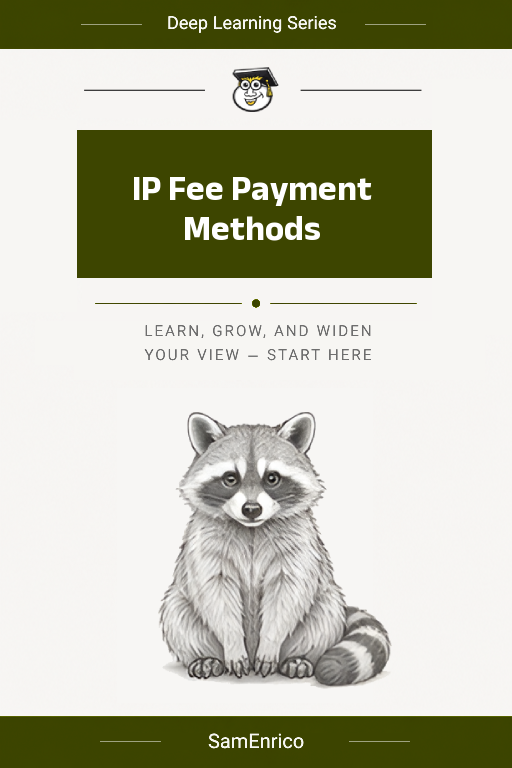
IP Fee Payment Methods eBook
Pay USPTO fees using credit card, deposit account,
Pay USPTO fees using credit card, deposit account, or EFT including processing times and convenience fees.
Formats
Free sample
Chapter 1: The Midnight Deadline...–- It was 11:47 PM on a Friday, and Sarah Chen, a seasoned patent paralegal with fourteen years of experience, had just finished reviewing a final fee submission for a client’s continuation application. The fee was $1,640 – standard issue fee for a small entity. She had processed thousands of these. She clicked “Submit” in EFS-Web, received a green confirmation screen, and closed her laptop. She went to bed satisfied.
What Sarah did not know was that her firm’s credit card processor would take 72 hours to settle the transaction. What she also did not know was that the USPTO’s internal systems would record the payment as “pending” rather than “paid” for two full business days. What she would discover three months later was that the patent office had declared the application abandoned for “failure to pay the issue fee by the due date.” The green confirmation screen meant nothing. The money had left the client’s credit card. But the clock had not stopped.This is not a cautionary tale from 1999, when the USPTO still relied on paper forms and carbon copies.
This happened in February of 2024. Sarah’s firm spent 12,000inlegalfeespetitioningthe Directortorevivetheapplication.Thepetitionwasgranted–butonlyafterthefirmpaidanadditional12,000 in legal fees petitioning the Director to revive the application. The petition was granted – but only after the firm paid an additional 12,000inlegalfeespetitioningthe Directortorevivetheapplication.Thepetitionwasgranted–butonlyafterthefirmpaidanadditional2,000 surcharge under 37 CFR 1.16(f). The client, a medical device startup, lost six weeks of market exclusivity. The paralegal lost her job.
And the root cause? A misunderstanding of the single most fundamental concept in USPTO payment processing: the difference between submission time, authorization time, and clearing time.Welcome to the hidden world of government fee payments, where a credit card’s authorization code can be less valuable than a handwritten signature on yellow paper, where a deposit account with 50,000canstilltriggerasuspensionovera50,000 can still trigger a suspension over a 50,000canstilltriggerasuspensionovera10 fee, and where the difference between “submitted” and “accepted” is measured not in seconds but in abandoned patents. This book exists because the USPTO’s payment systems are not designed to be intuitive. They are designed to be secure, auditable, and compliant with Treasury regulations that predate the internet. Your job – as a paralegal, attorney, docketing specialist, or firm administrator – is to navigate these systems without falling into the traps that have destroyed careers and cost millions in wasted fees.This chapter establishes the foundation for everything that follows.
You will learn the three primary payment channels, the critical distinction between time-of-submission and time-of-clearing, the truth about convenience fees (and who actually charges them), and why the government’s push to eliminate paper checks by 2025 will fundamentally change how you work. By the end of this chapter, you will never look at a green confirmation screen the same way again.The Three Pillars of USPTO Payments The United States Patent and Trademark Office processes over 10 million fee transactions annually, representing more than $4 billion in revenue. Every single one of those transactions flows through one of three channels: online, mail, or hand delivery. Understanding the strengths and catastrophic weaknesses of each channel is the first step toward mastery.The Online Channel – Fast, But Not Foolproof The online channel includes EFS-Web for patent filings, TEAS for trademark applications, and the USPTO Financial Manager for deposit account management. This channel accounts for approximately 94% of all fee transactions as of 2024.
When you submit a payment online, the USPTO generates an immediate acknowledgment receipt. This receipt includes a confirmation number, a timestamp, and a status indicator (typically “Submitted” or “Pending”).Here is what the acknowledgment receipt does NOT tell you: whether the payment has actually cleared your bank, whether the USPTO has officially credited your deposit account, or whether the fee will be considered “paid” for the purpose of a deadline. The acknowledgment receipt only confirms that the USPTO’s server received your submission. The actual transfer of funds – from your credit card issuer or bank to the USPTO’s Treasury account – happens separately, often hours or days later.As Sarah Chen discovered, a credit card authorization code is not a payment confirmation. It is a promise from your bank to remit funds, subject to verification, fraud checks, and settlement cycles.
The USPTO treats the authorization as sufficient for filing purposes only if the authorization is ultimately successful. If the authorization fails after the deadline – even if the failure is caused by a technical glitch at your bank – the application may be deemed abandoned.The Mail Channel – Dying, But Still Dangerous Mailing a payment to the USPTO involves sending a check, money order, or credit card form (PTO-2038) to the Commissioner for Patents or the Director of the USPTO’s Trademark Office. The mailing address varies depending on the fee type. For patent fees, the address is P.O. Box 1450, Alexandria, VA 22313-1450.
For trademark fees, it is P.O. Box 1451, same city and zip code.The mail channel seems straightforward. You place a check in an envelope, affix a stamp, and drop it in a mailbox. The USPTO considers the fee “paid” on the date of mailing – provided you use the Certificate of Mailing mechanism under 37 CFR 1.8. This rule is one of the most misunderstood provisions in patent law.
The certificate must be signed and dated on the same day you deposit the envelope. It must state that the correspondence is being deposited with the USPS as first-class mail. And it must include the return address of the sender. If any of these elements are missing or incorrectly formatted, the certificate is invalid, and the fee is considered paid only when the USPTO actually receives it – which can be three to ten days later.Even with a valid Certificate of Mailing, the mail channel carries hidden risks. The USPS loses approximately 0.3% of first-class mail annually.
For high-volume filers, that translates to a 3% chance of loss over ten years. More commonly, mail is delayed by weather, holiday backlogs, or incorrect sorting. A single day of delay can push a fee past a deadline. And unlike online submissions, mailed fees provide no real-time confirmation. You only discover a problem when the USPTO sends a Notice of Abandonment – often sixty to ninety days after the deadline.The Hand Delivery Channel – Obsolete for Most, Essential for Some Hand delivery involves walking into the USPTO’s Customer Service Window in Alexandria, Virginia, and submitting a payment in person.
This channel is available only for certain fee types and only during business hours (8:30 AM to 5:00 PM ET, Monday through Friday, excluding federal holidays).For most practitioners, hand delivery is impractical. Unless your firm is located within driving distance of Alexandria, the cost of courier delivery exceeds any potential benefit. However, hand delivery offers one unique advantage: immediate, incontrovertible proof of payment. When you hand a fee to a USPTO employee and receive a stamped receipt, there is no dispute about timing. No certificate of mailing.
No pending authorization. No email lost to a spam filter. The fee is paid the moment the stamp hits the paper.Hand delivery is most useful for emergency filings – for example, when an online payment fails at 4:30 PM on a due date and the applicant lives within an hour of the…
This is the end of the free sample. Get the eBook to keep going. Buy now
About this book
Details
- Author
- Faber Elenore
- Publisher
- SamEnrico
- Language
- English
- Genre
- Non-Fiction, Annual Checkup, Payment Methods, USPTO
- Released
- 2026-06-01
- Pages (approx.)
- 140
- Available as
- eBook, Audiobook

Read better in the ZLOADR app
Your eBooks on your phone or tablet. Sign in with your SamEnrico account and start reading.
More by Faber Elenore
 The Remote Work Transition PeriodsFaber Elenore$11.99
 Meeting Notes SystemFaber Elenore$11.99
 The Groin Strain PreventionFaber Elenore$11.99
 Vegan Food Allergy Cooking CourseFaber Elenore$11.99
 Franchising Your Local Brand Across Borders Tax GuideFaber Elenore$11.99
 The Quantum Crown Heist: How a Parallel Universe King Stole the British MonarchyFaber Elenore$11.99
 CRISPR: The Genetic ScalpelFaber Elenore$11.99
 Understanding Cutaneous AnthraxFaber Elenore$17.99
 Sales Scripts for StartupsFaber Elenore$12.99
 After School Program LeaderFaber Elenore$11.99
 How to Become a Tree PlanterFaber Elenore$11.99