
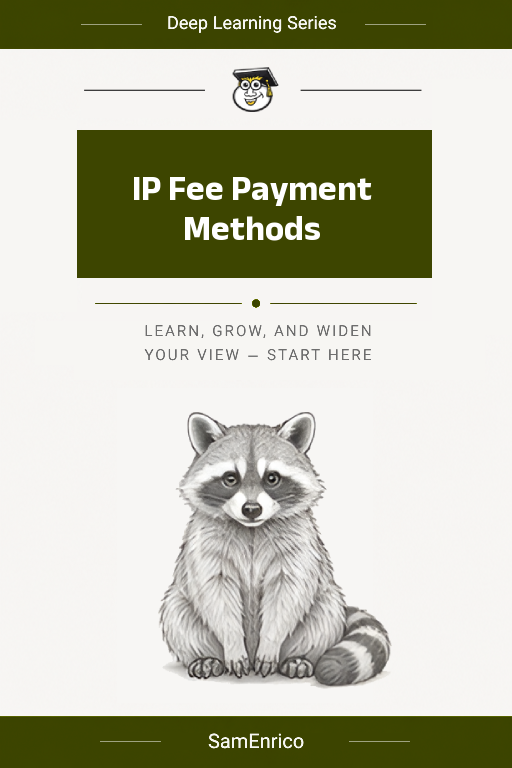
IP Fee Payment Methods
Pay USPTO fees using credit card, deposit account,
Pay USPTO fees using credit card, deposit account, or EFT including processing times and convenience fees.
Formats
About this book
Free sample
Chapter 1: The Midnight Deadline...–- It was 11:47 PM on a Friday, and Sarah Chen, a seasoned patent paralegal with fourteen years of experience, had just finished reviewing a final fee submission for a client’s continuation application. The fee was $1,640 – standard issue fee for a small entity. She had processed thousands of these. She clicked “Submit” in EFS-Web, received a green confirmation screen, and closed her laptop. She went to bed satisfied.
What Sarah did not know was that her firm’s credit card processor would take 72 hours to settle the transaction. What she also did not know was that the USPTO’s internal systems would record the payment as “pending” rather than “paid” for two full business days. What she would discover three months later was that the patent office had declared the application abandoned for “failure to pay the issue fee by the due date.” The green confirmation screen meant nothing. The money had left the client’s credit card. But the clock had not stopped.This is not a cautionary tale from 1999, when the USPTO still relied on paper forms and carbon copies.
This happened in February of 2024. Sarah’s firm spent 12,000inlegalfeespetitioningthe Directortorevivetheapplication.Thepetitionwasgranted–butonlyafterthefirmpaidanadditional12,000 in legal fees petitioning the Director to revive the application. The petition was granted – but only after the firm paid an additional 12,000inlegalfeespetitioningthe Directortorevivetheapplication.Thepetitionwasgranted–butonlyafterthefirmpaidanadditional2,000 surcharge under 37 CFR 1.16(f). The client, a medical device startup, lost six weeks of market exclusivity. The paralegal lost her job.
And the root cause? A misunderstanding of the single most fundamental concept in USPTO payment processing: the difference between submission time, authorization time, and clearing time.Welcome to the hidden world of government fee payments, where a credit card’s authorization code can be less valuable than a handwritten signature on yellow paper, where a deposit account with 50,000canstilltriggerasuspensionovera50,000 can still trigger a suspension over a 50,000canstilltriggerasuspensionovera10 fee, and where the difference between “submitted” and “accepted” is measured not in seconds but in abandoned patents. This book exists because the USPTO’s payment systems are not designed to be intuitive. They are designed to be secure, auditable…
This is the end of the free sample. Get the eBook to keep going. Buy now
Contents
- Chapter 1
- Chapter 2
- Chapter 3
- Chapter 4
- Chapter 5
- Chapter 6
- Chapter 7
- Chapter 8
- Chapter 9
- Chapter 10
- Chapter 11
- Chapter 12
Details
- Author
- Faber Elenore
- Publisher
- SamEnrico
- Language
- English
- Genre
- Non-Fiction, Annual Checkup, Payment Methods, USPTO
- Released
- 2026-06-01
- Pages (approx.)
- 140
- Available as
- eBook, Audiobook

Read better in the ZLOADR app
Your eBooks on your phone or tablet. Sign in with your SamEnrico account and start reading.
More by Faber Elenore
 The Remote Work Transition PeriodsFaber Elenore$11.99
 Meeting Notes SystemFaber Elenore$11.99
 The Groin Strain PreventionFaber Elenore$11.99
 Vegan Food Allergy Cooking CourseFaber Elenore$11.99
 Franchising Your Local Brand Across Borders Tax GuideFaber Elenore$11.99
 The Quantum Crown Heist: How a Parallel Universe King Stole the British MonarchyFaber Elenore$11.99
 CRISPR: The Genetic ScalpelFaber Elenore$11.99
 Understanding Cutaneous AnthraxFaber Elenore$17.99
 Sales Scripts for StartupsFaber Elenore$12.99
 After School Program LeaderFaber Elenore$11.99
 How to Become a Tree PlanterFaber Elenore$11.99