
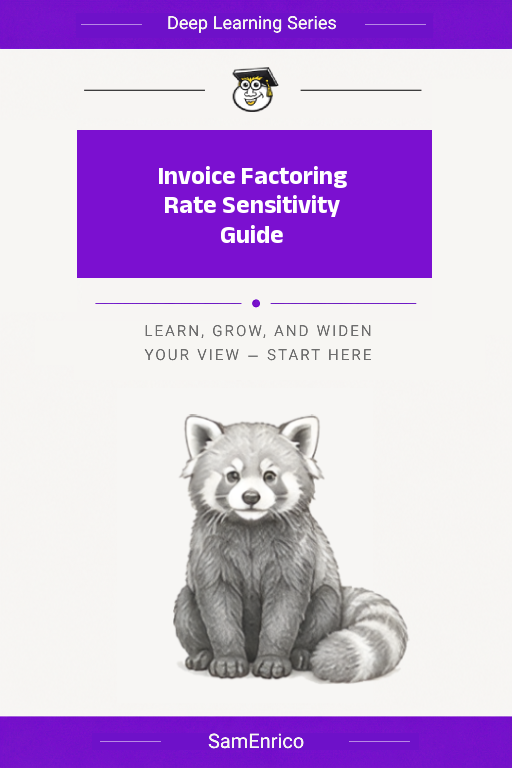
Invoice Factoring Rate Sensitivity Guide
Track how factoring discount rates move with prime
by Joyner Silas
Track how factoring discount rates move with prime, calculating effective interest costs as rates rise and determining when bank loans become cheaper.
Formats
About this book
Free sample
Chapter 1: The $47,000 Mistake--–- It was a Tuesday morning when Marcus, owner of a 14-truck freight company in Ohio, finally looked at his factoring statement. Really looked at it. For two years, he had been paying a “simple 2% fee” on every invoice. His factor advanced him 80,000ona80,000 on a 80,000ona100,000 invoice, charged 2,000,andheld2,000, and held 2,000,andheld18,000 in reserve until the customer paid. Marcus had signed the agreement during a cash flow crisis, grateful for the overnight funding that kept his trucks on the road.
He never asked what the 2% really meant. When a banker finally showed him the math—that his 2% fee was actually a 30% annual percentage rate—Marcus felt physically ill. Over two years, he had overpaid by an estimated $47,000 compared to a bank line of credit he could have qualified for after just six months of clean factoring history. He wasn’t alone. According to industry data, approximately 60% of businesses using factoring never calculate their effective APR.
They see a small percentage and assume it’s reasonable. This chapter exists to ensure you are not one of them.The Most Dangerous Sentence in Business Finance The sentence that costs business owners more money than any other is deceptively simple: “It’s only 2%.” This statement appears harmless. It sounds like a small price to pay for immediate cash. But that 2% is almost never 2% of what you think. It is not an interest rate.
It is a discount fee applied to the face value of an invoice, not to the money you actually receive. And unlike a bank loan, where interest accrues daily on a declining balance, a factoring fee is a fixed charge regardless of whether your customer pays in 15 days or 45 days—unless you have a tiered structure, which introduces its own complexities.To understand why “only 2%” is so dangerous, you must first understand the fundamental difference between two types of financing costs: interest and discount fees. This distinction is not academic. It is the difference between paying 10,000or10,000 or 10,000or47,000 for the same $100,000 of financing over two years. The entire remainder of this book builds…
This is the end of the free sample. Get the eBook to keep going. Buy now
Contents
- Chapter 1
- Chapter 2
- Chapter 3
- Chapter 4
- Chapter 5
- Chapter 6
- Chapter 7
- Chapter 8
- Chapter 9
- Chapter 10
- Chapter 11
- Chapter 12
Details
- Author
- Joyner Silas
- Publisher
- SamEnrico
- Language
- English
- Genre
- Non-Fiction, Annual Checkup
- Released
- 2026-06-01
- Pages (approx.)
- 133
- Available as
- eBook, Audiobook

Read better in the ZLOADR app
Your eBooks on your phone or tablet. Sign in with your SamEnrico account and start reading.
More by Joyner Silas
 Chronic Illness Childhood WorthJoyner Silas$11.99
 Anger De escalation for TeachersJoyner Silas$11.99
 Powder Cocaine AddictionJoyner Silas$11.99
 Blood Clot DisordersJoyner Silas$11.99
 The Question Ladder CourseJoyner Silas$11.99
 Exercise GH BoostJoyner Silas$11.99
 Chronic Pain and GamblingJoyner Silas$11.99
 Assertiveness Self EsteemJoyner Silas$11.99
 The Spice Kings: Portugal’s Golden FleetsJoyner Silas$11.99
 The Oscar Heist: The Night the Academy Lost Its Crown JewelJoyner Silas$11.99
 How to Start a Pile-extractors Business (Beginners Guide)Joyner Silas$11.99
 How to Produce Grains, Rice and CerealJoyner Silas$11.99
You may also like
 Hong Kong Handover 1997Dunn Johnnie$11.99
 Zumba For Postnatal Recovery CourseNeal Christian$11.99
 Zumba for BeginnersLadner Nikia$11.99
 YouTube Comment Mining GuideHumes Pandora$12.99
 Worry Box MeditationCarlin Rudy$11.99
 Workplace Stress MeditationNguyen Lynn$11.99
 Workplace Stress and Sleep RepairHawley Ivory$11.99
 Workplace Perfectionism CureDelaney Jeffry$11.99
 Workplace Injustice Anger GuideWallen Isabelle$11.99
 Work Addiction and Burnout LinkGreenwood Ester$11.99
 Women in Yoga and WellnessBeattie Galina$11.99
 Women in Stand Up ComedyChun Evangeline$11.99