
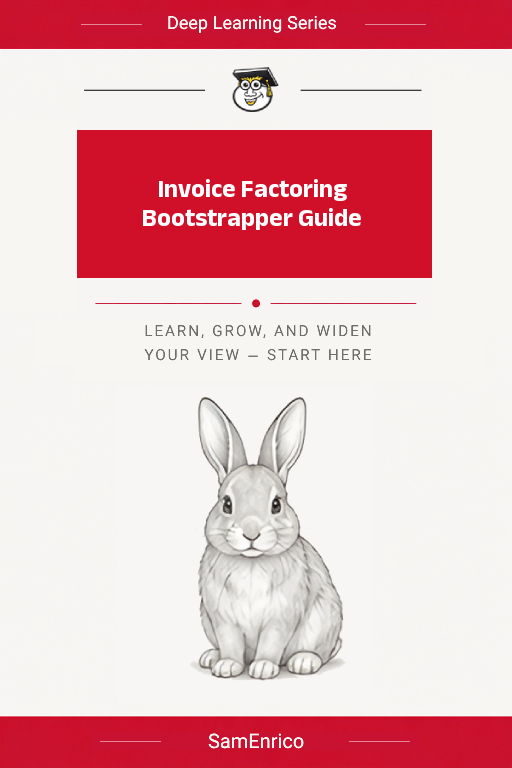
Non-FictionBusiness BriefInvoice Finance
Invoice Factoring Bootstrapper Guide eBook
Turn unpaid invoices into immediate cash using fac
Turn unpaid invoices into immediate cash using factoring services without taking on debt.
Formats
Free sample
Chapter 1: The Cash Gap--The day I signed the $200,000 contract should have been the best day of my business life. Instead, it was the beginning of my darkest week as an entrepreneur.My name is not important. Call me Alex. I had built a small IT services company from my kitchen table over three years. We were good—really good.
We had five employees, a growing reputation, and a pile of glowing testimonials. But we had one problem that kept me awake at night, staring at the ceiling while my wife slept peacefully beside me, unaware that her husband was slowly going broke while appearing successful to everyone who knew him.The contract arrived on a Tuesday. A regional hospital system needed a complete network overhaul. The price: 200,000.Foracompanythathadneverlandedajoblargerthan200,000. For a company that had never landed a job larger than 200,000.Foracompanythathadneverlandedajoblargerthan40,000, this was the big leagues.
I remember high-fiving my lead technician. I remember calling my father. I remember thinking, "This is it. This is the moment everything changes."Then I looked at the payment terms. Net-60.
Sixty days from invoice date. And the invoice could only be submitted upon completion of the work.Then I looked at what it would cost to deliver the project. 80,000inhardware,upfront,before Icouldinstallasinglecable.80,000 in hardware, upfront, before I could install a single cable. 80,000inhardware,upfront,before Icouldinstallasinglecable.40,000 in subcontractor payments, due weekly, because I didn't have enough staff to handle the workload alone. Another $15,000 in miscellaneous expenses—travel, temporary insurance, software licenses.Total upfront cash needed before I would see a single dollar from the client: $135,000.I opened my business checking account.
The balance was $10,412.83.I was profitable. I had never missed payroll. My customers loved me. And I was completely, terrifyingly broke.The Paradox That Kills Good Businesses What happened to me has a name. Academics call it the "cash conversion cycle." I call it the cash gap—the time between when you pay for something and when you get paid for it.
For most small businesses, that gap is a silent killer.Let me explain something that business school professors rarely emphasize: profit and cash are not the same thing. You can be profitable on paper and dead in the water on Monday morning when payroll is due. In fact, many of the most spectacular business failures happen to companies that were technically profitable right up until the moment they collapsed.I learned this the hard way. My profit and loss statement showed a healthy business. My accounts receivable aging report showed a business that was owed more than $150,000 from various clients.
My problem wasn't that I wasn't making money. My problem was that my money was trapped inside other people's accounts payable departments, sitting on their balance sheets, doing nothing for me while I scrambled to survive.Here is the math that nearly destroyed me: Every dollar I was owed took an average of 52 days to reach my bank account. During those 52 days, I still had to pay rent, salaries, utilities, and suppliers. I was essentially acting as an unpaid bank for my customers. They got to use my money for free while I paid interest on credit cards and begged vendors for extensions.The cash gap is not an abstract concept.
It is the difference between sleeping through the night and waking up at 3 AM to check your bank balance. It is the difference between saying "yes" to a new opportunity and saying "sorry, we're too small for that job." It is the difference between building a company that serves your life and building a prison that consumes it.The Three Ways Entrepreneurs Try to Escape (And Why Most Fail)When I realized I needed $135,000 to deliver that hospital contract, I did what every entrepreneur does. I started looking for money. And I quickly discovered that the world of small business finance offers three main doors. I knocked on all of them.
Here is what I found.Door Number One: The Bank I put on my best suit. I printed three years of tax returns, profit and loss statements, and a detailed business plan. I walked into my local bank—the same bank where I had kept my business account for four years—and sat down with a commercial lending officer named Gary.Gary was polite. He asked questions. He nodded at the right moments.
And then he delivered the news that I would hear from seven different banks over the next two weeks: "You don't have enough history. Your business is only three years old. You don't have enough collateral. And your personal credit score, while decent, doesn't meet our threshold for an unsecured line of credit."Here is what Gary did not say but what I later learned: Banks do not lend money to people who need it. They lend money to people who can prove they do not need it.
They want two years of audited financials, hard collateral (my house, my equipment, my retirement accounts), and a personal guarantee that would follow me even through bankruptcy. They wanted me to prove that I was creditworthy by showing that I had already done exactly what I was trying to do.The bank's model is built for established businesses with predictable cash flows, audited statements, and assets to pledge. It is not built for bootstrappers. It is not built for growth. It is built for preservation of the bank's capital, not acceleration of your company.I left Gary's office with a headache and the realization that the traditional path was closed to me.Door Number Two: The Investor Next, I tried the equity route.
I found a local angel investor group—wealthy individuals who pooled money to invest in promising startups. I prepared a pitch deck. I practiced my presentation. I drove to a sterile conference room and stood in front of twelve people who had collectively made more money than I would see in my lifetime.They liked my story. They liked my team.
They liked the hospital contract.Then they made me an offer: $150,000 in exchange for 25 percent of my company. Plus a board seat. Plus quarterly financial reporting. Plus a liquidation preference that meant they would get paid before I did if we ever sold the business. Plus a "ratchet" provision that would give them even more equity if I raised money at a lower valuation later.I did the math.
That $150,000 would cost me a quarter of my company—a quarter of every future dollar, every decision, every exit. And the investors would have a say in major decisions. I would no longer be the sole captain of my ship.I walked out of that conference room with a different kind of headache. Equity capital is not free. It is the most expensive capital you will ever raise, because you are selling a piece of your future.
For some companies, that trade makes sense. For a bootstrapper who wants to build something lasting and independent, it often does not.Door Number Three: The High-Interest Lenders Desperate, I started looking at alternative lenders. These are the companies that advertise "fast approval," "no credit check," "business cash advances." They appear in your social media feeds and your…
This is the end of the free sample. Get the eBook to keep going. Buy now
About this book
Details
- Author
- Oglesby Karole
- Publisher
- SamEnrico
- Language
- English
- Genre
- Non-Fiction, Business Brief, Invoice Finance
- Released
- 2026-05-29
- Pages (approx.)
- 141
- Available as
- eBook, Audiobook

Read better in the ZLOADR app
Your eBooks on your phone or tablet. Sign in with your SamEnrico account and start reading.
More by Oglesby Karole
 Creative Thinking for LawyersOglesby Karole$11.99
 Permanent Establishment RiskOglesby Karole$11.99
 Estimator vs System VariablesOglesby Karole$11.99
 Landscaping Company Transaction AnalysisOglesby Karole$11.99
 Nancy Lopez Magic SeasonOglesby Karole$11.99
 Relationship OCD GuideOglesby Karole$11.99
 The Cocaine Trafficked LaborerOglesby Karole$11.99
 Sobriety and EmploymentOglesby Karole$11.99
 Sumo in the Andes: The Unlikely Rise of Latin America’s Wrestling WarriorsOglesby Karole$11.99
 The Healers of Nubia: Medicine in the Kingdom of KushOglesby Karole$11.99
 Service Providers Guide to Lawn Mower & Power Tool RepairOglesby Karole$11.99
 A Collector's Handbook to the Franklin Series 14Oglesby Karole$11.99
You may also like
 Hong Kong Handover 1997Dunn Johnnie$11.99
 Zumba For Postnatal Recovery CourseNeal Christian$11.99
 Zumba for BeginnersLadner Nikia$11.99
 YouTube Comment Mining GuideHumes Pandora$12.99
 Worry Box MeditationCarlin Rudy$11.99
 Workplace Stress MeditationNguyen Lynn$11.99
 Workplace Stress and Sleep RepairHawley Ivory$11.99
 Workplace Perfectionism CureDelaney Jeffry$11.99
 Workplace Injustice Anger GuideWallen Isabelle$11.99
 Work Addiction and Burnout LinkGreenwood Ester$11.99
 Women in Yoga and WellnessBeattie Galina$11.99
 Women in Stand Up ComedyChun Evangeline$11.99