
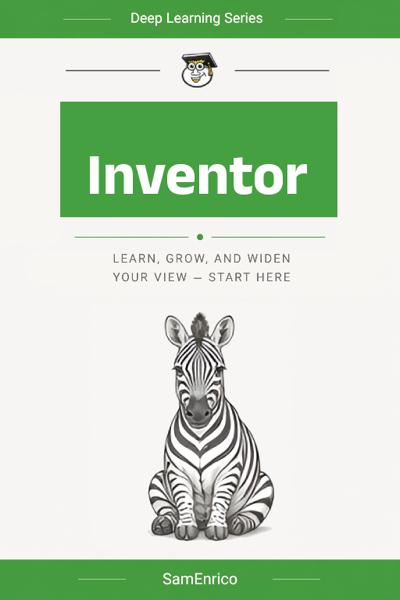
Inventor eBook
A Coursebook on Inventor
A Coursebook on Inventor
Formats
Free sample
Chapter 1: The Logbook Rebellion--– You are about to do something most people never attempt. You are going to take an idea that exists only in your imagination and drag it, kicking and screaming, into the physical world. Along the way, you will be told that you lack the credentials, the capital, or the luck to succeed. You will be told that everything worth inventing has already been invented. You will be told that the age of the lone inventor is dead.
Every single one of those statements is a lie.Welcome to the Logbook Rebellion. Not because you are fighting against any particular person or institution, but because you are refusing to accept the most dangerous assumption in all of creation: that someone else will solve the problem you see. The history of invention is not a story of geniuses struck by lightning bolts of inspiration. It is a story of ordinary people who trained themselves to see what others overlooked, who kept records when others trusted memory, and who built when others only complained.This chapter is the foundation of everything that follows. Before you open a single piece of software, before you file a single patent application, before you cut a single prototype, you must first understand what an inventor actually is and how to start thinking like one.
More importantly, you must begin your inventor's logbook—the single most powerful tool in your possession, and the one that will be cited in every subsequent chapter of this book.The Myth of the Overnight Eureka Television and movies have sold us a dangerous fantasy. The inventor stares at a wall, furrows their brow, and then—ping—a lightbulb appears above their head. They scribble something on a napkin, rush to a garage, and emerge three minutes later with a billion-dollar product.Real invention does not work that way. Real invention is a discipline. It is a set of repeatable thinking strategies that can be learned, practiced, and refined, just like playing the piano or welding steel.
The difference between someone who has one good idea and someone who invents throughout their entire life is not raw intelligence. It is methodology.Consider the difference between innovation and mere improvement. Improvement asks: "How can I make this existing product slightly better, slightly cheaper, or slightly faster?" Innovation asks: "What problem does this existing product fail to solve entirely, and what would a completely different approach look like?" The inventor is not in the business of making better horse-drawn carriages. The inventor is in the business of imagining the automobile while everyone else is still measuring harness straps.This chapter will introduce you to three core cognitive tools: divergent and convergent thinking, the practice of overcoming functional fixedness, and improvisational thinking borrowed from theater. Each tool is useless on its own.
Together, they form a cognitive toolkit that you will use for the rest of your career. And every single exercise, every single sketch, every single mistake and insight will be recorded in one place: your inventor's logbook.Divergent and Convergent Thinking: The Rhythm of Creation Most inventors fail because they converge too early. They have an idea, and before they have generated any alternatives, they immediately judge it. "That's stupid." "That would never work." "Someone else must have tried that." This premature criticism kills novel ideas before they have a chance to breathe.The solution is to separate inventive thinking into two distinct modes that must never be mixed in the same session.Divergent thinking is the act of generating many possible solutions without any judgment whatsoever. Quantity over quality.
Absurdity welcome. The goal is to push past the obvious first answers—which are usually just recycled solutions from other problems—and into the territory of genuinely novel possibilities. In divergent mode, you are a faucet, not a filter. Everything flows.Convergent thinking is the act of narrowing possibilities down to the best solution. This is where judgment, analysis, and criticism belong.
But convergence can only work well if divergence has already done its job. Converging on an empty set of ideas produces nothing. Converging on a rich, absurd, and diverse set of ideas produces gold.The four-step creative process that emerges from this rhythm is simple but not easy. First, you clarify the problem. What exactly are you trying to solve?
Write it down in plain language. Second, you ideate. You diverge. You generate at least twenty to thirty potential solutions before you allow yourself to evaluate any of them. Third, you develop.
You converge. You combine, refine, and select the most promising candidates. Fourth, you implement. You execute. You build, test, and iterate.Here is the exercise you will complete in your logbook right now.
Choose a problem you have noticed in the last week—something small, something annoying, something that made you say, "There has to be a better way." Write that problem at the top of a fresh logbook page. Then, set a timer for ten minutes. During those ten minutes, you are forbidden from saying "that won't work," "that's silly," or any variation thereof. Your only job is to list as many potential solutions as you can, no matter how absurd. A solution that involves magnets?
Write it down. A solution that involves trained squirrels? Write it down. A solution that defies the laws of physics? Write it down and note which law it violates—that itself is useful information.After the ten minutes, you may switch to convergent mode.
Review your list. Combine similar ideas. Eliminate the truly impossible. Identify two or three candidates worth exploring further. This process—divergence followed by convergence—will generate more novel ideas in thirty minutes than most people generate in thirty days.But there is a trap.
Your brain will try to sneak convergence into your divergence sessions. You will catch yourself thinking, "That idea is dumb" before you have even finished writing it. When this happens, you are not failing. You are noticing your brain's default mode. The solution is not to eliminate that voice—that is impossible—but to recognize it and deliberately set it aside.
With practice, the voice gets quieter.Overcoming Functional Fixedness: Breaking the Cage of Labels The single greatest barrier to invention is not lack of intelligence or resources. It is functional fixedness—the cognitive bias that causes you to see objects only for their intended purpose. A hammer is for driving nails. A paperclip is for holding papers together. A smartphone is for calling people.Functional fixedness is why the candle problem is so famous.
In 1945, psychologist Karl Duncker gave participants a candle, a box of thumbtacks, and a book of matches. Their task: attach the candle to a wall so that it burns without dripping wax onto the floor. Most participants failed. They saw the box as a container for thumbtacks, not as a potential candle platform. They saw the thumbtacks only as fasteners, not as tools for attaching the box to the wall.The solution was simple: empty the box, tack it to the wall, and place the candle inside.
But participants could not see it because they were fixed on the box's function as a container.Functional fixedness is not…
This is the end of the free sample. Get the eBook to keep going. Buy now
About this book
Details
- Author
- Prichard Anglea
- Publisher
- SamEnrico
- Language
- English
- Genre
- Non-Fiction, Informative, Educational
- Released
- 2026-05-04
- Pages (approx.)
- 150
- Available as
- eBook, Audiobook

Read better in the ZLOADR app
Your eBooks on your phone or tablet. Sign in with your SamEnrico account and start reading.
More by Prichard Anglea
 Public Speaker EQ SkillsPrichard Anglea$11.99
 Stress Cholesterol Lipid GuidePrichard Anglea$11.99
 Garage Startup Immigrant TalePrichard Anglea$11.99
 The Ray Kroc McDonald's EmpirePrichard Anglea$11.99
 Nefertiti's Lost Sun: The Forgotten Pharaoh's CursePrichard Anglea$11.99
 One Hour Strategy Meeting GuidePrichard Anglea$12.99
 Learn to Play the EktaraPrichard Anglea$11.99
 How to Start a Photo Electric Cell Business (Beginners Guide)Prichard Anglea$11.99